AWESOME: Ukraine Likely to Open Embassy Branch in Jerusalem

Ukrainian Ambassador to Israel says their official recognition of Jerusalem as Israel’s capital may only be months away!

By Nosson Shulman: Licensed Tour Guide of VIP Israel Tours Authentic Virtual Tours (click here to check out his free trailer videos)

Israeli President Herzog and Ukrainian President Zelensky meeting in October.
Photo Credit: GPO/Haim Zach

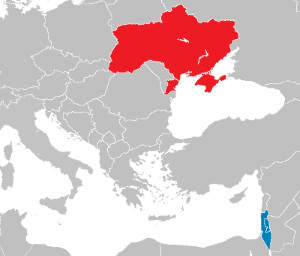
“My Country recognizes the one and only capital of Israel, and that is Jerusalem.” These were the exact words last week by Ukrainian Ambassador to Israel Yevhen Korniychuk at a special 2 day-event in Kiev, marking 30 years of diplomatic relations between the two states. Ambassador Korniychuk, (although it is not yet official) has spoken with President Zelensky about the decision to recognize the Holy City and to open a branch of the embassy in Jerusalem, further stating that it will likely happen in a “Matter of months, not years”.

Israel’s Jerusalem Affairs Minister Zeev Elkin (himself Ukrainian born) was also at the event and presented Korniychuk with a 2,700-year-old artifact bearing the word “Jerusalem” in Hebrew. Elkin praised the positive direction going forward of the relationship between the two nations. In October, Israel’s new President Isaac Herzog visited Ukraine in his first official state visit. During this visit, he met with Ukrainian President Volodymyr Zelensky (who is Jewish himself) and invited him to come to Israel.

Should the Ukraine finalize this move, they will be joining other European countries (Hungary, Czech Republic, and Slovakia) who have already opened an embassy branch in Jerusalem, thus giving de facto recognition of Israel’s claim to the Holy City. Brazil and Columbia have recently opened diplomatic missions in the ancient city, while four countries (US, Guatemala, Kosovo, and Honduras) have moved their entire embassy operations to Jerusalem. Malawi and Equatorial New Guinea have also pledged to open their embassies in the near future in Jerusalem, Israel’s Eternal Capital!

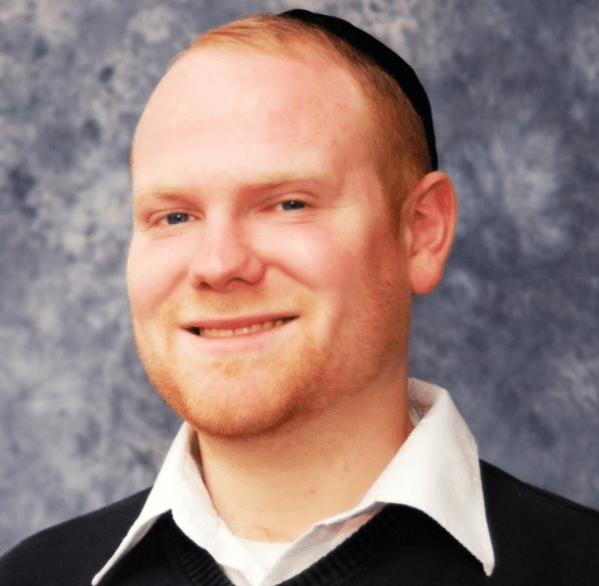
Nosson Shulman is a journalist and Licensed Tour Guide in Israel specializing in Biblical toursTo allow tourists to experience Israel during the Corona era, he created the new hit Israel tour video series which brings Israel to the home of viewers by simulating actual tours. To check out his free sneak preview tour videos, click here. To view sample tour itineraries or to inquire about private tour opportunities with a personalized itinerary on your next trip to Israel, click here.
This image has an empty alt attribute; its file name is image-24.png
Nosson Shulman

Biblical Beth-horon

By Nosson Shulman: Licensed Tour Guide of VIP Israel Tours Authentic Virtual Tours (click here to check out his free trailer videos)

And it was as they (the Canaanites) fled from before Israel, and were in the descent of Beth-horon, that the Lord cast down great stones from heaven upon them to Azekah, and they died. There were more who died with the hailstones than whom the children of Israel slew with the sword (Joshua 10:11)”

Seron, commander of the (Greek) army, heard that Judah had mustered an assembly of faithful men ready for war(They) reached the ascent of Beth-horon. Judah went out to meet him with a few men. But when they saw the army coming against them, they said to Judah “How can we, few as we are, fight such a strong host as this? Judah said… “Victory in war does not depend upon the size of the army, but on strength that comes from Heaven” … When he finished speaking, he rushed suddenly upon Seron and his army, who were crushed before him. He pursued Seron down the descent of Beth-horon into the plain. About eight hundred of their men fell, and the rest fled to the land of the Philistines (1 Maccabees 3:13-24).”

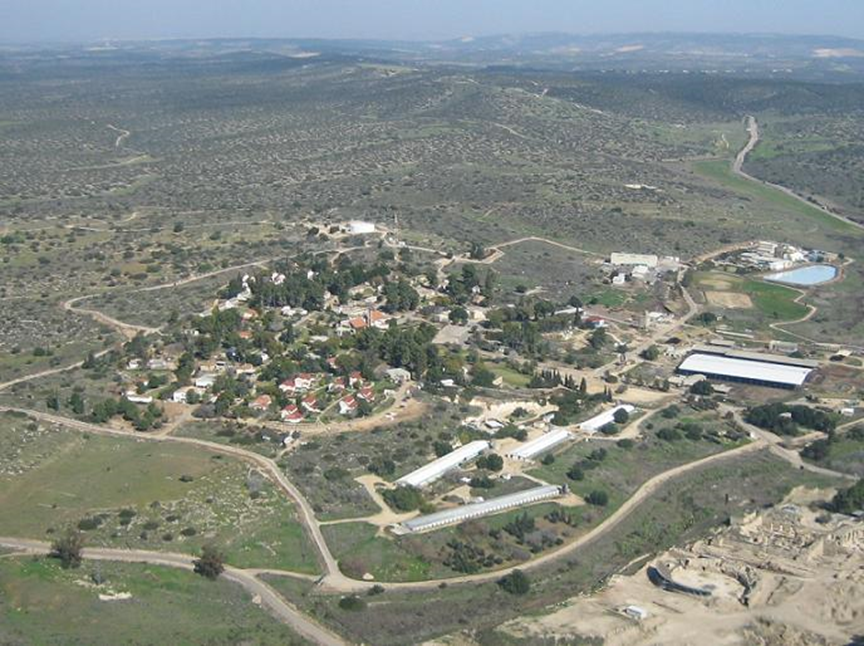
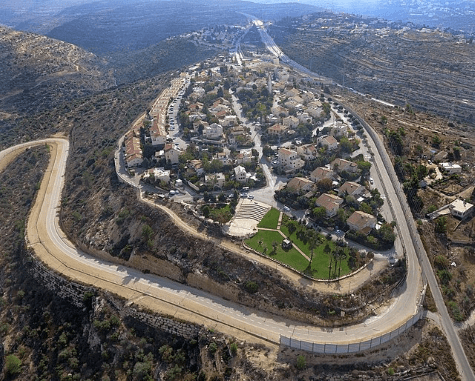
Today the Jewish town of Beit Horon (biblical Beth-horon) in Judah and Samaria is a flourishing bedroom community, with a population of close to 1500 people.
Photo Credit: מיכאלי under CC BY-SA 2.5

Today we are visiting an unassuming, Biblical treasure that few tourists (and not even every tour guide) know about! It is not a tourist site per say (although I do bring groups here and my tourists love it) but the views are spectacular and some of the most dramatic (and consequential) events in Jewish history happened here. Once we enter the town, we will immediately drive to the quiet, breathtaking “Beth-horon ascent” lookout point.

Looking out onto the Beth-horon Ascent, referenced several times in the Bible.
Photo credit: Leiah Jaffe

In biblical times, there were twin towns (Upper and Lower Beth-Horon) located on the main Jerusalem-Coastal Road (roughly today’s Highway 443).

As in ancient times, today’s Jewish town of Beit Horon is strategically situated along Highway 443 (connecting Jerusalem to major coastal cities like Tel Aviv). For most of history this was the main route and continues to be an important throughway (although today, Highway 1 has overtaken it as the main Jerusalem-Tel Aviv route).
Photo Credit: מיכאל יעקובסון

The towns derived their name from an Egyptian-Canaanite deity.  Indeed, pottery from the late Canaanite period (when the Egyptians were the overlords of the land) has been excavated here, suggesting that it may have been a place of idol worship. The villages marked the border between the territory of the Tribes of Benjamin and Ephraim (See Joshua 16: 3-5). Although located on the Ephraim side of the border, Beth-horon (and the surrounding land) was one of the 48 cities given to the Levites (see Joshua 21:22).

The Arab town of Beit Ur Al-Fauqa (as seen from modern Beit Horon) is believed to be the exact location of Upper Beth-Horon, mentioned several times in the bible.
Photo Credit: טייכר אבישי ר”ד:צילום CC BY 2.5

The original builder of both the upper and lower biblical towns of Beth-horon was Sheerah, Ephraim’s daughter (see 1 Chronicles 7:24). King Solomon turned them into greatly fortified cities. (see 2 Chronicles: 8:5).

The Arab town of Beit Ur Al-Tahta is believed to be the location of Lower Beth-Horon

Why was it so crucial to fortify? This was because they were not only situated on arguably the most important route in the country, but they were also sitting strategically on the most vulnerable (and extremely steep) part of the road, known in the Bible as the “Ascent of Beth-horon.” According to Jewish sources, this piece of the road that connected the Upper and Lower towns (which were about two miles apart) was so narrow that if two camels tried to pass together, side by side at the same time, they would both fall into the deep canyons which flanked its right and left below.

The Beth-horon ascent has been widened in the modern era for the highway, but for most of its history, it was so narrow that two camels could not go side by side at the same time.
Photo credit: BiblePlaces.com

It was along this route where one of the most dramatic biblical events took place. After Joshua and his army defeated the city states of Jericho and Ai, the powerful city of Gibeon made an alliance with the Israelites (see previous article on Hazor where I discuss the structure of Canaanite city states, Tel Hatzor).  Five Canaanite kings attacked Gibeon, sending a message that making peace with the Children of Israel was not in their interest.  When they attacked, Joshua felt bound by his oath and came to their rescue.  As the armies of the five kings saw him coming, G-d put panic into their hearts and they were smitten, with the survivors fleeing by way of the “Ascent of Beth-horon”. As they started to descend from Beth-Horon, G-d sent a hailstorm that finished off most of the remaining troops (Joshua 10). According to Jewish sources, these very hailstones were left over from the plague of hail in Egypt.  When Moses asked G-d to stop the plague (see Exodus 9:33) the remaining hail was saved.

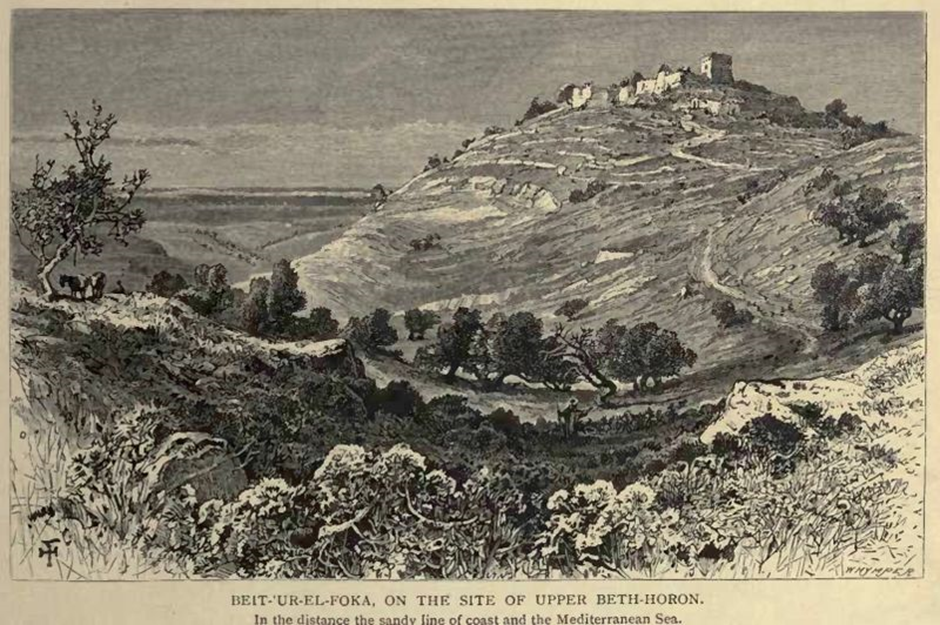
Drawing from 1880 illustrating Upper Beth-horon on the top of the hill, with the route clearly seen in the foreground. After passing this hill, the hailstorm hit the majority of the remnant of the Canaanite troops fleeing from Joshua.

During the Second Temple Period, two of the most dramatic (and consequential) events in Jewish history took place here. The first happened when the Syrian-Greek rulers wanted to force the Jews to assimilate and practice paganism. They made the observance of Jewish laws a capital crime and took over the Holy Temple, desecrating it by making it a place of worship to the idol Zeus. Wanting to remain faithful to the Torah, a small band of pious Jewish brothers called the Maccabees rebelled. They did not expect to win the war against the superior armed forces, but with G-d’s help they won the first battle (circa 167 BCE). For the second battle, Seron came from the coast and headed for Jerusalem on this road with a major, well-armed force. When he got to the pass, Judah the Maccabee’s troops were about to attack until they saw the superior Greek forces and didn’t know how they (few in number) had any chance. Judah with his great faith reminded them that G-d (and not the superior strength of an army) was the One who decides who is victorious. After his speech, his men rushed suddenly against Seron’s army, falling 800 of his soldiers, with the remnant of the Greek forces fleeing to the coast. This battle caused the local Greeks and surrounding nations to fear Judah and brothers (See 1 Maccabees 3). After two more battles ended in victory, he liberated and rededicated the Temple to the service of G-d (an event which is still celebrated by Jews for 8 annually through the Festival of Chanukah) and ultimately declared an Independent Jewish state.     

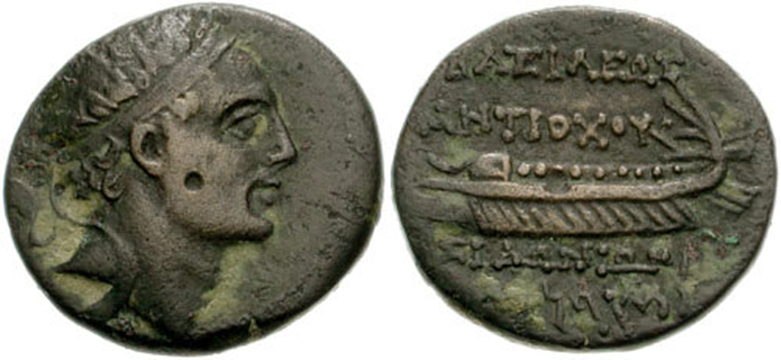
A coin depicting Antiochus IV, who was the King of the Syrian Greek (aka Seleucid) Empire who fought against the Maccabees. The backside depicts a Seleucid naval victory (unconnected to the stories of the Maccabees).
Photo CreditClassical Numismatic Group, Inc under CC BY-SA

The second happen a couple of centuries later. Starting in 63 BCE, the Romans seized control over the land of Israel from the Maccabees. For the next (more than a) century, the Romans ruled with an iron fist, often oppressing their Jewish subjects. When the Jews could no longer bear the cruelty shown by the Romans, they rebelled by attacking Roman soldiers in Jerusalem, causing them to flee the city (circa 66 CE). Gaius Cestius Gallus, the Roman Governor of Syria (which include Judea), brought the powerful 12th legion to retake Jerusalem, but they failed and had to retreat. On their way back to the coast, as they were approaching the narrow ascent, they were attacked by a barrage of rock-missile fire and arrows. Once the soldiers were on the pass (where it’s narrow confines forced them to march one by one), they were ambushed by a heavy force. With no where to turn, they were easily slaughtered (almost 6000 of them) with only a few (including Gallus) able to escape and fled to Antioch (in modern day Turkey which was then controlled by Rome). In his escape, he had to leave most of his weapons and equipment, which fell into the hands of the Jewish rebels. They also stripped the dead soldiers of their armor and helmets. With this stunning victory, many Jews (who at first were hesitant to fight the mighty Roman empire), now volunteered for combat and once again, Judea (i.e Israel) became an Independent Jewish State. It wouldn’t last long as the next year, the Romans sent an invading force to re-conquer the land and after 4 years, Jerusalem was taken and the Second Temple was destroyed.

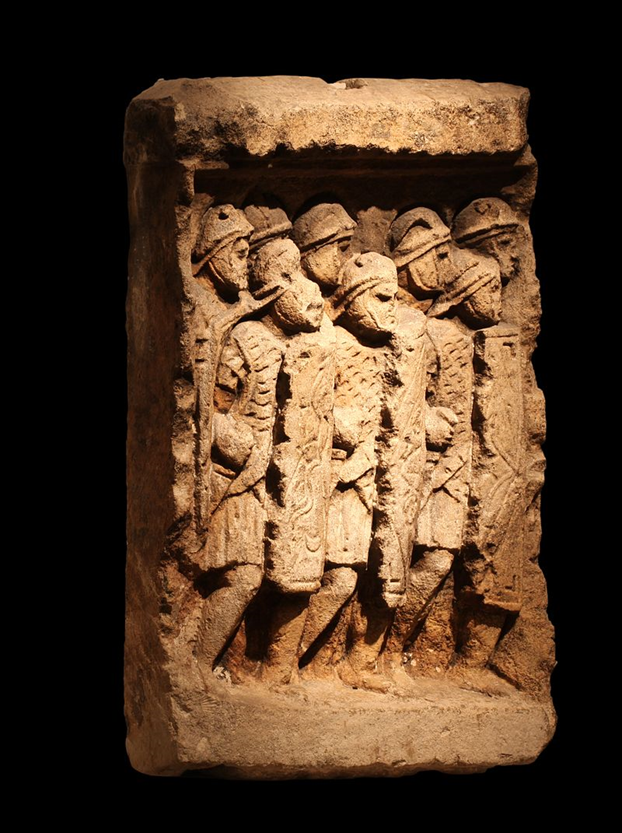
Ancient Relief of a Roman legion in tight formation. Such a tactic was impossible to implement on the narrow Beit Horon Ascent and as a result, most of the 12th legion was wiped out when attacked.
Photo Credit: Rama under CC BY-SA 2.0 fr

After the revolt, the Romans built fortifications to protect the ascent and by the late Byzantine period (and all the way until modern times), Upper and Lower Beth Horon (today the Arab villages of Beit Ur Al-Tahta and Beit Ur Al-Fauqa) became insignificant, small villages.

In 1948, Jordan took possession of this land and built an army base (whose remnants can still be seen today from the Beit Horon lookout). In 1967, Israel liberated Judah and Samaria and in 1977 they started the modern-day Jewish town of Beit Horon which is growing and flourishing.

On your next tour of Israel, I highly recommend visiting this site, which can be done as a quick stop (and can be conveniently combined with other sites in the area). If you’re looking for a beautiful, off the beaten track site where intriguing biblical stories and formative Jewish history took place, this is the site!

For a sample tour itinerary which can include visiting Beit Horon, click here

Nosson Shulman is a journalist and Licensed Tour Guide in Israel specializing in Biblical toursTo allow tourists to experience Israel during the Corona era, he created the new hit Israel tour video series which brings Israel to the home of viewers by simulating actual tours. To check out his free sneak preview tour videos, click here. To view sample tour itineraries or to inquire about private tour opportunities with a personalized itinerary on your next trip to Israel, click here. 

Nosson Shulman

FINALLY: After Years of Inaction, the UK Declares Hamas a Terrorist organization

In another major development, Australia blacklists Hezbollah in its entirety!

By Nosson Shulman: Licensed Tour Guide of VIP Israel Tours Authentic Virtual Tours (click here to check out his free trailer videos)

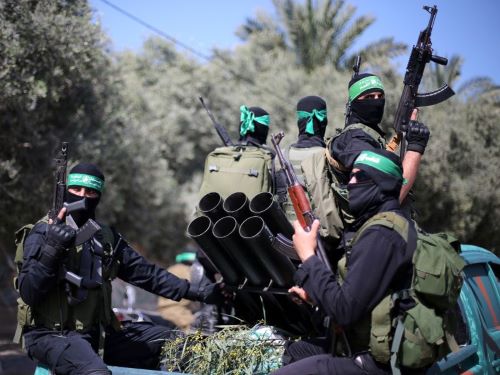
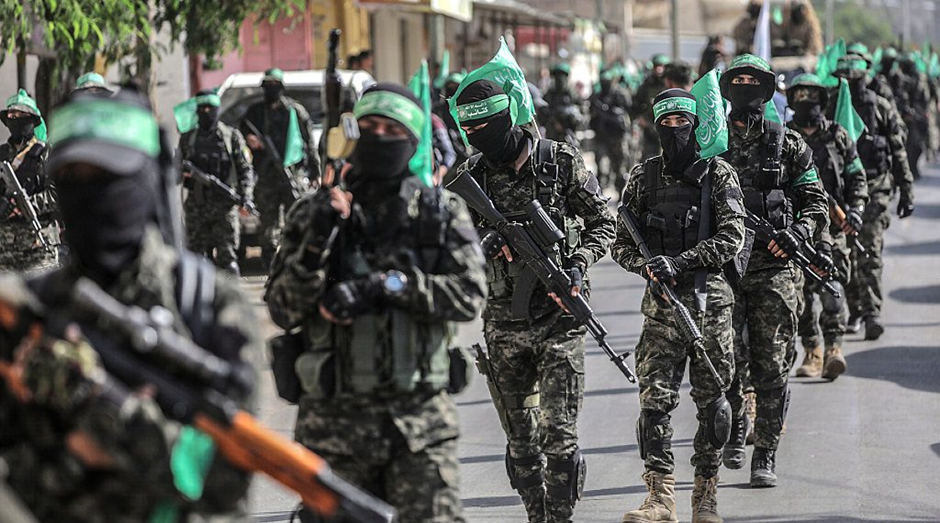
Armed Hamas Terrorists march in Gaza City in 2019

In a surprising move, the UK has just blacklisted the entirety of Hamas as a terror organization. The astonishing part isn’t that Britain, an Israeli “ally”, is making this sensible move, but rather that they had not already. Although the British government had long ago declared the military wing of the group a terrorist entity, its political wing was not.

Britain was not the only country that differentiated between Hamas’ political and military wings. Countries such as Japan, New Zealand, Australia, and Paraguay have only outlawed Hamas’ armed forces, claiming that the political wing carries out important civil society functions like charity, humanitarian projects and building of infrastructure in Gaza, and therefore should not be sanctioned on that end. Those opposed to this idea are quick to point out the fallacy from both a moral and practical point of view. Morally both wings have the same goal, the utter destruction of the Jewish State and its inhabitants and cannot be considered separate entities (as a comparison, no decent person would ever even consider funding the “political wing” of the mafia or racial supremacy groups like the KKK, Neo-Nazi movement and Louis Farrakhan’s Nation of Islam regardless of the social service programs they were offering).

From a practical perspective, once countries and private donors give money to the “political wing” of Hamas, the money can “find” it’s way to the military wing (indeed, this arrangement often allows Hamas to by-pass sanctions against it). Even where there is oversight on how the money is spent, Hamas uses the money to build schools encouraging a life of Jihad, establishing community centers where weapons of the “military wing” can be stored in the basement, funding “certain science and technology (i.e., weapon building)” university programs in Gaza and paying terrorists who are sitting in Israeli prisons.

It’s not just the money. Because the “political wing” members aren’t sanctioned, influential citizens and politicians can meet with them, giving them legitimacy. The policy has led to hundreds of very powerful institutions (like the UN and universities) and NGOs to hire terrorists (many of them who have spent time in Israeli prisons) who in turn hire more Hamas members. Once in a position of power, they use their positions to recruit would-be terrorists to the organization and also lobby countries to apply pressure on Israel to free convicted terrorists.

The UK’s sanctions represent a major blow to Hamas. Besides the UK being a major source of funding for the terrorist group, politicians like Jeremy Corbyn (the former head of Labor who famously called members of Hezbollah and Hamas his “Friends”) meet with them, granting them a certain air of legitimacy. Today that is illegal and if Jeremy Corbyn were to meet with his “friends” from the group, he could spend the next 14 years in prison.

It needs to be pointed out that the political wing isn’t immune to using direct violence to obtain their goals (even without the help of the military wing). Indeed, the most recent terrorist attack in Jerusalem (in which a 26-year-old civilian was shot and killed in cold blood, 2 officers injured, and a Rabbi (and father of 8) still dressed in his prayer shawl was shot and miraculously survived the attack) was committed by a senior member of the political wing.

In another important development, Australia has blacklisted Hezbollah’s political wing, which now makes association with any part of the terror group punishable by up to 25 years in prison. This represents a major blow to the organization, especially as Australia has a large Lebanese community. Other countries which have banned Hezbollah in its entirety include Canada, United States, Argentina, Bahrain, Columbia, Guatemala, Honduras, Israel, Japan, Paraguay, Serbia, Switzerland, United Kingdom, and the United Arab Emirates. International Arab organizations like the Arab League and Gulf Cooperation council have also labeled the entire group terrorists. Surprisingly, the European Union currently considers the political wing of Hezbollah to be legitimate, although individual member countries like Germany, The Netherlands, Czech Republic, Estonia, Lithuania, Austria, and Slovenia have blacklisted the terror organization in its entirety.

Nosson Shulman is a journalist and Licensed Tour Guide in Israel specializing in Biblical toursTo allow tourists to experience Israel during the Corona era, he created the new hit Israel tour video series which brings Israel to the home of viewers by simulating actual tours. To check out his free sneak preview tour videos, click here. To view sample tour itineraries or to inquire about private tour opportunities with a personalized itinerary on your next trip to Israel, click here.

This image has an empty alt attribute; its file name is image-24.png
Nosson Shulman

SHOCKING: Tel Aviv is Now the World’s Most Expensive City

The Metropolis has overtaken Paris to secure this distinction

By Nosson Shulman: Licensed Tour Guide of VIP Israel Tours Authentic Virtual Tours (click here to check out his free trailer videos)

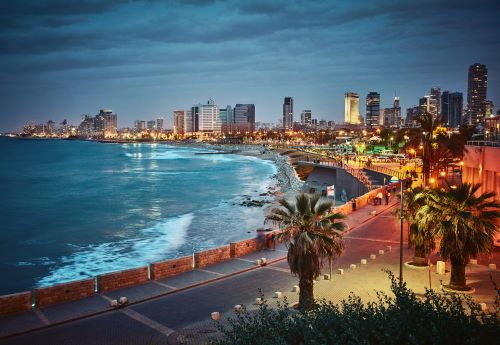
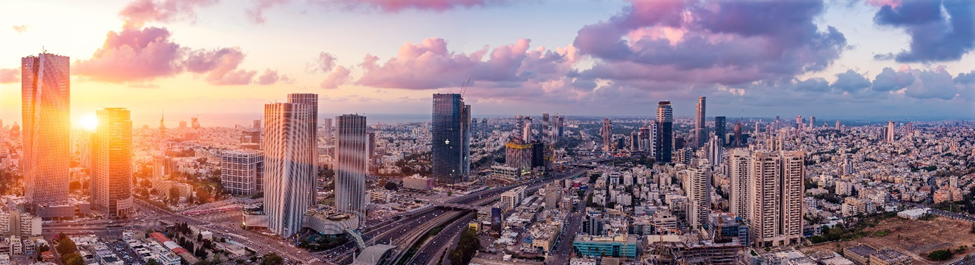
The Tel Aviv skyline at sundown. Living in this beautiful coastal city accompanies a hefty price tag! 
Photo Credit: Dmitry Pistrov /Shutterstock      

For the first time ever, according to the Economist Intelligence Unit (the research arm of the prestige Economist) an Israeli city is considered to be the most expensive to live in!

Tel Aviv has long been in the top 10 most expensive cities, largely due to its exorbitant real estate prices and transportation costs (in Israel the tax on new cars is more than 100%) although until now, it never reached in the top five. Last year it was the 6th most expensive city.

The predominant reason that Tel Aviv reached this distinction in such a short time is because of the strength of the shekel, currently the world’s strongest currency (some say it’s the second most). As the list is ranked in US dollars (now at a 25 year low against the shekel) it costs more US dollars to live in Tel Aviv than any other city in the world! Other factors include the rise in the price of groceries and gasoline (considerably higher than in the US).

According to the Economist, the ten most expensive cities are:

1) Tel Aviv

2) Paris

3) Singapore

4) Zurich

5) Hong Kong

6) New York

7) Geneva

8) Copenhagen

9) Los Angeles

10) Oslo

The least expensive city to live in is Damascus, the capital of Syria.

Nosson Shulman is a journalist and Licensed Tour Guide in Israel specializing in Biblical toursTo allow tourists to experience Israel during the Corona era, he created the new hit Israel tour video series which brings Israel to the home of viewers by simulating actual tours. To check out his free sneak preview tour videos, click here. To view sample tour itineraries or to inquire about private tour opportunities with a personalized itinerary on your next trip to Israel, click here.

This image has an empty alt attribute; its file name is image-24.png
Nosson Shulman

HUGE: 2100-year-old Hellenistic Fortress Connected to Chanukah Story Discovered!

This well-preserved structure was destroyed by the Maccabees. The announcement comes just in time for the approaching Jewish 8-day festival of Chanukah!

By Nosson Shulman: Licensed Tour Guide of VIP Israel Tours Authentic Virtual Tours (click here to check out his free trailer videos)

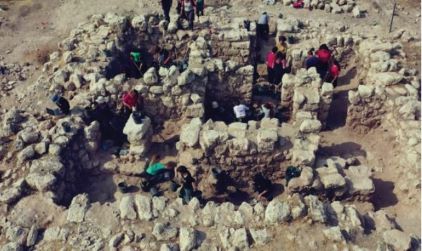
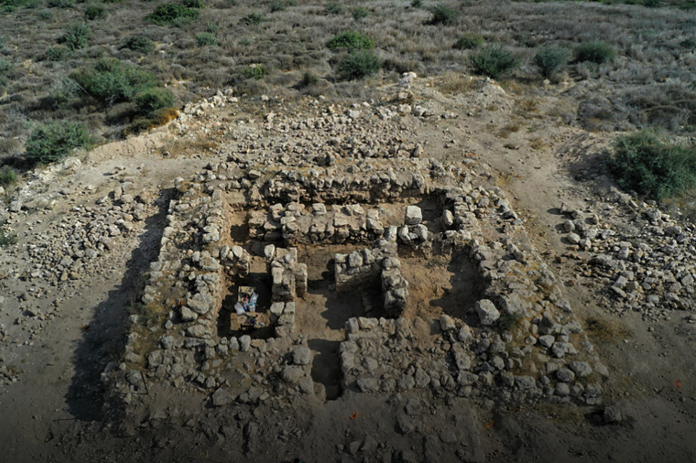
Aerial shot of the Hellenistic (Greek) fortress discovered in the Lachish Fores

In just a few days, Jews from all over the world will be celebrating the festival of Chanukah. The holiday commemorates the miraculous recapture and rededication of the Second Temple (circa 167 BCE) which had been desecrated by the occupying Hellenistic Greeks, and the subsequent lighting of the Menorah (with only enough oil to last one day) which remained alight for 8 days! This gave the Jews enough time to reproduce the pure olive oil required for the nightly service. The Jews were led by a small band of pious brothers (all priests) known as the Maccabees (aka the Hasmoneans) who, with G-d’s help, were able to overthrow the Greeks and ultimately expel them from the land. One of the forts the Hasmoneans had to destroy has been recently discovered (well-preserved) in the Lachish Forest (approx. 60 KMs south-west of Jerusalem).

This fortress was built by the Hellenists as part of a fortified line to protect the nearby Hellenistic metropolis of Maresha from a Hasmonaean offensive. Excavations have revealed a well-fortified building 15 x 15 meters (49×49 feet) with a massively thick exterior wall 3 meters (10 feet) wide which was sloped in order to prevent scaling. The interior of the structure has 7 rooms. Astonishingly, the ruins are preserved to an exceptional height of 2 meters (6.5 feet). It is believed that the original height was 5 meters.

The findings (including pottery, dozens of coins from the late 2nd century BCE, slingshots, iron weapons, burned wooden beams, and historical records) indicate that the fortress was destroyed by the Maccabean leader John Hyrcanus in 112 BCE. Shortly after, Maresha (the major city that this excavated fortress had originally been built to protect) itself was destroyed.

It is hoped that this wonderous site will soon become open to the public.

Nosson Shulman is a journalist and Licensed Tour Guide in Israel specializing in Biblical toursTo allow tourists to experience Israel during the Corona era, he created the new hit Israel tour video series which brings Israel to the home of viewers by simulating actual tours. To check out his free sneak preview tour videos, click here. To view sample tour itineraries or to inquire about private tour opportunities with a personalized itinerary on your next trip to Israel, click here.

Nosson Shulman

BREAKING NEWS: IDF Updates Open-Fire Rule to Allow Soldiers to Shoot Suspected Thieves and Smugglers

These updated rules are now in place to crackdown on weapons theft from Military bases and drug smuggling into Israel from bordering countries.

By Nosson Shulman: Licensed Tour Guide of VIP Israel Tours Authentic Virtual Tours (click here to check out his free trailer videos)

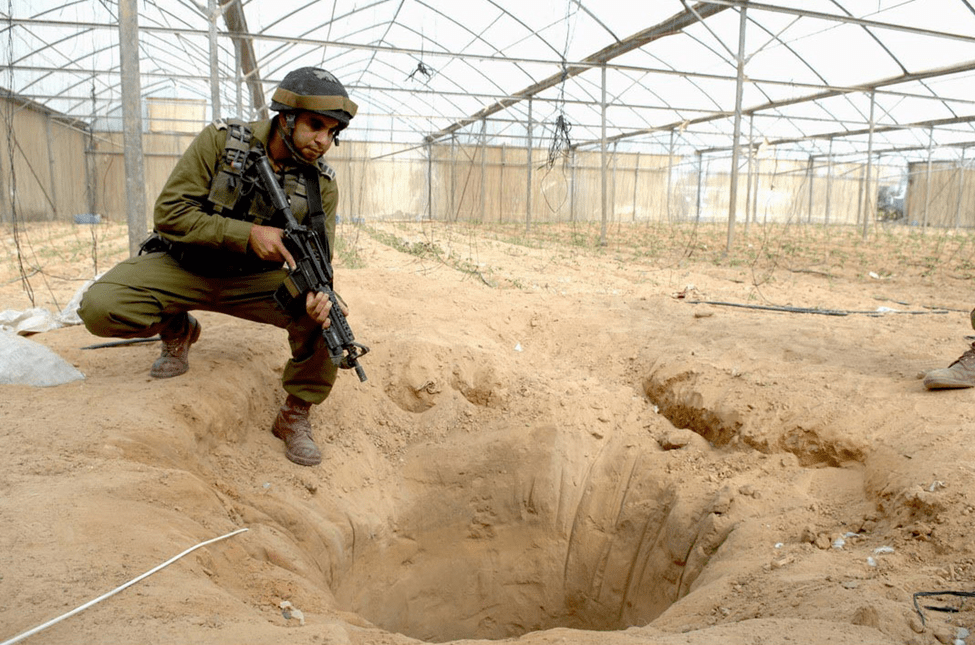
Smuggling tunnel uncovered near Egyptian border during a counter terrorism operation. Photo Credit: Israel Defense Force

In a major game changer for Israel’s public safety of its citizens (both Jewish and Arab alike), the IDF has finally rectified some of its absurd rules of engagement! Beginning immediately, soldiers are now allowed to open fire on suspected thieves of army bases and cross-border drug smugglers. Prior to this new ruling, soldiers were only allowed to shoot if their lives were in danger (a fact well known and exploited by criminals).

This comes after years of public and internal criticism of leniency. It was not uncommon for criminals (predominantly from the Bedouin and Arab sectors) to sneak onto bases and steal weapons, with soldiers being unable to do much to stop it. According to the IDF’s own data, thousands of deadly equipment and ammunition are stolen every year. Shockingly, the weapons stolen included pistols, grenades, machine guns, rockets, mines, and anti-tank weapons. It is estimated that 70% of all illegal weapons in the country are stolen from the police and military. In addition to the theft of weapons, criminals entered bases and stole the personal property of thousands of soldiers and reservists (some of whom have individually lost thousands of shekels). Soldiers are now also permitted to open fire on potential drug and weapon smugglers who illegally cross the borders from Jordan and Egypt. Only last week, millions of shekels worth of drugs were seized at the Egyptian border (although because of the rules of engagement at that time, no arrests were made). Also last week, deadly weapons (smuggled in from Jordan) were seized.

While all Israelis stand to benefit from these new rules, the biggest victors are by far the Arab sector. Although Israel as a whole has one of the OECD’s (“First world countries”) lowest homicides rates (in 2018, the murder rate was 1.4 per 100,000 people vs the OECD rate of 3.7 per 100,000), in the Arab community, violence and murder (often due to family feuds or organized crime) is rampant. Although Arabs make up 20% of the population, they are the largest percentage of victims (84%) of gun violence in the country (almost entirely committed by other Arabs). In the middle of October, the 100th Arab murder victim of 2021 was shot (in the Arab city of Umm al-Fahm). Many, if not the majority, of victims were killed with weapons stolen from bases. Preventing criminals from having access to drugs and weapons will make the streets of Arab communities (who have long complained about the lawlessness reigning in some of their towns) considerably safer!

Nosson Shulman is a journalist and Licensed Tour Guide in Israel specializing in Biblical toursTo allow tourists to experience Israel during the Corona era, he created the new hit Israel tour video series which brings Israel to the home of viewers by simulating actual tours. To check out his free sneak preview tour videos, click here. To view sample tour itineraries or to inquire about private tour opportunities with a personalized itinerary on your next trip to Israel, click here.

Nosson Shulman

HISTORIC RARITY: For the First Time in 21 Years, Construction of a New Jewish Neighborhood in Hebron has Begun!

31 Housing Units to be built in the new “Nahalat Chabad” Neighborhood

By Nosson Shulman: Licensed Tour Guide of VIP Israel Tours Authentic Virtual Tours (click here to check out his free trailer videos)

Future location of the new Jewish neighborhood of Nahalat Chabad

It has taken almost 21 years, but for the first time in decades a new Jewish neighborhood is being built. Construction has begun on 31 housing units, a public park, two kindergartens and a dormitory for the nearby Yeshiva (Academy of advanced Torah and Talmudic Studies). After completion, the new residents will join the 850 Jews who currently call Hebron home.

Artist’s rendition of the planned apartment complex of the soon-to-be established Nahalat Chabad Neighborhood.
Photo Credit: Hebron Fund

While 31 units may not seem like a lot, in actuality this a very important step in the development of the second holiest city in all of Judaism, whose growth throughout history has always come with a struggle. The Jewish connection to the land began roughly 4000 years ago when Abraham (the world’s first Jew) bought the Cave and Field of Machpelah (Cave of the Patriarchs) from Ephron as recorded in Genesis (for more on that special site, click here). Since then, the city has had a special place in the Jewish heart, mostly having had a Jewish community without interruption (the 19-year Jordanian occupation of the city between 1948-67, when Jews were forbidden from living there and had their property illegally seized, is a notable exception).

Cave of the Patriarchs. This is the burial place of Abraham, Sarah, Isaac, Rebecca, Jacob, Leah, and Adam and Eve.

When Israel liberated Hebron in 1967, although the Jews still owned deeds to much of the land, the Israeli government had a policy of allowing the Arabs to remain in the homes they had taken over. Jews were not allowed to resettle on their own property. In 1968, Rabbi Moshe Levinger rented the Park Hotel for Passover and declared that he and his guests were re-establishing the ancient community and not leaving (the owner of the hotel, who had fallen on hard times, was delighted as he was given large, cash-filled envelopes). The government was not happy with this and wanted them to leave. Eventually, a compromise was reached where the guests would leave the hotel and be given land adjacent to Hebron to build the new town of Kiryat Arba (which today is a flourishing town of 8000 and growing).

The flourishing Jewish town of Kiryat Arba is seen across the valley from Hebron

By the late 1970s Rabbi Levinger held a meeting with community members, and they agreed that it was important for Jews to live in the city of Hebron itself near the holy sites, not just in the “Suburb” of Kiryat Arba. In 1979, they resettled the Beit Hadassah Community, which they still had the deed to. Only women and children came (they volunteered to do it this way, knowing that the IDF would be less likely to evict them than their husbands. Indeed, the army commander told the new residents that if they were to leave the building even for a minute, they would not be allowed to re-enter). For one year they lived without running water and electricity, while their husbands brought them food through the window. In May 1980 the men came to wish their wives and kids a “Shabbat Shalom”, and in an act of terror were gunned down, with 6 losing their lives. Because of this horrific incident, then Prime Minister Menachem Began allowed the Jews to return here permanently and even to build new buildings in the complex. Today, approximately 35 Jewish families live in the complex which houses a park, basketball court, synagogue, and an excellent Museum/Visitor’s Center.

Part of the Beit Hadassah complex, which houses a thriving Jewish community.
Photo Credit: Roman Yanushevsky / Shutterstock

In the 1980s the Jewish community led efforts to restore the Avraham Aveinu neighborhood, which had been the main center of Jewish life in Hebron since the 1500s. The local Arabs had destroyed most of the buildings during riots in the 1930s. When Jordan took over, they intentionally converted the synagogue into a public latrine (the only one which existed in Hebron). Part of the Synagogue was also converted to a sheep pen. With great efforts, the debris and ruins were cleared away and new homes were built. The Synagogue, built in 1540, was restored and now holds services daily. Today, this is the largest Jewish neighborhood in all of Hebron.

Interior of the restored Avraham Aveinu Synagogue (originally built in 1540).
Photo Credit: Beit HaShalom

In 1984, a Jewish community was established on Tel Rumeida (this land has been owned by Jews since 1807 when it was purchased from Arabs). The government allowed Jews to live in caravans but not to build an actual building. Although conditions were tough the community flourished until 1998, when a terrorist entered the community and murdered a leading Rabbi. Because of this horrible incident, the government gave permission to build. During construction, the archeology of Biblical Hebron was discovered. So as not to destroy the ruins, the building (completed in 2005) was built on concrete pillars to keep the ruins underneath them visible to visitors. Today, between 15 and 20 families live there.

The ruins of Biblical Hebron. In the background, the pillars holding up the homes and a Torah study hall high above the ruins can be seen.

Additionally in the last 15 years, 4 individual (isolated) buildings (each hosting several apartments) were purchased from Arabs. Today, several brave Jewish families live in them.

The new neighborhood being built was bought by Jews affiliated with Chabad (Lubavitch Chasidim) in 1909, and they still have the original deed in Arabic to prove it. Since it was the Chabad community who originally bought the land, this new community will fittingly be called “Nahalat Chabad” which literally translated means “The Inheritance of Chabad”.

Additionally in the last 15 years, 4 individual (isolated) buildings (each hosting several apartments) were purchased from Arabs. Today, several brave Jewish families live in them.

The new neighborhood being built was bought by Jews affiliated with Chabad (Lubavitch Chasidim) in 1909, and they still have the original deed in Arabic to prove it. Since it was the Chabad community who originally bought the land, this new community will fittingly be called “Nahalat Chabad” which literally translated means “The Inheritance of Chabad”.

Deed in Arabic from 1909
Photo Credit: Lubavitch.com

Today, there are approximately 850 Jews living in Hebron, surrounded by 120,000-250,000 Arabs (the reason for this huge range in population is because the Palestinian Authority often inflates their numbers for political and financial reasons (the more people they report, the more foreign aid they receive). With this soon-to-be built neighborhood, the Jewish population is expected to exceed 1000.

Nosson Shulman is a journalist and Licensed Tour Guide in Israel specializing in Biblical toursTo allow tourists to experience Israel during the Corona era, he created the new hit Israel tour video series which brings Israel to the home of viewers by simulating actual tours. To check out his free sneak preview tour videos, click here. To view sample tour itineraries or to inquire about private tour opportunities with a personalized itinerary on your next trip to Israel, click here.

Nosson Shulman

­­­­

Biblical Mount Ebal

By Nosson Shulman: Licensed Tour Guide of VIP Israel Tours Authentic Virtual Tours (click here to check out his free trailer videos)

And it will be, when the Lord, your God, will bring you to the land to which you come, to possess it, that you shall place those blessing upon Mount Gerizim, and those cursing upon Mount Ebal (Deuteronomy 11:29)”

Then Joshua built an altar to the Lord God of Israel on Mount Ebal (Joshua 8:30)”

Altar built by Joshua located on Mount Ebal

Today we are visiting Mount Ebal, a special biblical site (whose structure is mentioned explicitly in the Bible). This site is breath taking, but seldom visited due to certain security concerns and its unique geo-political location. In order to visit, one must have an IDF escort. While the nearby Tomb of Joseph (for more on that site, click here) also requires an IDF escort, a monthly escort is arranged in advance. Mount Ebal has no set schedule, rather one has to arrange for it privately. Getting IDF permission can take several months. However, the privileged few who get to visit are certainly happy that they made the effort!

Mount Ebal (in Red circle). To its left is biblical Mount Gerizim (mountain of blessings). The large city in the valley is Nablus (biblical Shechem). For those who are unable to arrange an IDF escort to Mount Ebal itself, the next best way to experience these Biblical sites safely is from the Jewish settlement of Elon Moreh (where this picture was taken).
Photo Credit: alefbet / Shutterstock

Even before the Children of Israel entered the Holy Land, Mount Ebal was chosen to be the site of a prominent Biblical event. Moses told the people that when they were to cross the Jordan River into Israel, there would be opportunities for blessings (if they listened to and followed G-d’s commandments) or curses if the opposite, G-d forbid, was done. The actual blessings and curses were to be pronounced on Mount Gerizim (blessings) and Mount Ebal (curses) immediately upon entering the land (see Deuteronomy 11).

Mount Ebal, roughly at the center of the country, has a stunning, panoramic view of much of the country. The Skyscrapers of Tel Aviv and the Mediterranean Sea can be seen in the background, while the city of Nablus (Shechem) and Mount Gerizim (behind it) can be seen in the foreground.
Photo Credit: Arieleizen CC BY-SA 3.0

In Deutoronomy 27, Moses commanded that when the Children of Israel arrived, half the tribes (Simon, Levi, Judah, Issachar, Joseph, and Benjamin) would stand on Mount Gerizim and the other half (Reuben, Gad, Asher, Zebulun, Dan, and Naphtali) would stand on Mount Ebal. In the valley between the two mountains (the city of Shechem) the Levite Elders formed a circle around the Kohanim (Priests), who in turn stood in a circle around the Ark of the Covenant.

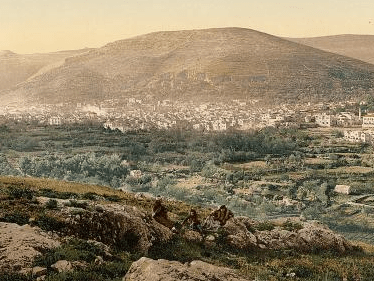
View from Mount Ebal (circa 1890). Six tribes stood on this mountain, and six tribes stood on Mt Gerizim (seen across the valley). In the valley the Priests, Levite Elders, and Ark of the Covenant stood.

The Levites in the valley turned to the tribes on Mount Gerizim and proclaimed a blessing (the first of which was “Blessed be the man who does not make a graven or molten image”) to which the tribes on both sides answered “Amain”. They then turned towards the tribes on Mount Ebal and issued a curse (the first one being “Cursed be the man who makes a graven or molten image”) to which the tribes on both mountains answered “Amain”. They would continue in this fashion with the rest of the blessings and curses.

Upon entering the land, Joshua immediately brought the people to Mount Ebal (and Gerizim) and fulfilled this commandment (see Joshua 8).

In addition to the blessings and curses, Moses commanded that stones be taken from the Jordan River bed which would miraculously split open, allowing the Children of Israel to cross on dry land (For more on this historic event, click here). With the stones, they were to build an altar on Mount Ebal and offer a sacrifice. According to Jewish sources, the reason it was specifically built there was to gladden the hearts of the tribes who were stationed on the mount where curses were directed. When Joshua took the people to Mount Ebal, he built the altar as Moses had commanded and offered an Elevation and Peace offering (see Joshua 8).

Giving a tour at the exact location of the Jordan River where the stones were retrieved to build the altar on Mount Ebal.

In the modern era, explorers and researchers spent much time and effort to locate the altar, but without success. Part of the reason they were unable to find it was because they were looking on the Southern slope facing Mount Gerizim (although nowhere in the Bible does it say that the altar was built there). They erroneously assumed that was the location, because of all the dramatic blessings and curses uttered there.

In 1978, Archeologist Adam Zartel began to survey the mountain (meter by meter) but was disappointed that all of the findings were from the Persian Period (5th-4th Century BCE). Towards the end, he found a massive slab of stones and was certain that he had found something special.

Picture of the Slab of Stones which covered the Altar for Millenia until it was dug up in the early 1980’s.

Upon his initial surveying, he discovered that the pottery found was from the time of Joshua. Additionally, he found two ancient Egyptian Scarabs from the times of Ramses II, who most historians agree was the Pharoah from Exodus (since the Children of Israel had come with treasure from Egypt, and they were all brought to this area by Joshua, it makes sense that findings like this would be discovered here).

During the excavation (which took him a year and a half), he discovered an altar whose measurements corresponded to the altars discussed in Jewish sources. In addition, only Kosher animal bones were found. The animals had been slaughtered according to Jewish law and then burned on an open fire, as required. The archeologist concluded that he had indeed found the Biblical altar!

Diagram of the discovered altar

In 1995, Israel gave partial control of this land to the Palestinian Authority (PA) as part of the failed Oslo 2 Accords. Israel retained military control of the mountain because of it’s strategic location but civil control (including archeological sites) of the mountain was given to the PA, leaving the site at their mercy. Over the years, the site has been desecrated by the locals. In February 2021, the PA government itself breached a millenia-old wall (which surrounded the altar) for roadwork, causing irreparable damage. Today, Israelis can only visit with an IDF escort arranged in advance. Although technically, non-Israelis are free to visit even without an escort, to do so is considered very dangerous.  This should NEVER be attempted without first coordinating with (and receiving permission from) the IDF.

For those who want to experience the site without an IDF escort, there is an amazing lookout point from the Jewish settlement of Elon Moreh. In addition Mount Gerizim is also fully under Israeli control, and an amazing site to visit in its own right (although prior to visiting, it is always highly recommended to check out and see if there are any security issues that need to be considered at that particular time).

Nosson Shulman is a journalist and Licensed Tour Guide in Israel specializing in Biblical toursTo allow tourists to experience Israel during the Corona era, he created the new hit Israel tour video series which brings Israel to the home of viewers by simulating actual tours. To check out his free sneak preview tour videos, click here. To view sample tour itineraries or to inquire about private tour opportunities with a personalized itinerary on your next trip to Israel, click here.

Nosson Shulman

MAJOR NEWS: New York Becomes Third State to Take Official Action Against Unilever’s Boycott of Israel

Ben and Jerry’s parent company stands to immediately lose $111 million in the Empire State

By Nosson Shulman: Licensed Tour Guide of VIP Israel Tours Authentic Virtual Tours (click here to check out his free trailer videos)

Picture of a fake ice cream flavor, meant to mock the anti-Semitic nature of Ben & Jerry’s boycott of Israel

New York has become the third state to take official action against Unilever (the parent company of Ben & Jerry’s) after July’s shocking announcement that, beginning in 2023, they will no longer do business with the Jewish State! Due to the Empire State’s strict anti-boycott laws, this international conglomerate stands to lose a lot of money!

The last few years have seen the rise of the radical, anti-Semitic BDS (Boycotts, Divestments, Sanctions) movement which seeks to harm (and in many cases eradicate) the Jewish State through economic isolation. Some of their tactics include pressuring companies that do business with Israel and pushing Universities (and professors) to blacklist Israeli academic institutions. They also try to coerce non-profit organizations to divest their money from investment funds that work with Israel (some officially target “only” Judea and Samaria and the Golan Heights, but the majority of them openly target the entire state). In order to combat this disgraceful movement, 35 states have passed Anti-Boycott laws prohibiting their government from doing any business with (or awarding/renewing) contracts to companies who blacklist Israel. From them, 21 states explicitly include Judea & Samaria (the West Bank) in their laws, and 12 (including New York) require their state to remove companies that engage in boycotts from state employee retirement investment funds (the latter of which experts say is far more damaging than simply ending contracts for goods and services)!

Started in 1978, Ben and Jerry’s became one of the most popular ice cream brands in the world. Its founders were known for their (often extreme) leftwing views. Though primarily a for-profit company, the company often involves itself in (non-business related) political issues. In 2000, they sold the company to the giant British conglomerate Unilever (who also own many huge companies including Dove, Lipton Tea, Hellman’s Mayonnaise and several other products) for $326 million. Unilever claims that when they bought the company, they agreed to the founder’s stipulation that Ben and Jerry’s retain a board of directors who would remain independent from its parent company. Although the original owners are supposedly not involved in company decisions, they wrote an op-ed in the New York Times saying they are “proud” of the company for taking such a “brave” stance (although the company continues to do business with China despite its actions against Hong Kong and Taiwan, while staying silent on the country’s genocide (and forced slave labor) against the Uyghur Muslims).

At $263 billion dollars, New York has the largest pension fund in the US (except for California)! Currently, the state has $111 million invested in Unilever. In addition to the immediate loss, experts say it will negatively impact the company’s stock prices. They will also be prohibited from buying Unilever products for Government institutions (as an example many states have lucrative contracts with Unilever to supply hygienic products to its prison population).

Unilever is protesting the decision, claiming that they are the victims because their hands are tied to stop this. They argue that it is unfair to hold the entire company liable for the actions of one of their subsidiaries. State Comptroller Tom DiNapoli, however, sees it differently. He said in a statement:

After a thorough review, the New York State Common Retirement Fund will divest its equity holdings in Unilever PLC. Our review of the activities of the company, and its subsidiary Ben & Jerry’s, found they engaged in BDS activities under our pension fund’s policy.”

He added:

“We as a pension fund have significant investments in Israel and Israeli companies. It’s been a very profitable area for us to invest in. … So, any effort with a BDS action to harm the Israeli economy presents a risk to our pension fund investments. And we’re in business to make money, to secure retirement benefits for the 1.1 million New Yorkers who are part of our retirement system.”

New York is not the first state to pull the trigger. As reported here in August and September, Florida & Arizona respectively took official action against Unilever. Just last week, Florida took further action against the company by announcing the divesting of $139 million dollars its pension fund has invested in it. In addition, New Jersey gave a 90-day notice to the conglomerate that they too would be divesting $182 million if the company doesn’t reverse its illegal boycott. Other states are currently considering similar steps including Rhode Island, Illinois, Maryland, and Texas.

Authors note: For Israel, a lot more than ice cream is at stake here. Many corporations are currently facing pressure to cease doing business with the Jewish State and are closely watching to see how this is played out. Everyone can do their part to counter the BDS movement by raising awareness (including by reaching out to Unilever and the stores that carry their products). Let them know what it means to you as a customer, share your concerns with local (and national) politicians, talk to your friends and/or congregations and share this (and similar) articles that discuss the threats posed by BDS!

Nosson Shulman is a journalist and Licensed Tour Guide in Israel specializing in Biblical toursTo allow tourists to experience Israel during the Corona era, he created the new hit Israel tour video series which brings Israel to the home of viewers by simulating actual tours. To check out his free sneak preview tour videos, click here. To view sample tour itineraries or to inquire about private tour opportunities with a personalized itinerary on your next trip to Israel, click here.

Nosson Shulman

HUGE ANNOUNCEMENT: Israel to Allow Vaccinated Foreign Tourists to Enter the Country Starting November 1st!

This follows a year and a half of almost total closure of the Jewish state to all but a select few!

By Nosson Shulman: Licensed Tour Guide of VIP Israel Tours Authentic Virtual Tours (click here to check out his free trailer videos)

Ben Gurion Airport’s departure hall sits empty in this early 2021 picture. Beginning November 1, scenes like this will be a thing of the past, as fully vaccinated tourists from most countries will be allowed once again to visit the Holy Land.

In mid March 2020, Israel closed its borders to almost all foreigners and its booming tourism industry came to a screeching halt overnight with no known end date in sight. It has remained that way ever since, but there now finally appears to be some light at the end of the tunnel!

Starting Monday November 1st, foreign (vaccinated) tourists will finally be able to enter the country for the first time in a year and a half, providing they meet certain conditions. The criteria (issued by the Israeli government) are that foreign tourists must not have visited a red country within 14 days (as of this writing no country is considered red by Israel). They must also enter through Ben Gurion airport, and be vaccinated with a World Health Organization (WHO) approved vaccine such as Moderna, Pfizer, AstraZeneca, Johnson & Johnson, etc.

Persons that received Moderna or Pfizer vaccines must have had two shots, and 14 days must have passed since the second shot was taken, while less than 180 days since the second shot has elapsed. Those that have received a booster (3rd) shot more than 14 days before arrival may enter the country, even if 6 months have elapsed since their shot. Other vaccines will have their own criteria.

Recovered individuals from 45 countries (including the EU) who had Corona Virus and recovered within the last 6 months may enter Israel even without a vaccine (though they will need to prove it with official documents). If more than 6 months have elapsed since Corona, individuals from these countries may only enter Israel if they have also received a booster shot from one of the approved vaccines. As of now, this does not apply to US or Canadian citizens who cannot enter without getting the vaccines, even if they have recovered.

Anyone wishing to visit Israel must perform a PCR Test up to 72 hours before an outbound flight and must fill out a passenger declaration of health. According to the website of the Israel Consulate General in Los Angeles) they are two categories of declarers:

1) Passengers with a verifiable digital certificate will scan or upload their immunization or recovery certificate to the incoming passenger form and receive a green pass before boarding the plane.

2) Passengers who do not have a verifiable digital certificate will declare their vaccination status in the incoming passenger form and fill out an application to shorten the isolation period. Then, they will attach the relevant documents to receive a green pass before boarding the plane.

When boarding their flights, they will need to present certain documents such as their negative PCR test result (for more on that, check out the website of the Israel Consulate General).

Upon landing, another PCR test will need to be done. Tourists will need to remain in isolation until they either receive the results or 24 hours have elapsed (whichever comes first).

For more information on the criteria for entering Israel, the vaccines which are accepted, boarding requirements, documentation, and more, it is recommended to check the website of the Israeli consulate general.

With tourists now being allowed to enter the country, it is hoped that Israel will once again become a major tourist destination for people all over the world looking for their unique, one-of-a kind experience!

Disclaimer

The author of this article is not an attorney, and this article should not be construed as legal advice or an authoritative source. This article is for informational purposes only and should never be relied upon. The author takes no responsibility for the content or accuracy of this article. It is highly recommended for anyone wanting to enter Israel to do their due diligence and independently verify that they are indeed qualified to enter the country, and to ensure that they have the appropriate documents to successfully do so.

Nosson Shulman is a journalist and Licensed Tour Guide in Israel specializing in Biblical toursTo allow tourists to experience Israel during the Corona era, he created the new hit Israel tour video series which brings Israel to the home of viewers by simulating actual tours. To check out his free sneak preview tour videos, click here. To view sample tour itineraries or to inquire about private tour opportunities with a personalized itinerary on your next trip to Israel, click here.

Nosson Shulman