FANTASTIC NEWS: Israeli city ranks 6th among the world’s greatest culinary cities.

Tel Aviv’s unique blend of street foods, vegetarian eateries, charming cafes and multi-ethnic restaurants is turning it the city into an international mecca for food lovers

By Nosson Shulman: Licensed Tour Guide of VIP Israel Tours Authentic Virtual Tours (click here to check out his free trailer videos)

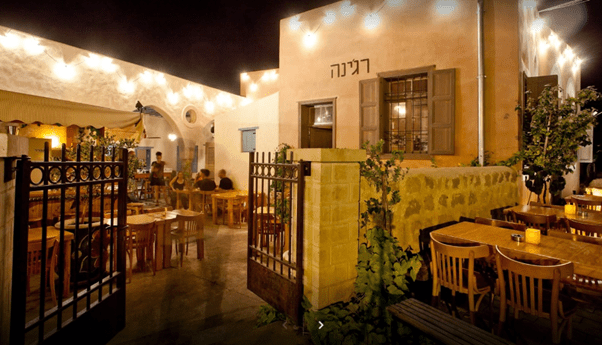
Regina, a charming restaurant located in the trendy, reconverted old Jaffa Train Station

Tel Aviv has just been ranked #6, by the prestigious US based travel magazine “Food and Travel”, in their ranking of the best culinary cities in the world. Only Palermo (Italy), Chania (Crete), Vienna (Austria), San Sebastian (Spain) and Marseille (France) ranked higher.

Well-travelled food enthusiasts will not be surprised by Tel Aviv’s high grade. Due to the fact that almost all of the vegetables and fruit consumed in Israel are locally grown, and the travel time from farm to table is low (often the same day), the food is fresh. In fact, the city calls itself the vegan capital of the world with at least 255 veggie friendly restaurants. They even have Domino Pizza stores which serve animal free menus.

Unbelievably, though Tel Aviv has some very nice, high end restaurants, what sets this city apart is its street food. The city abounds with Falafel stands, mom and pop Shawarma joints, tiny Shakshuka (an egg, tomato sauce and cheese dish popular in Israel) eateries, and more which tourists can’t get enough of. Of course, no discussion of Tel Aviv’s fast-food scene is complete without mentioning the trendy Carmel Market. One tourist said the simple dishes served in these places are so good, it hurts.

Since its creation in 1948, Israel has absorbed millions of Jewish immigrants from far flung places of the world like Morocco, Russia, Iraq, Persia, Georgia, Italy, Turkey, Ethiopia, India and many others. These immigrants brought their culinary traditions, spices, and family recipes with them to Israel, giving diners in Tel Aviv a plethora of dining options. Of the restaurants serving traditional, ethnic food, perhaps the most popular are the ones found in the Yemenite Jewish neighborhood of the city. Many of their menu options include secret family recipes which have been passed down from generation to generation for centuries.

Tel Aviv is also a European style café city with a distinct Israeli flavor and because of its proximity to the Mediterranean, fresh fish is found in abundance.

This is not the first time Tel Aviv has made the cut. In December 2019, the coastal city was ranked 9th, by the BBC, as the best place in the world for foodies.

Nosson Shulman is a journalist and Licensed Tour Guide in Israel specializing in Biblical toursTo allow tourists to experience Israel during the Corona era, he created the new hit Israel tour video series which brings Israel to the home of viewers by simulating actual tours. To check out his free sneak preview tour videos, click here.

Nosson Shulman

MAJOR NEWS: Arab country signs massive energy deal to import Israeli natural gas

Israel as a new major exporter of energy is a major game changer, with serious security and geo-political implications.

By Nosson Shulman: Licensed Tour Guide of VIP Israel Tours Authentic Virtual Tours (click here to check out his free trailer videos)

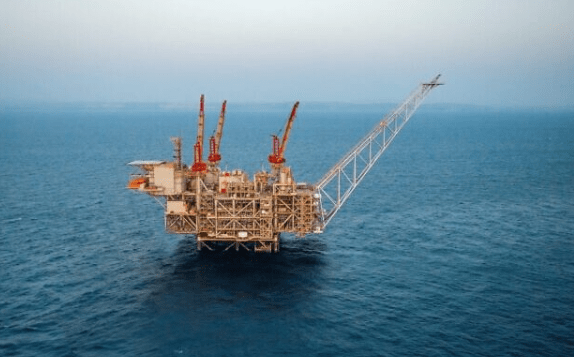
Natural gas platform of Leviathan, Israel’s largest known gas field, is a major game changer!

Egypt and Israel have signed a major deal, entailing major implications for the world.  An underwater pipeline is to be built in the Eastern Mediterranean, connecting Israel’s offshore rig in the Leviathan field (Israel’s largest natural gas reserve) bringing the gas directly to Egypt’s liquidation facilities where the gas will be turned into liquid for easy export to Europe.

The idea that Israel would be an energy exporter was considered preposterous.  Since its founding in 1948, Israel has been reliant on oil, coal, and gas from abroad, particularly Russia, Norway, Azerbaijan and (until 1979) Iran.  Israel’s oil rich neighbors in the Middle East did not recognize Israel and refused to sell to them.  Israel had no choice, but to shell out large sums of money to transport energy from other, willing countries.  Since Israel relied on Russian energy, Russia (a major trading partner of the Arab world) was able to use this leverage to get Israel to make decisions which were not necessarily in Israel’s best interests, including militarily, fighting terrorism or projects in Judah and Samaria.  In addition, the Arabs weaponized their resources, such as putting oil sanctions on western countries depending on them and influencing their foreign policy vis a vis Israel.

Everything changed in 2009, when natural gas was discovered off the coast of Haifa.  Israel immediately began working to build pipelines and infrastructure to export its gas.  In the interim, Jordan and Egypt signed major, multi-year deals with Israel to buy their gas to the tune of a combined 30 Billion dollars US.  On December 16 2019, Israel officially became a major energy exporter, sending massive amounts of gas to Egypt for the first time.

In 2018 with the backing of the EU, Israel, Greece, Cyprus, Italy, and Crete agreed to build the world’s longest underwater pipeline (more than 1300 miles) to export Israel’s gas to these countries, who in turn would export Israel’s gas to the rest of Europe.  The EU is currently dependent on Russian gas.  No longer wishing to be reliant, they would like to be free to take a more aggressive stance against Russian policies in Eastern Europe (such as the Crimea) and domestic politics like the jailing of political opponents of Putin.

In September 2020, Egypt and Jordan joined with Israel, Greece, Cyprus, Italy, and Crete to create the East Mediterranean Gas Forum (EMGF).  Countries such as France have applied to join with the US and EU requesting observer status.  Israel’s gas fields have clearly raised its profile worldwide!

The implications could not be bigger!  With Israel less dependent on foreign energy, it has more freedom to act against threats to its security, with less fear of economic sanctions from its major trading partners.  In addition, with the 1300-mile pipeline set to be operational by 2025, Europe will have a freer hand to act against what it sees as Russian aggressions.  The fact that the world is less dependent on Arab oil (including the US which became energy independent itself for the first time under the previous administration) means that the Arab countries and Iran will be less able to influence foreign policies in the west.  Because international terrorism is largely (though not entirely) paid for through the middle eastern oil trade (in the past, every time you pumped gas, there is a good chance you were unwittingly funding international terrorism), terror supporting countries have less money to distribute to terrorist groups who have been suffering from major cash flow problems in the last few years.

Many countries around the world, especially in developing nations, have become dependent on Israeli water/agricultural technological know-how and medical research. Israel has used this leverage to build brand new relationships with countries, many of whom had not previously recognized Israel’s right to exist.  Many peace deals have been signed, making the world a safer place.  Now with its new energy resources, the sky’s the limit!

Nosson Shulman is a journalist and Licensed Tour Guide in Israel specializing in Biblical toursTo allow tourists to experience Israel during the Corona era, he created the new hit Israel tour video series which brings Israel to the home of viewers by simulating actual tours. To check out his free sneak preview tour videos, click here.

Part 2: Mount Nebo

Moses ascended from the plains of Moab to Mount Nebo, to the summit of the cliff that face Jericho, and Hashem (G-d) showed him the entire land…And Hashem (G-d) said to him “This is the land which I swore to Abraham, to Isaac, and to Jacob saying “I will give it to your offspring.” I have let you see it with you own eyes, but you shall not cross over to there (Deutoronomy 31: 1-4).”

Area of Mount Nebo (in Red) as seen from the Israeli town of Mitzpe Yericho (the town in the foreground is Biblical Jericho)

As we saw last week, Jordan’s best Biblical sites can be experienced WITHOUT ever leaving Israel (to read about the Gilead Mountains & Jabbok River, click here).  Today, we will explore a site so important that the Torah (Five books of Moses) ends with it and the Book of Joshua begins in that area.  Of course, I am talking about Mount Nebo!

For the best view, we will head to Mitzpe Yericho, a Jewish Israeli town in Judea & Samaria which has an amazing lookout!

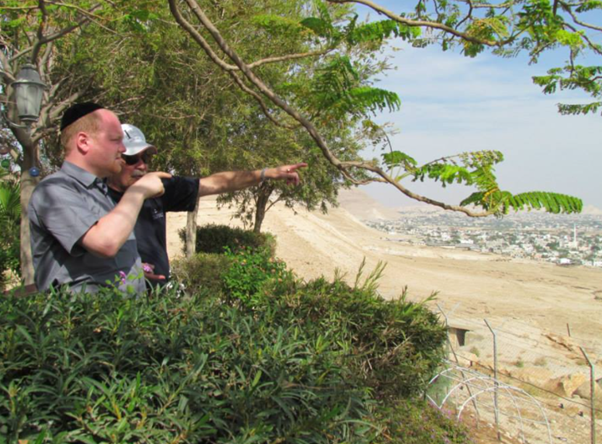
Pointing out Mount Nebo on a tour of Vered Yericho, which also has a great lookout of Har Nebo. Jericho, one of the world’s oldest cities, can be seen in the background.

On a clear day many sites of significance are visible from here, including Jerusalem (Israel’s eternal capital), Amman (Jordan’s capital), Jericho (the first city conquered by the Children of Israel upon entering Israel), the Dead Sea (which is the lowest spot on Earth), Biblical Mount Nebo and more.

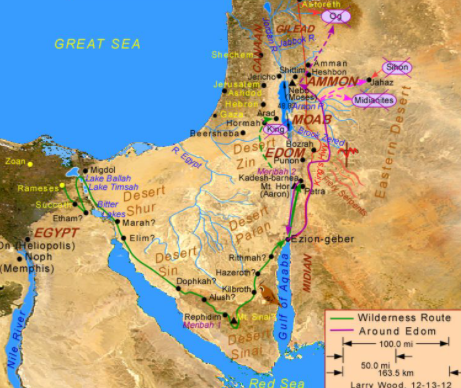
The story of Moses ascending Mount Nebo on his last day on earth actually started 40 years earlier with the exodus from Egypt, where the Children of Israel spent 40 years wandering in the desert.  The route they travelled encompassed Egypt, Jordan, Eilat (known as Ezion-Geber in the Bible, not part of Biblical Israel) and perhaps Saudi Arabia.

The possible route taken by the Children of Israel. Note that this route is not universally accepted, and some suggest that Saudi Arabia was really the location of Mount Sinai.

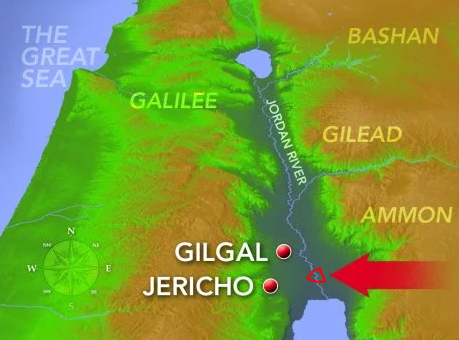
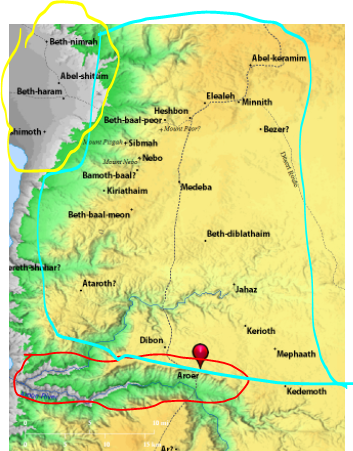
After 40 years the Jews, led by Moses, crossed the Arnon river and conquered the territory of the giant Sihon, who controlled the Ammonite Mountains.  They then found themselves just east of the Jordan River, opposite Jericho, in the plains of Moab.

The Jews were in eastern Jordan and crossed, via the Arnon River (see Numbers 21 about the Miracles that took place), to the other side which faces Israel (see red circle). They then conquered the mountains of Ammon controlled by the Giant Sihon (see aqua circle) and found themselves in the plains of Moab facing Jericho (see Yellow circle)

The tribe of Reuben asked Moses to be able to stay on the eastern side of the Jordan River. Moses reluctantly agreed and gave them the newly conquered territory of Sihon, which included Mount Nebo, as their tribal portion.

On the last day of his life (his 120th birthday) Moses was told by G-d that he was about to die, and that he should ascend to the top of Mount Nebo (Deutoronomy 32:49) to see the land of Israel before he died.  Before he ascended, he blessed all of the twelve tribes who were encamped at the plains of Moab and then ascended the mountain.

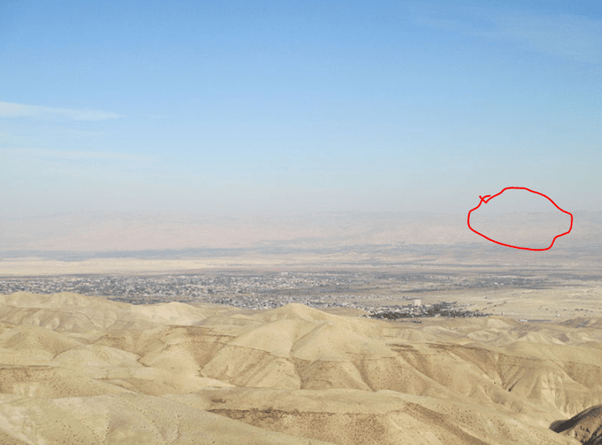
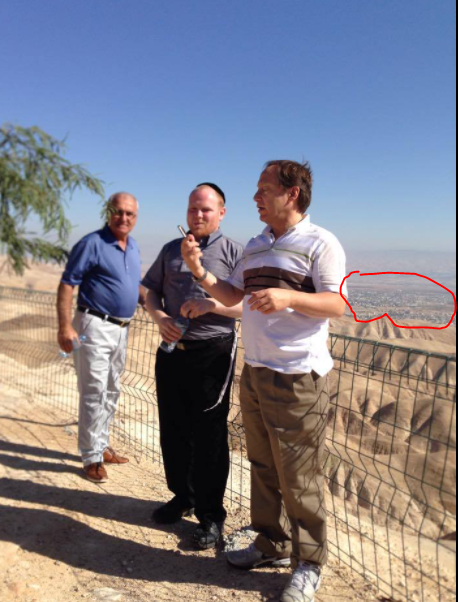
Giving a tour at Mitspe Yericho’s lookout point. The Plains of Moab, where Moses blessed the tribes and took leave from them, is clearly visible in the background (see red circle)

According to Jewish sources, when it was time for Moses’ soul to depart, G-d did not allow the angel of death to take his soul (as is done with most people) but told him to lie down, close his eyes, and then took his soul with a Divine kiss, and buried him himself in an unknown location on Mount Nebo.  In Jordan by Mount Nebo, there is a touristy site called “Tomb of Moses”.  There is actually little validity to this claim, in fact the Bible says, “No one knows his burial place to this day” (Deuteronomy 34:6).

View from Mount Nebo in Jordan, similar to what Moses saw on his last moments on Earth.
Photo Credit: Shutterstock

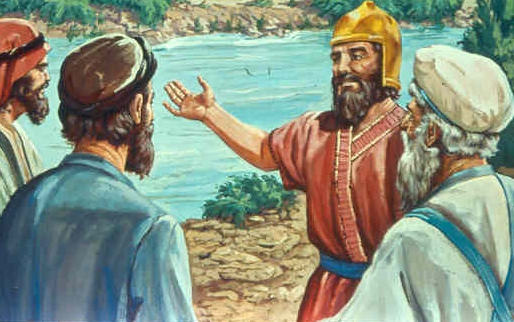
After Moses died, the Children of Israel mourned thirty days for their beloved leader.  After the thirty days, G-d told Joshua (Moses’ successor) to get his troops ready, for in three days they would be crossing the Jordan River.

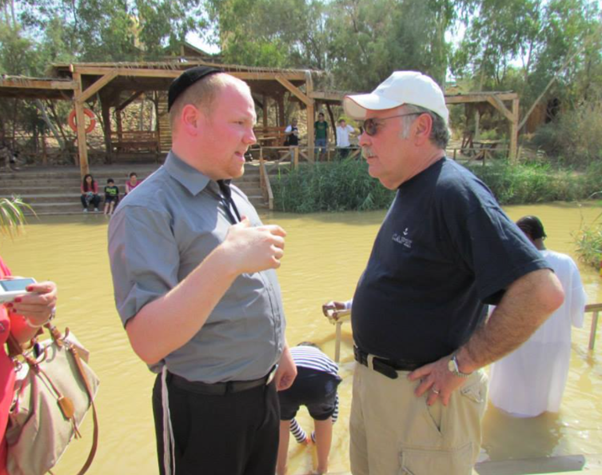
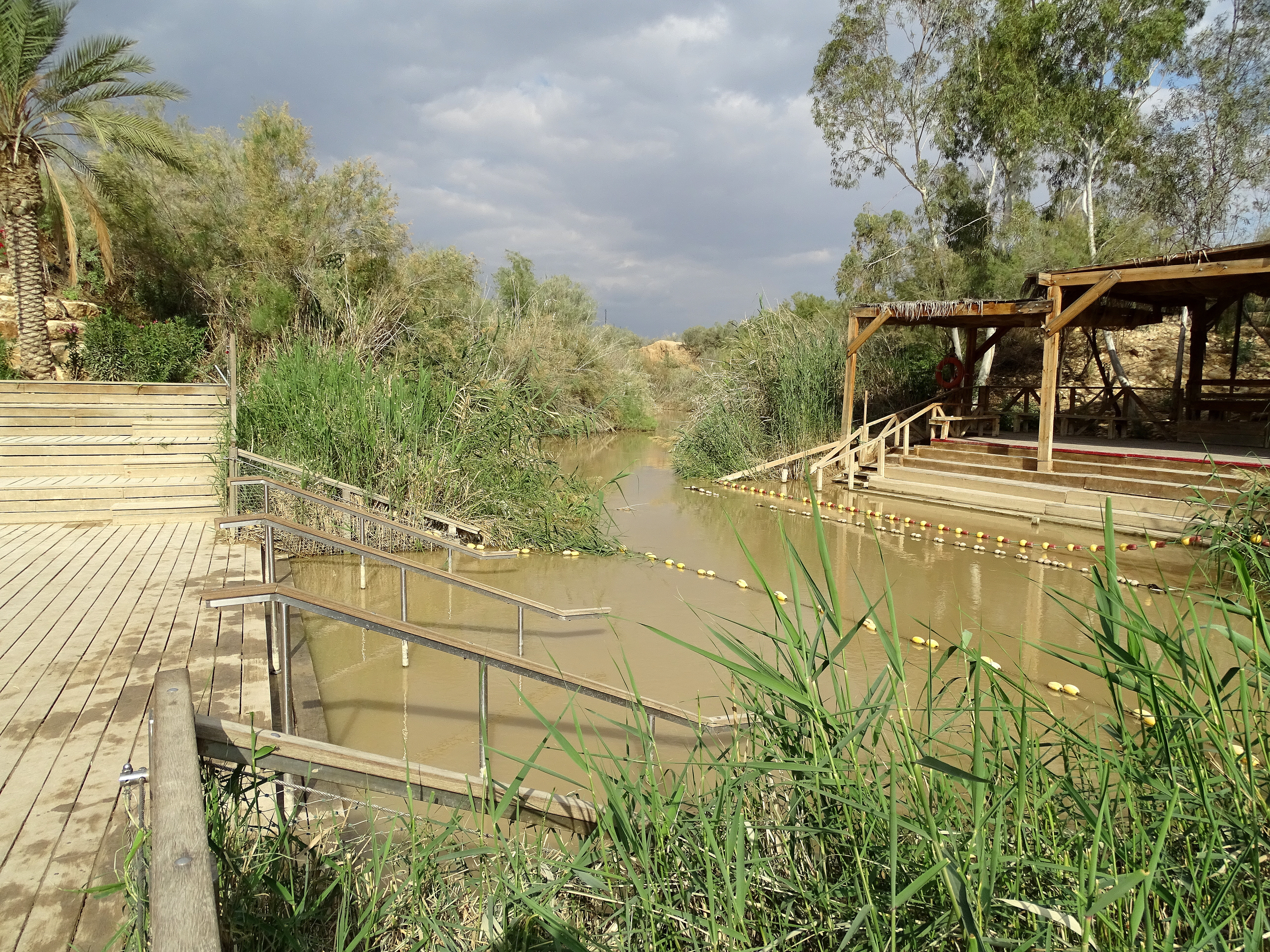
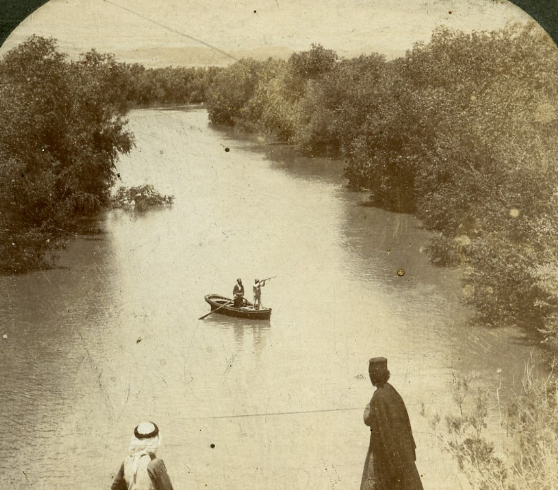
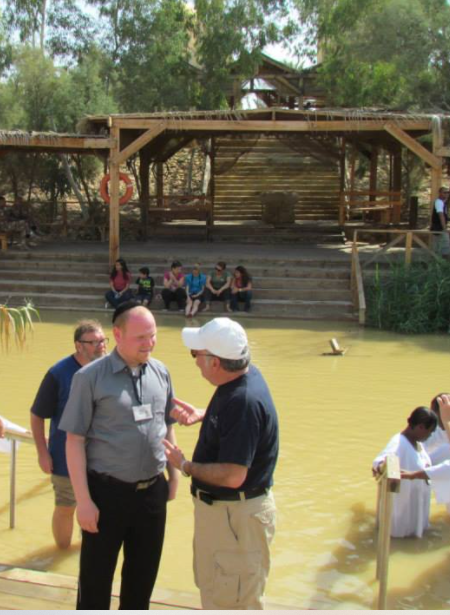
The Jordan River is today’s border between Israel and Jordan (I am giving a tour on the Israel side, the people sitting on the steps are on the Jordanian side). This is believed to be the exact location of the river that the Children of Israel used to cross into the holy land!

Three days later, the Children of Israel were about to change world history forever…

-To Be Continued…

Relive the biblical Jordan, from Israel, with Nosson Shulman on your very own private luxury Israel tour. To experience Israel from the comfort of your own home see our new Virtual Tours including our new released Hebron Tour.


By Nosson Shulman – Licensed Tour Guide and Trip Organizer in Israel who specializes in History, Tanach (Bible) and Adventure Tours. For more itineraries click here. Check out our new Virtual tours including Jerusalem: free sneak preview videos.

© 2021 All Rights Reserved – Unauthorized Duplication is prohibited
BREAKING NEWS: Equatorial Guinea to Move Their Embassy to Jerusalem

The coastal, western African nation, with Africa’s highest per capita income, currently has their embassy in Tel Aviv

By Nosson Shulman: Licensed Tour Guide of VIP Israel Tours Authentic Virtual Tours (click here to check out his free trailer videos)

Malabo, the capital city of Equatorial Guinea. The city’s beautiful beaches and rain forest hiking trails makes it a popular destination for Western tourists.

After speaking with President Teodoro Obiang Nguema Mbasogo of Equatorial Guinea, Israel’s Prime Minister Benjamin Netanyahu announced that the west African nation promised to move its embassy, currently in Tel Aviv, to Jerusalem.

Equatorial Guinea becomes just the latest nation to recognize Jerusalem as the capital of Israel. Long considered taboo for political reasons, the US formally moved their embassy to Jerusalem on May 14, 2018. Two days later, Guatemala followed suit. Since then, several nations have announced they will move their embassies to Jerusalem including Kosovo, Serbia, Malawi, and Honduras. The Czech Republic, Brazil and the Dominican  Republic have also taken formal steps to recognize Jerusalem as Israel’s capital such as opening official diplomatic missions in the Holy City, though they have yet to officially announce moving their physical embassy from Tel Aviv to Jerusalem.

This major news is not merely symbolic, but has the potential to contribute positively to the peace process. Though Jerusalem is Israel’s true capital, for many years almost every country had their embassy in Tel Aviv, with none found in Jerusalem. In the 1947 UN Partition plan which declared the founding of a Jewish state, Jerusalem was given the status of “Corpus Separatum” an international zone which would be ruled by a consortium of nations. In the 1948 War of Independence, Israel gained controlled of Western Jerusalem, while eastern Jerusalem was seized by Jordan’s army. The UN never officially recognized Israel’s claim to Jerusalem (even it’s western half).

In the 1967 Six Day war, the IDF, fighting a defensive war, liberated Eastern Jerusalem and united it with the rest of the city. In 1980, Israel legally annexed eastern Jerusalem, a moved not recognized by most of the international world, including allies of Israel, for fear of angering the oil rich Arab world. Many countries and organizations, including the EU and UN, claimed without evidence that to recognize Jerusalem as Israel’s capital would lead to terrorism against western targets, crippling oil sanctions, and would destroy the peace process. Others countered that moving the embassy was the right thing to do because every country has the right to pick its capital, Jerusalem has been the capital of the Jewish people for over 3000 years and far from hurting the peace process, it would enhance it by removing false hopes from the Palestinians that Jerusalem would ever be their capital. History proved the latter experts correct: not only were participating countries not rocked by the “predicted” international incidents but in quick succession, four Muslim countries made peace with Israel, with more considered likely to follow in the not to distant future.

Since Israel’s founding, Equatorial Guinea has had an off and on relationship with the Jewish state. Relations between the nations started in 1968, though the coastal African nation cut off relations with Israel in the aftermath of the 1973 Yom Kippur War. Relations were re-established in 1994. In 2019, Equatorial Guinea opened their first embassy in Tel Aviv which they have now announced they plan to relocate to Jerusalem.

With a GDP per capital income of $34,865, oil rich Equatorial Guinea which has a population of 1.3 million people, is officially Africa’s richest country. Blessed with fertile soil, the country is an exporter of cassava, coffee, bananas, rice and yam. It’s vast rain forests make it a major producer of timber and its beaches/natural beauty attract tourists worldwide. Because most of the wealth is contributed in the hands of the elite, the country suffers from severe, abstract poverty and some of the worst infrastructure on the continent.

Prime Minister Netanyahu has made building relationships with African nations a cornerstone of his governance. As Israel is a world leader in agricultural, water and medical technologies, many African nations plagued with these issues have experienced firsthand the benefits of good relations with Israel. By increasing ties, President Mbasogo is hoping it will pay dividends for his the citizens. 

Nosson Shulman is a journalist and Licensed Tour Guide in Israel specializing in Biblical toursTo allow tourists to experience Israel during the Corona era, he created the new hit Israel tour video series which brings Israel to the home of viewers by simulating actual tours. To check out his free sneak preview tour videos, click here.

MAJOR NEWS: The JNF is set for the first time ever to buy private land in Judea and Samaria for Jewish Settlement

The Jewish National Fund was founded in 1901 to buy lands throughout Ottoman Israel from absentee Arab landlords for Jewish settlement

By Nosson Shulman: Licensed Tour Guide of VIP Israel Tours Authentic Virtual Tours (click here to check out his free trailer videos

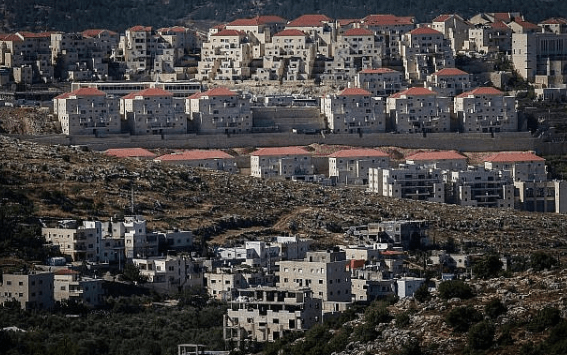
Betar Illit, a Torah Observant Jewish city in Judea and Samaria (West Bank) has a population of almost 65,000

Last week Israel and its supporters woke up to good news! For the first time ever, the Jewish National Fund (JNF) will be buying up private land from Arabs (who are willing to sell) in Judea & Samaria (AKA the West Bank) in order to expand Jewish settlement in Israel’s biblical heartland.

The JNF raised money to buy land, drain the swamps, plant trees, and build homes and agricultural infrastructure, while encouraging the Jews to return to Israel and live in these new towns (many have since become major cities).  By 1948 the populations of Israel’s Jezreel valley, coastal area and other regions became predominantly Jewish.  The sole reason that approximately 70% of Israel’s Jews live along the coast today is because the JNF bought that land first.

After Israel declared independence, the JNF continued to plant trees, and build water and tourism infrastructures needed for the new, fledging towns.  After 1967 when Israel liberated Judah and Samaria, the JNF for political reasons (though they deny the assertion that politics influenced their decisions) did not directly involve itself openly in projects in Judea and Samaria (indirectly they did sometimes).

The major policy reversal was made possible due to the changing demographics of Israel.  During most of Israel’s early years, Israel’s left wing led by the Labor party controlled the Knesset and state institutions such as the JNF (though “officially” they are apolitical).  Since the late 1970s, with the election of Menachem Begin as Prime Minister and even more so in the last 20 years, the Israeli electorate has overwhelming elected rightwing coalitions.  The leftwing parties have been decimated, and many polls show the once powerful Labor and Meretz parties failing to pass the threshold in March’s elections.  Today’s most influential “left wing” parties such as “Blue and White” and “Yesh Atid” are better described as centrist.  Even as Israel moved rightwards, the left was able to hold onto influence for decades by “controlling” institutions like the JNF.  At the recent elections in the World Zionist Organization the rightwing parties were able to form a coalition, making this decision possible.

The final vote will be held after the March 23 election.  If the motion passes, as it is expected to, $11.7 million will be allocated to expand Jewish settlement in existing towns over the 1967 Greenline.

Nosson Shulman is a journalist and Licensed Tour Guide in Israel specializing in Biblical toursTo allow tourists to experience Israel during the Corona era, he created the new hit Israel tour video series which brings Israel to the home of viewers by simulating actual tours. To check out his free sneak preview tour videos, click here.

Part 1: Biblical Gilead Mountains, Jabbok River and Jordan Valley IDF Monument

It was told to Laban on the third day that Jacob had fled. So, he took his kinsmen with him and pursued him…catching up with him on Mount Gilead (Genesis 31:22-23)”

He (Jacob)…crossed the ford of the JabbokJacob was left alone, and a man (angel) wrestled with him until the break of dawn. When (the angel) perceived he could not beat (Jacob)… (the angel) said let me goAnd (Jacob) said “I will not let you go unless you bless me” … (the Angel) said no longer will it be said that your name is Jacob, but Israel for you have striven with the divine…and overcome (Genesis 32: 23-29)”

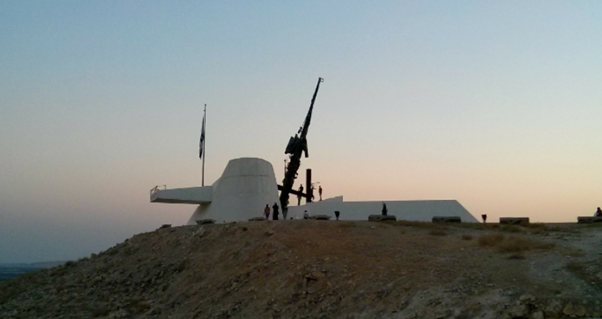
IDF Jordan Valley Monument where the biblical Gilead Mountains and Jabbok River can best be seen.

The modern country of Jordan has many biblical sites, where several of your favorite Biblical stories occurred.   In fact, for much of ancient history the Israelites even ruled much of the country, specifically western Jordan, which today runs along Israel’s eastern border.   This is great news for tourists to Israel, as most of these sites are visible from Israel and can be experienced without even leaving the Jewish state!

Today, we will leave Jerusalem and head north along highway 90, on route to Tiberias.  On the way, we will stop at the IDF Jordan Valley war monument which is merely a few kilometers from the border.  This area offers a panoramic view of a large section of Jordan, specifically the Biblical Gilead mountains and Jabbok River.

Standing from the Jordan Valley IDF Monument (circled in pink), we are treated to an awesome view of the Jabbok River (circled in Yellow) and the Gilead Mountains (circled in red)

The war monument itself is dedicated to the 400 soldiers who died protecting the Jordan Valley area in the War of Attrition (1967-1970), perhaps Israel’s least famous (but one of it’s most deadly) wars. Illegally occupied by Jordan starting from 1948, this land was liberated by the IDF in the 1967 war of Independence.

Judea and Samaria were liberated during the 6-day war by Israel. The strategic Jordan Valley section of it can be seen circled in pink.

After Israel miraculously won the six day war against 3 powerful Arab armies, the Arabs realized that Israel could not be defeated in conventional warfare.  Instead, they tried a new tactic which involved sending individual Fedayeen (Arab peasants in Jordan and Egypt) to infiltrate Israel’s border and commit acts of terrorism against army and civilian targets, in order to defeat Israel by lowering its morale.  Under the instructions of Prime Minister Golda Meir, Israel developed a strategy of heavy retaliation, whereby an attack by a terrorist coming from Jordan would lead to heavy attacks against its military infrastructure and soldiers.  With mounting losses to the Arab militaries and the death of President Nassar (a very anti-Semitic ruler of Egypt) the Arab countries then requested a ceasefire, which Israel accepted.  Unfortunately, 400 soldiers serving in the Jordan valley lost their lives (on the Egyptian front another 1000 IDF soldiers were to be killed) although they saved thousands of lives which surely would have been lost if the terrorists been able to advance further.\

In 1972, Israeli sculptor Yigal Turmarkin designed this Jordan Valley Monument. The names of all 400 soldiers who lost their lives are inscribed on it. This memorial was built with cement and steel. He took several guns, melted them, and shaped them into a 21-meter, anti-aircraft cannon facing the Jordanian border.
Photo Credit: Nosson Shulman

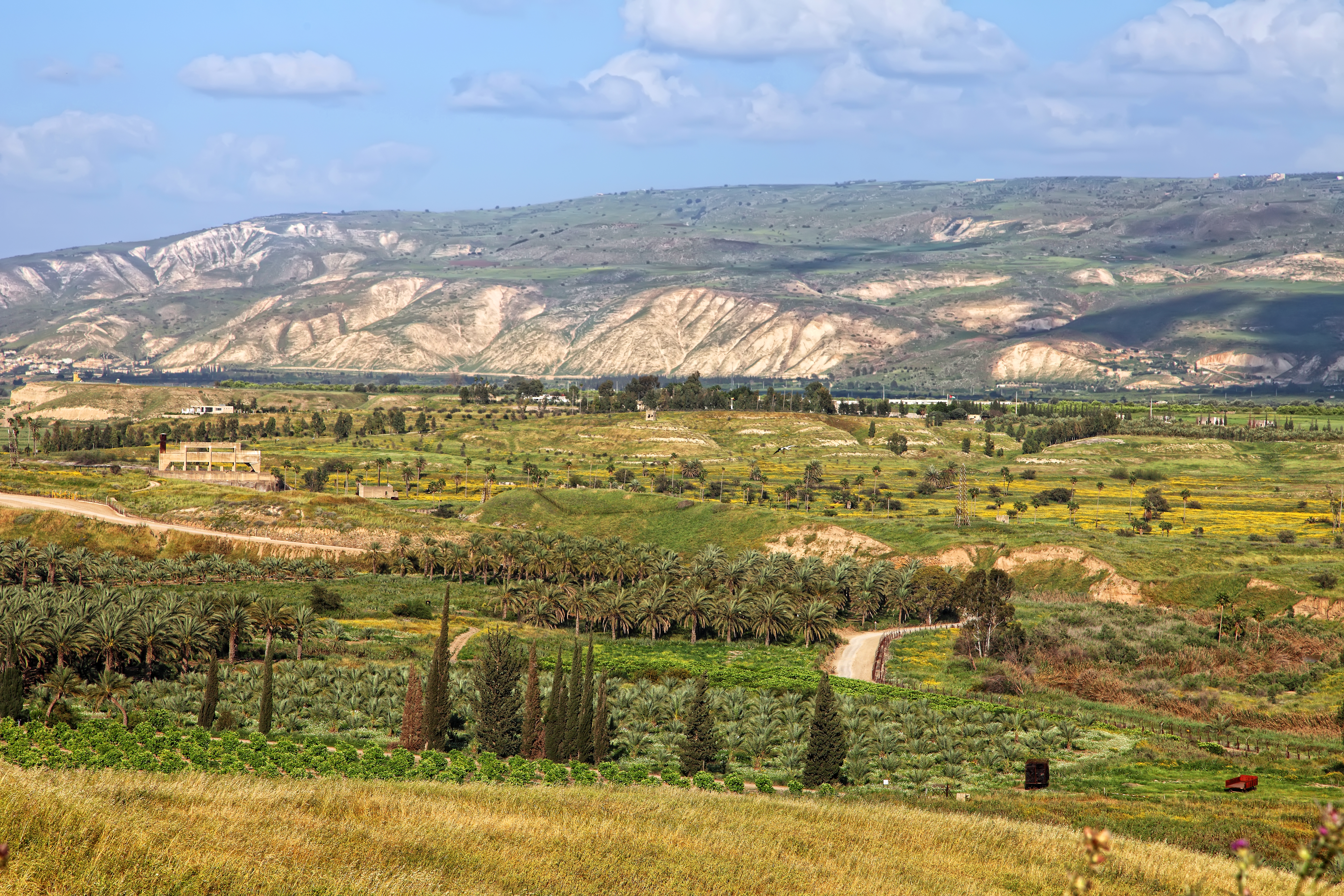
From the vantage point of the memorial, one can easily see the Biblical Gilead Mountains in today’s Jordan.

Gilead Mountains as seen from Israel.
Photo Credit: Shutterstock

This historic mountain range is mentioned many times in the bible.  Joseph was sold by his brothers to a caravan of Ishmaelites (Arabs) coming from Gilead (Genesis 37:25).  The tribes of Reuben and Gad, who owned large herds of cattle, requested Gilead as an inheritance for their abundant cattle, and it will be given to them (Numbers 32).  In Deuteronomy 4, Ramoth in Gilead was designated as a city of refuge for inadvertent murderers (for more on city of refugees, click here).  Elijah the Prophet was from Tishbi, a town in Gilead (1 Kings 17).  Jepththat the Gileadite, judged Israel for six years and waged their wars from Gilead (see Judges 11 and 12).

One of the most interesting stories to take place in Gilead occurred when Jacob, living in modern day Iraq, fled from Laban with his wives (Laban’s daughters) and children, on route to Israel.  At Mount Gilead, Laban overtook Jacob’s camp and was about to kill him when G-d appeared  and warned him not to harm Jacob in any way (Genesis 31).  Laban returned to present day Iraq, while Jacob continued on to Israel, going southwards until he reached the Jabbok river (the southern end of the Gilead mountain range).

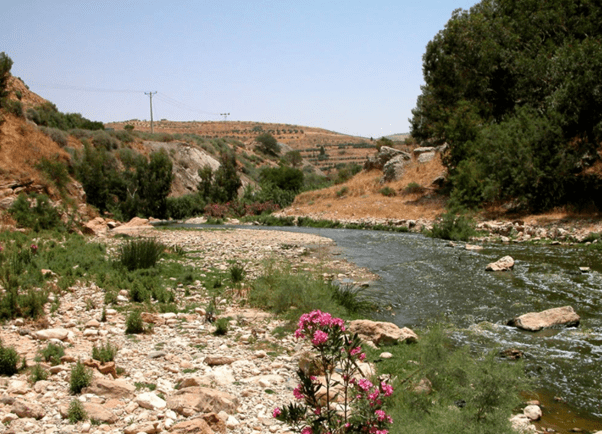
Jabbok River as seen from Jordan.
Photo Credit: Shutterstock

Jacob first helped his family over the stream and then returned alone to the other side to retrieve his property.  Whilst there, an Angel attacked him.  According to Jewish sources, this was the protective angel of Edom (the nation composed of Esau and his descendants), who Jacob was about to confront.  Ultimately Jacob prevailed, though a blow to his thigh caused him to limp for the rest of his life.  This signified that many nations descending from Edom would try to harm the Jewish people throughout the coming generations, and in many cases would severely wound them.  Ultimately Jacob’s descendants would never be fully annihilated, and ultimately prevail!

In addition to Mount Gilead and the Jabbok River, many other great sites in Jordan can be experienced from within Israel’s borders.  In fact one site is so significant, the Chumush (Five books of Moses) finishes with it and the Book of Joshua begins with it.

To be continued…

Relive the biblical Jordan Valley with Nosson Shulman on your very own private luxury Israel tour. To experience Israel from the comfort of your own home see our new Virtual Tours including our new released Hebron Tour.

Please visit the author’s Israel tour guiding site: https://guidedtoursofisrael.com


By Nosson Shulman – Licensed Tour Guide and Trip Organizer in Israel who specializes in History, Tanach (Bible) and Adventure Tours. For more itineraries click here. Check out our new Virtual tours including Jerusalem: free sneak preview videos.

© 2021 All Rights Reserved – Unauthorized Duplication is prohibited

Part 4: Ancient Hebron

By Nosson Shulman: Licensed Tour Guide of VIP Israel Tours Authentic Virtual Tours (click here to check out his free trailer videos)

“Afterwards Judah went forth with his brethren and attacked the Children of Esau… and (recaptured) Hebron (1 Maccabees 5:65)”


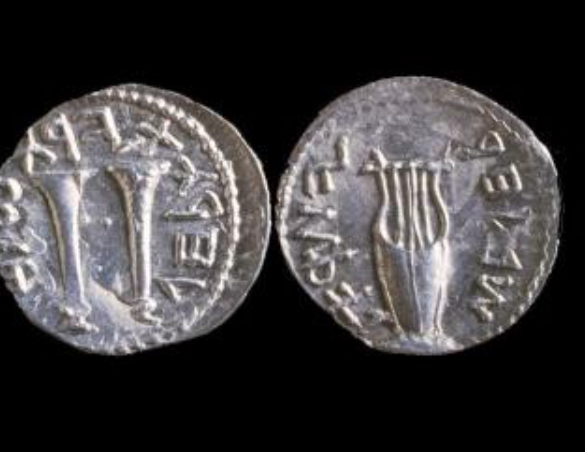
Coins minted during the Bar Kochba Revolt between 132-135 CE were found in abundance in the Hebron area

In 70 CE (circa) the Romans destroyed the Temple, and things were not looking good for the Jewish people!  Although the Jewish people had miraculously survived enslavement in Egypt and conquest by the Assyrians, Babylonians, Edomites (Descendants of Esau), and Hellenic Greeks, contemporary observers assumed that this time, the Jews would not survive as a distinct nation and would assimilate into the larger Roman population.  However, once again G-d had other plans!

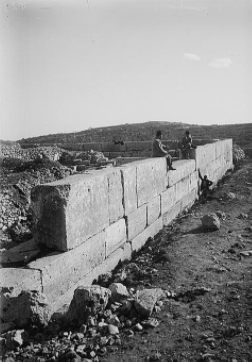
Remnants of the Roman era wall of Hebron destroyed in 70 CE

In the same year that the Temple was destroyed, Hebron was also ruined (although the Cave of the Patriarchs built by King Herod was left intact).

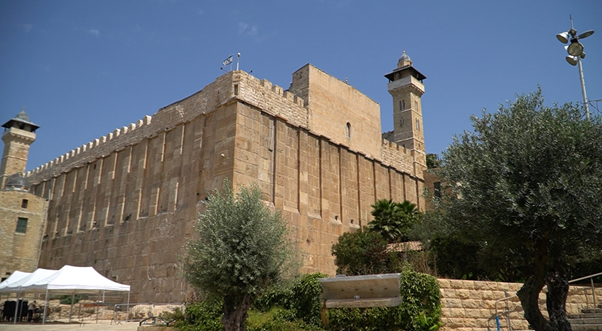
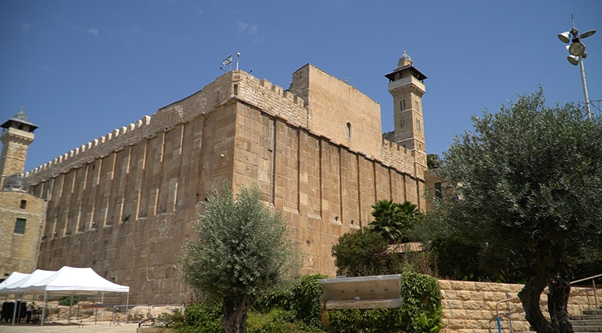
The Cave of the Patriarchs is the world’s oldest active public structure

Shortly after Hebron was destroyed, the Jews returned and rebuilt this holy city!  The Romans were shocked that even without the precious Temple in Jerusalem, the Jewish religion continued to flourish.  In ancient times the Romans destroyed the temples of the conquered people, and the losers of war then converted to Roman paganism.  This was because the Roman gods had been victorious over their gods.  Yet, here were a people that continued to observe the commandments.  If their goal to convert the Jews was to be realized, a new strategy was needed.

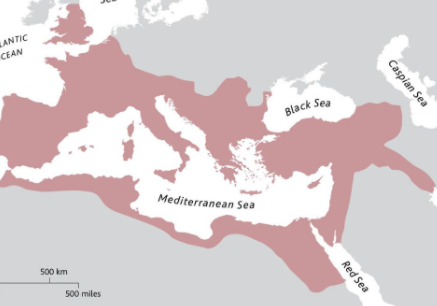
In 117 CE, two important events were to take place.  The Roman empire reached its zenith, and the Emperor Hadrian came to power.  Many years later, Hadrian travelled to almost every province in his large territory, becoming the first Roman emperor to leave Italy during his reign.  He came to Jerusalem and saw a city in ruins (unlike Hebron, Jerusalem was not rebuilt).  He ordered it to be rebuilt as a pagan city, with a temple to Jupiter at the exact location where the original Temple had stood.  Under penalty of death, he also forbade Jews from observing fundamental commandments like circumcision and teaching Torah in public.

The Roman empire at its Zenith in 117 CE. Since it controlled all of the land surrounding the Mediterranean, the sea was called the “Roman Lake”

For the Jewish people, this was to be the last straw!   Although the Romans were extremely powerful, ruthless in battle, firmly in control of Israel and possessing the greatest army the world had ever seen, a rebellion was planned to expel the Romans from the Holy Land in 132 BCE.  Led by a charismatic leader known as Bar Kochba, the Jewish people were (almost) universally united under his leadership.  They began digging a complex tunnel system underground for Guerilla warfare, including under the majority of the Hebron Hills.  However, by natural means this would not be enough to defeat such a formidable army.  They prayed that G-d would perform miracles on their behalf, and that is exactly what He did!

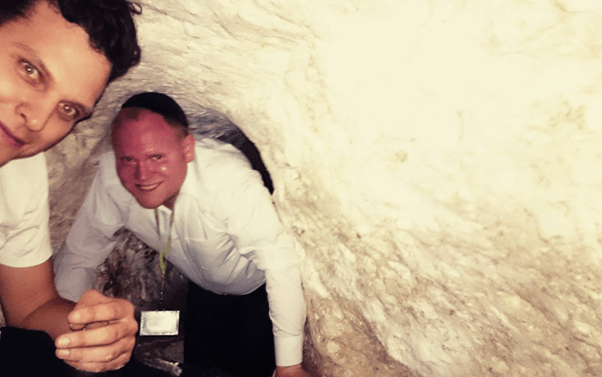
Crawling through one of the Bar Kochba caves used for subterranean guerrilla warfare, with my tourist. If you would like to explore this cave (and more) on your next trip to Israel, check out this itinerary

The two Roman Legions stationed in Israel were almost completely wiped out, after which Bar Kochba declared independence.  The Romans then called on more troops from Egypt, Syria, and Arabia, and they too were massacred.  Hadrian, desperate to put down this rebellion, called his greatest general, stationed in faraway England.  General Julius Severus took many legions from Europe with him, altogether an unprecedented 30-40% of the Roman’s entire army came to Israel (never before had that been required).  For the first time in Roman history, when the Emperor wrote to the senate, he left out the customary greeting “I and the army fare well”.

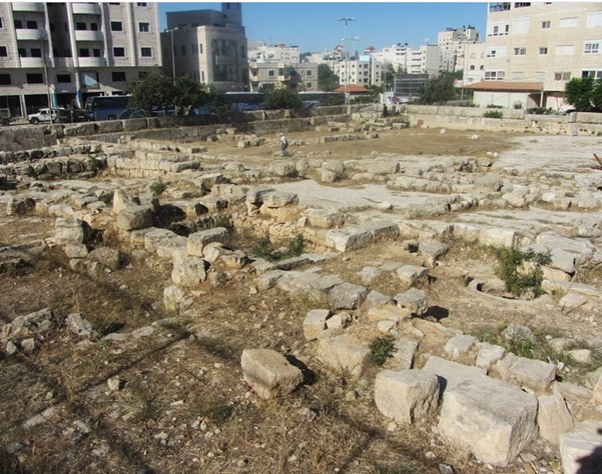
In the beginning, Severus suffered big losses.  These miraculous victories caused Bar Kochba to feel that his skills, as opposed to G-d’s help, were the reason for his army’s success.  According to Jewish sources, Bar Kochba even said that G-d should not get involved to help or hurt him.  This attitude changed the tide of war, and the Jewish people began to suffer defeat after defeat, until the summer of 135 CE when the city of Betar fell to the Romans.  The Romans massacred hundreds of thousands of Jews in order to show the rest of the empire the consequences of rebelling.  In addition, hundreds of thousands of Jews were sold at the marketplace in Elonei Mamre (Northern Hebron).  So many slaves were sold, that just a small measure of barley could purchase four slaves.

Ruins of Elonei Mamre where the Jewish slaves were sold after the failed rebellion

As further punishment, meant to sever the Jewish connection to the land, the province of Judea was renamed Palestine (the name is Latin, not Arabic, and was given 500 years before the advent of Islam).  Also, Jews were forbidden from living in any area where Jerusalem could be even seen in the distance.  Most Jews moved to the Galilee, and it looked like the more than 2000-year-old relationship between the Jews and Hebron was over; or was it?

To be continued…

Did you know that you can now actually tour Hebron from the comfort of your own home as if you were actually there? Check out my new, Hebron tour video, where we will explore this incredible city’s many historic alleyways and Biblical sites on a guided tour.  Check out the free sneak preview tour video from a Biblical worldview perspective: Trailer

Relive Hebron with Nosson Shulman on your very own private luxury Israel tour. To experience Israel from the comfort of your own home see our new Virtual Tours including our new released Hebron Tour.


By Nosson Shulman – Licensed Tour Guide and Trip Organizer in Israel who specializes in History, Tanach (Bible) and Adventure Tours. For more itineraries click here. Check out our new Virtual tours including Jerusalem: free sneak preview videos.

© 2021 All Rights Reserved – Unauthorized Duplication is prohibited
BIG NEWS: Israel opens its first embassy in the UAE

In other news, trade between Dubai-Israel has reached 1 billion Dirham (272 Million USD)

By Nosson Shulman: Licensed Tour Guide of VIP Israel Tours Authentic Virtual Tours (click here to check out his free trailer videos)

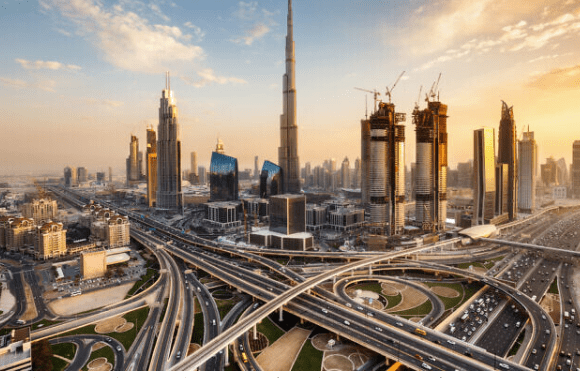
Skyline of Dubai at sunset

Last week history was made, when Israel opened an Embassy in Abu Dhabi, the capital of the United Arab Emirates (UAE), only four months after signing the Abraham Accords!

Israel’s foreign ministry stated that the new embassy will advance the range of relations between the countries in all areas including the private sector, academia, media and more.

Since the summer, many lucrative deals have been signed between Emirati and Israeli companies.  Last week trade between Israel and Dubai reached 1 billion AED and is expected to reach 15 AED (4 Billion USD) within the next 3-5 years, which according to Dubaian officials will create 15,000 jobs.  This figure does not include trade deals involving Israel and the other 6 Emirates, including Abu Dhabi,  for which official figures have yet to be published.

The primary Israeli exports have been fruits and vegetables, diamonds, medical devices, and electronics.  Dubai’s main exports to Israel are phones, perfumes, and engine parts.  Only last week, the UAE announced they will be investing 100 million dollars in Israel’s cutting-edge green technology, particularly in solar energy.

Amazingly, the UAE has also signed on to import wines, olive oil and honey from Jewish companies in Judah and Samaria (the West Bank).  They will be labelling the products as “Made in Israel”.

Nosson Shulman is a journalist and Licensed Tour Guide in Israel specializing in Biblical toursTo allow tourists to experience Israel during the Corona era, he created the new hit Israel tour video series which brings Israel to the home of viewers by simulating actual tours. To check out his free sneak preview tour videos, click here.

Part 3: Ancient Hebron

By Nosson Shulman: Licensed Tour Guide of VIP Israel Tours Authentic Virtual Tours (click here to check out his free trailer videos)

Some of the children of Judah (returning from the Babylonian exile) settled in the villages, in their open areas: in Kiryat Arbah (i.e. Hebron) and its suburbs (Nehemiah 11:25)”

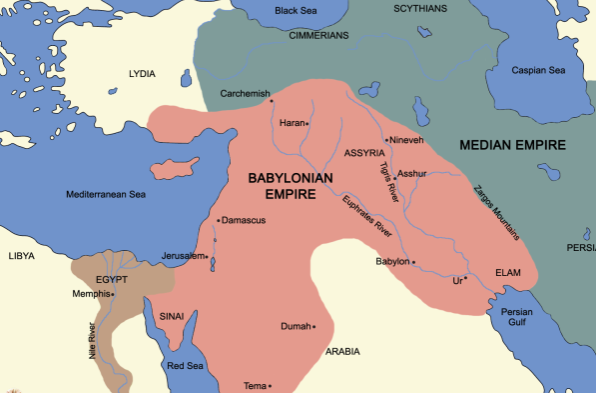
After the destruction of the first Temple in 422 BCE (some say 586 BCE) the Jewish people were exiled to Babylonia.  Never before, had a people been driven from their homeland yet observed their customs for more than a few years.  It would only be a matter of time until they assimilated and ceased being a distinct nation of their own.  But G-d had different plans!

The Babylonian Empire at its Zenith (in Pink)

Fifty years later the mighty Persian Empire conquered Babylonia and its territory, becoming the new rulers of Israel.  Miraculously, during this time the Jewish people had remained a distinct nation who had preserved their religion.  Their yearning to return one day to their homeland had never ceased.

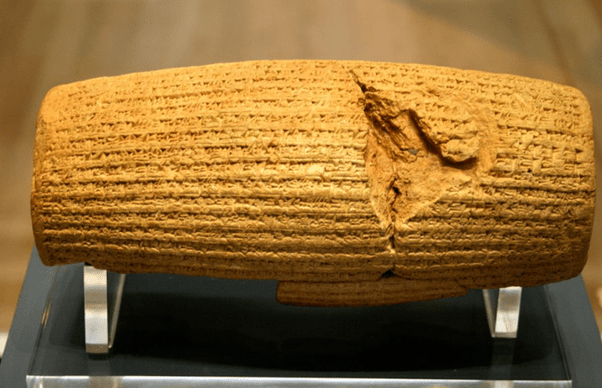
The new Persian King Cyrus issued a proclamation that the Jewish people had permission to return to Israel. He even gave them the right to rebuild their Temple.

The “Cyrus Cylinder”, found in excavations, was the written proclamation allowing Jews to return to Israel. Today, the original is in the British Museum.

Under Ezra and Nehemiah, 50,000 Jews returned to Israel with some moving to Hebron (Nehemiah 11:25). In their 50-year absence the Edomites had moved into the Hebron region, settling in the once Jewish land. Now the two peoples, who had waged war on and off for centuries, had to live side by side together

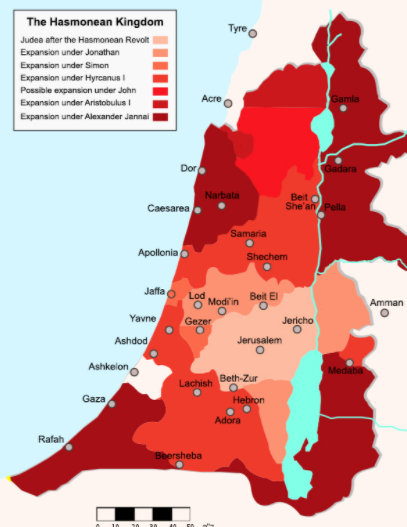
The Persian empire was eventually conquered by the Greeks.  As time passed, they began to oppress the Jewish inhabitants, including passing capital laws which restricted Jewish religious practices.  In 167 BCE a small group of Torah observant rebels (known as the Maccabees) revolted.  They eventually overthrew the Greeks and re-established an independent Jewish State.  Judah the Maccabee overtook Hebron, and his successors made it into a Jewish city.  Several generations later (circa 125 BCE) the Maccabees forcibly converted  the Idumeans to Judaism (although forced conversions are not valid in Judaism, by this time the Maccabean rulers were no longer fully Torah observant).

The Hasmonaean (Maccabee) Kingdom at its zenith included land in today’s Israel, Jordan, Syria, Egypt and Lebanon (circa 100 BCE)

One of those Idumeans who became “Jewish” was Antipater, the father of the infamous King Herod.

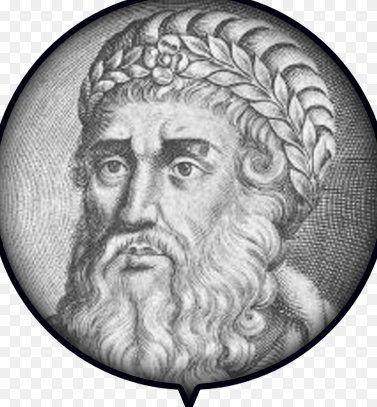
King Herod who built the Cave of the Patriarchs in Hebron

In 63 BCE, the Romans took over Israel. Antipater assisted the Romans with the conquest and as a reward for his help, they appointed his son Herod when he became of age, to be the puppet King of Israel (although Herod ruled the land, he did so only because the Romans let him. Ultimately the Romans had the final say in all decisions).

Herod built a massive structure over the cave of the Patriarchs in Hebron where Abraham, Isaac, Jacob, and their wives were buried. This structure still stands at its original heights in pristine shape (for more on the Cave of the Patriarchs, Click here).

The more than 2000- year- old structure built by Herod is the oldest building in the world still in continuous use

In Herod’s time, Hebron’s Jewish population was largely religious.

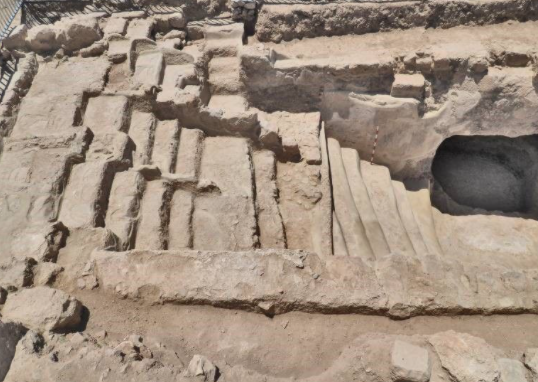
Mikvahs (Ritual Baths) from the Second Temple Era in Hebron, which testify to the level of religious observance of its population

Also, Jews from all over the world continued to come and pray at the Cave of the Patriarchs, the second holiest site in Judaism after the Temple in Jerusalem.

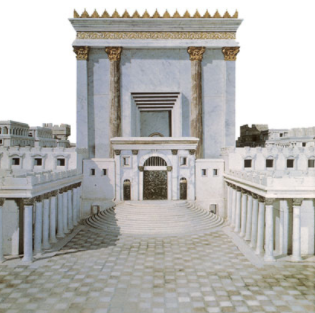
Model of the Second Temple which stood in Jerusalem until it’s destruction in 70 CE

As time progressed, the Roman rulers of the land began to oppress its Jewish population.  By 66 CE Roman rule had become so unbearable, that the entire country revolted and expelled the Roman army from its borders.  The Romans began sending legion after legion into Israel in order to re-conquer it.  By 73 BCE though they had suffered heavy losses, the Romans had entirely put down the rebellion and destroyed the Holy Temple.  Jerusalem was turned into inhabitable rubble.

The Roman Emperor Titus thought that the Jewish people would not be able to sustain their religion without their precious Temple.  This was because anytime the Romans had conquered lands, they first destroyed their local religious places of worship.  Subsequently, its inhabitants would take on the Roman religion because the Roman “gods” had “beaten” their “gods”.  Without a Temple, the Romans reasoned, the Jews would become Roman and cease being a distinct people.  But once again, G-d had different plans.

To be continued (for part 4, click here)

Did you know that you can now actually tour Hebron from the comfort of your own home as if you were actually there?  Check out my new, Hebron tour video, where we will explore this incredible city’s many historic alley ways and Biblical sites on a guided tour.  Check out the free sneak preview tour video from a Biblical worldview perspective: Trailer

Relive Hebron with Nosson Shulman on your very own private luxury Israel tour. To experience Israel from the comfort of your own home see our new Virtual Tours including our new released Hebron Tour.


By Nosson Shulman – Licensed Tour Guide and Trip Organizer in Israel who specializes in History, Tanach (Bible) and Adventure Tours. For more itineraries click here. Check out our new Virtual tours including Jerusalem: free sneak preview videos.

© 2020 All Rights Reserved – Unauthorized Duplication is prohibited

BIG NEWS: Israeli town becomes first city in the world to vaccinate all residents ages 60+!

Beit El, a Jewish town in Judea & Samaria (part of the West Bank), is frequently a target of the anti-Semitic Boycott Israel movement.

By Nosson Shulman: Licensed Tour Guide of VIP Israel Tours Authentic Virtual Tours (click here to check out his free trailer videos)

Ulpana neighborhood in Beit El

Beit El, a modern town with a rich biblical past, has become the world’s first city to successfully vaccinate its entire elderly population!  Founded in 1977 over the Greenline (West Bank) this charming town has grown to around 6500 people.

Beit El municipal council official Shai Alon said, “It is impossible not to get excited after the difficult year we all went through.  The expectation of returning to a normal and regular life has accompanied us for many months, and now we can see the beginning of the end of the corona nightmare.”
In other Beit El news, the government is set to approve this week the building of 800 new homes. While urban planning, construction and building permits elsewhere in the world are rarely newsworthy, as Beit El is in Judea & Samaria (West Bank) any time a new unit is approved, it makes significant world news.  Already France has condemned the announcement, calling on Israel to stop building more units in their Biblical Heartland.  They have suggested (without evidence) that settlements are an impediment to the peace process, though Israel’s recent Peace treaties with the UAE, Bahrain, the Sudan and Morocco, would suggest otherwise.  The European Union by law forbids products made in settlements like Beit El to be labeled as “Made in Israel” when sold in European stores, however, some member countries do not enforce it.
To learn more about Beit El’s rich biblical history, click here!

Nosson Shulman is a journalist and Licensed Tour Guide in Israel specializing in Biblical toursTo allow tourists to experience Israel during the Corona era, he created the new hit Israel tour video series which brings Israel to the home of viewers by simulating actual tours. To check out his free sneak preview tour videos, click here.