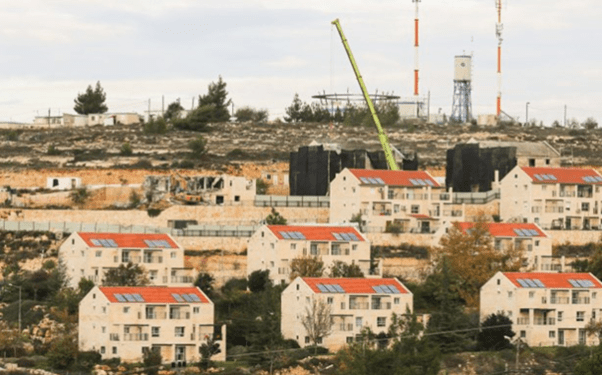
Beit El, a modern town with a rich biblical past, has become the world’s first city to successfully vaccinate its entire elderly population! Founded in 1977 over the Greenline (West Bank) this charming town has grown to around 6500 people.
Beit El municipal council official Shai Alon said, “It is impossible not to get excited after the difficult year we all went through. The expectation of returning to a normal and regular life has accompanied us for many months, and now we can see the beginning of the end of the corona nightmare.”
In other Beit El news, the government is set to approve this week the building of 800 new homes. While urban planning, construction and building permits elsewhere in the world are rarely newsworthy, as Beit El is in Judea & Samaria (West Bank) any time a new unit is approved, it makes significant world news. Already France has condemned the announcement, calling on Israel to stop building more units in their Biblical Heartland. They have suggested (without evidence) that settlements are an impediment to the peace process, though Israel’s recent Peace treaties with the UAE, Bahrain, the Sudan and Morocco, would suggest otherwise. The European Union by law forbids products made in settlements like Beit El to be labeled as “Made in Israel” when sold in European stores, however, some member countries do not enforce it.
To learn more about Beit El’s rich biblical history, click here!
Nosson Shulmanis a journalist and Licensed Tour Guide in Israel specializing in Biblical tours. To allow tourists to experience Israel during the Corona era, he created the new hit Israel tour video series which brings Israel to the home of viewers by simulating actual tours. To check out his free sneak preview tour videos, click here.
“All the elders of Israel came to the king at Hebron, and King David sealed a covenant with them in Hebron before Hashem (G-d), and they anointed David as King over Israel (2 Samuel 5:3)”
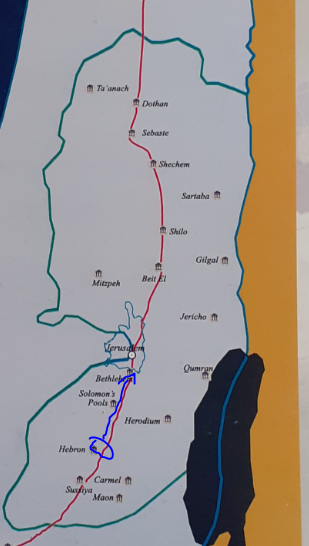
Unbeknownst to most, Hebron was the capital of Israel prior to Jerusalem becoming the eternal capital. During the first 7 years of his reign, King David ruled from Hebron. In his 7th year, King David planned a military operation that would change world history forever: the conquest of Jerusalem. He and his men headed north on today’s highway 60 and captured the holy city, making it Israel’s capital forever.
The exact route King David took to conquer Jerusalem. 3000 years later, this route (now paved) is still the main Hebron-Jerusalem route.
After the conquest of Jerusalem, Hebron is mentioned much less frequently in the Bible, although we know from Archeology that it continued to be an important administrative center. It was also one of the 6 cities of refugee (click here to read more about the Biblical Cities of Refugee).
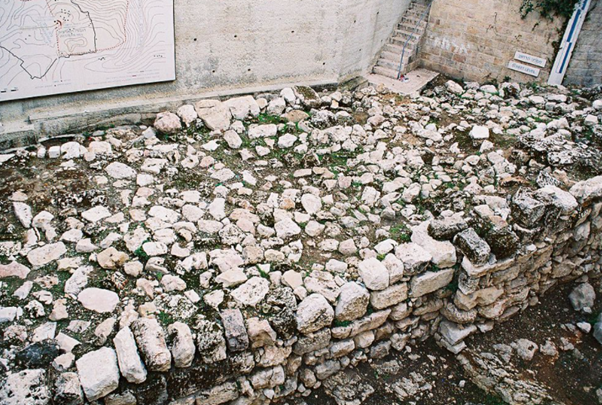
When the righteous King Hezekiah and his kingdom of Judah was threatened with annihilation by the Assyrians (see events from 2 Kings: 17-18) he mobilized all of his resources, including collecting the materials needed to build fortification walls.
The wall Hezekiah built in Jerusalem with the help of his subjects in Hebron. For more on this wall, click here
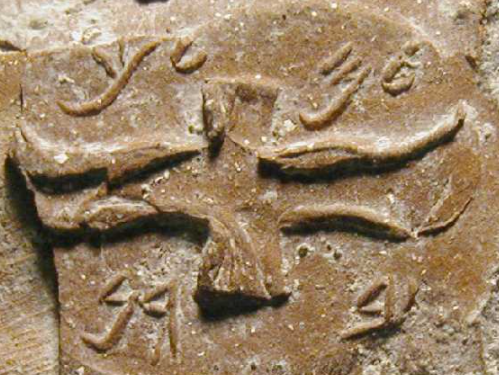
Based on archeological finds, it appears that King Hezekiah designated 4 cities as regional capitals, to collect materials in preparation for war with Assyria from the surrounding areas. One of these cities was Hebron.
Clay impression found on Jars in Hebron which state “For the King” which were used to collect materials needed for the upcoming war effort with Assyria.
Ultimately one of the greatest miracles in world history happened, and Assyria was defeated for the first time ever (if you want to explore where these events took place, click here to see my Jerusalem tour video).
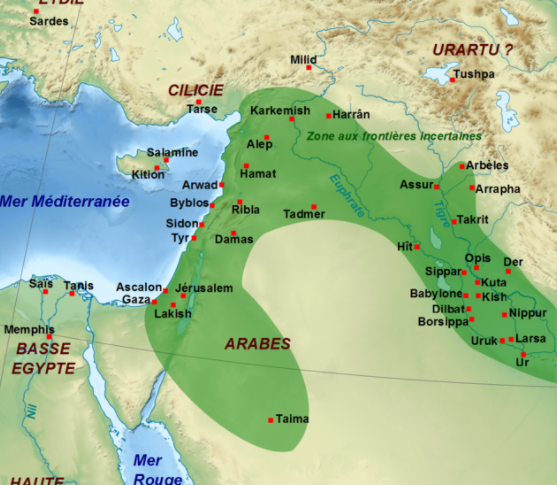
In 422 BCE (some historians say 586 BCE) the Kingdom of Judah, including the city of Hebron, was conquered by the Babylonians who exiled its inhabitants to modern day Iraq.
The Babylonian Empire at its Zenith included Israel.
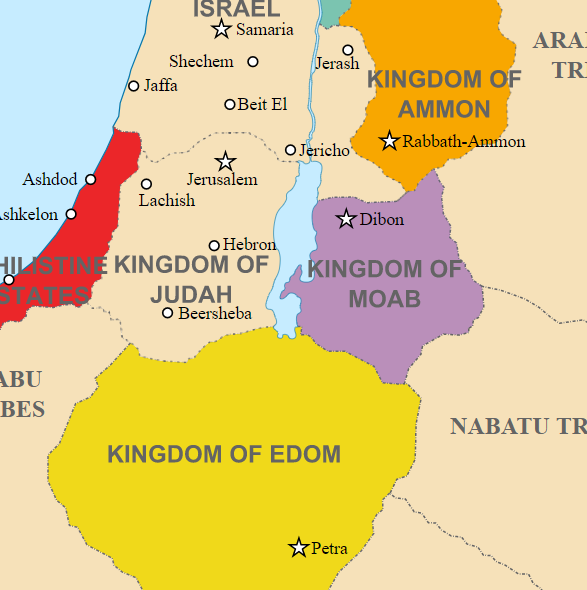
The void in Hebron was filled with Edomites, Biblical enemies of Israel, who moved into the abandoned Jewish homes.
Residents of Edom (from the territory in Yellow) moved into the abandoned homes of the Kingdom of Judah, including Hebron, after it’s inhabitants were exiled.
To contempary observers from that time, it seemed like the Jewish people and their connection to Israel would cease to exist. This is because never in history had a small people been expelled from their land, yet returned to reestablish their Kingdom, all the while keeping the same religion and customs of their forefathers. But G-d had other plans!
Did you know that you can now actually tour Hebron from the comfort of your own home as if you were actually there? Check out my new, Hebron tour video, where we will explore this incredible city’s many historic alley ways and Biblical sites on a guided tour. Check out the free sneak preview tour video from a Biblical worldview perspective: Trailer
By Nosson Shulman – Licensed Tour Guide and Trip Organizer in Israel who specializes in History, Tanach (Bible) and Adventure Tours. For more itinerariesclick here. Check out our new Virtual tours including Jerusalem: free sneak preview videos.
An emotional Benjamin Netanyahu greeting Jonathan Pollard on the tarmac upon his arrival
An unfortunate chapter which captivated the entire nation of Israel for over 35 years, is finally over. Jonathan Pollard, the only man in US history to ever get a life sentence for spying for an ally, landed this morning in Israel after 30 years of cruel incarceration. Seven of those years were spent in solitary confinement in a tiny cell, three stories below ground, followed by five more years of strict home confinement, with conditions more restrictive than most paroled inmates. This left him unable to care for his wife Esther who was battling cancer.
When Jonathan descended from the plane with Esther, he immediately got on his knees and kissed the ground of the land which he yearned for decades to return to. Prime Minister Netanyahu, who spent years working for his freedom, was there to greet him. Immediately he was handed his Israeli citizenship card and welcomed home!
This saga began in the 1980’s, when the Stanford University graduate became an intelligence analyst for the US Navy, receiving top secret clearance. While at his position, the US and Israel signed a memorandum of understanding (MOU), requiring the US to give all documents relevant to Israel’s security to the Jewish state. During his research, he found that Israel’s enemies were developing weapons of mass destruction which threatened to annihilate Israel (their stated goal was to attack civilian centers). As this was information that the US security establishment had committed to providing Israel, Pollard went to his superiors to get official permission to hand it over, a mere technicality he thought. He was surprised and shocked when his superior told him to “mind his own business” and “Jews get nervous talking about poison gas; they don’t need to know.” He now faced a dilemma; either break the law or watch the potential, unnecessary destruction of a true American ally. He chose the former.
He then contacted Israel, providing them with the lifesaving documents, allowing Israel to destroy the deadly weapons being developed by state and non-state actors like terrorists. Undoubtedly, American lives were saved as these terrorists would later target US troops and civilians. According to declassified US documents, not once did Pollard ever hand any information to Israel which put American troops in danger. The only information he ever gave was US intelligence on Israel’s enemies.
Eventually, Jonathan Pollard was caught. On November 21, 1985 (the FBI hot on his trail) he and his wife entered the US embassy in Washington, where he thought he would be safe and spirited secretly to Israel to start his new life. One of the guards even told him, “Don’t worry Mr. Pollard, we will take care of you”. The guard then made a call to Jerusalem to inquire about the next step. Then Prime Minister Shimon Peres was worried about fallout with the U.S., so he ordered Pollard to be thrown out of the embassy grounds into the waiting hands of the FBI, where he was arrested. He also denied that Pollard worked for Israel, calling him a “rogue agent” (in 1995, Israel would finally admit that he was in fact a bona fide Israeli agent).
Both the U.S. and Israel requested that he take a plea bargain, to avoid an embarrassing trial, by pleading guilty to one act of “Conspiracy to commit treason” with a 2 to 4 year sentence. Pollard agreed, but the day before sentencing, then Secretary of Defense Caspar Weinberger (a known ideological opponent of the state of Israel) sent the judge secret documents which the judge used to sentence a surprised Pollard to life imprisonment despite his pleading guilty (today this charge carries a maximum of 10 years in prison). His lawyers were not allowed to access the documents (it should be noted that Caspar Weinberger was later indicted on serious felony charges for betraying America by illegally selling missiles to the anti-American Iranian regime). If convicted, he would have had life in prison, but George H.W. Bush pardoned him one month before he left office).
Thus, Jonathan Pollard became the only man in U.S. history to receive a life sentence for spying for an ally. Over the years, those with the most intimate knowledge of the case and its implications to U.S. security (the Reagan administration officials who served at the time of his arrest) including Secretary of State Schultz, FBI director William Webster, U.S. Senate Intelligent chairman Dennis Deconcini, NSA Robert McFarlane and Deputy Defense Secretary Lawrence Korb, have all called his case a travesty of justice and called for his release. Other officials with access to the relevant classified intelligence, including former U.S. Attorney General Michael Mukasey, Vice President Dan Quayle, Director of the CIA James Woosley, Mayor Rudy Giuliani, Senator John McCain, Senator Chuck Schumer, and several other congressmen (both Democratic and Republican) also called for his release. Jewish and Christian religious leaders, including Governor Mike Huckabee, Pastor Pat Robertson, and Pastor John Hagee joined chorus. The fact that the Obama Administration in 2014 offered to release Jonathan Pollard in exchange for the release of several hundred Palestinians in Israeli prisons, most of whom were convicted of murder and terrorism charges (including some with multiple life sentences) lent credence to the idea that Jonathan Pollard’s release posed no threat to US national security, and that he had become a pawn in the larger Israeli-Arab Peace process.
In a country of less than 9 million people, yet still has a mind-boggling 12 elected parties represented in the Knesset (Israel’s parliament), there are few consensus issues. Yet the Pollard case united the far left, the right and even the Arab parties. In 2013, when it was leaked that the Obama administration had agents spying on Israel, 106 out of the 120 Knesset members signed a petition asking for Pollard’s Clemency. In fact, every Prime minister since 1995 has officially asked for his release.
It has been a long 35 years. Welcome Home Jonathan!
Nosson Shulmanis a journalist and Licensed Tour Guide in Israel specializing in Biblical tours. To allow tourists to experience Israel during the Corona era, he created the new hit Israel tour video series which brings Israel to the home of viewers by simulating actual tours. To check out his free sneak preview tour videos, click here.
“They… spied out the land…and arrived at Hebron where there (lived)…the offspring of the giant…They (the spies) returned after spying out the land (of Israel) at the end of 40 days…They…said…the people that dwells in the Land is powerful, the cities have massive and big walls (Numbers 13: 21-28)”
Ancient City of Hebron: The wall on the left is a remnant of the one mentioned in Numbers 13. Photo Credit: Shutterstock
My tourists often ask where my favorite place in Israel is to guide. As a licensed tour guide whose heart is tied to the entire land, it is difficult to pick a favorite because I love it all! However, if I really had to choose, there are two places that have the deepest meaning for me; Tzfat and Hebron, where we will be touring today (click here to see my sample tour video of Hebron). Although slightly more visited than some of the sites I have written about, most groups still do not come here. Those that do, usually only visit the Cave of the Patriarchs (click here to read more about that special site). Today, we will venture off the beaten track and visit Biblical Hebron, one of the world’s oldest and holiest cities!
Hebron is mentioned 87 times in the (Hebrew) Bible. When Abraham entered Israel, he settled in the plains of Mamre, which is in Hebron. He built an altar to G-d and spread Monotheism from this holy location (Genesis 13).
Plains of Mamre in Hebron where G-d made an eternal covenant with Abraham and his descendants (i.e. the Jewish people) At this location, Abraham gave hospitality to the three angels (Genesis 18)
In Hebron, the Jewish nation came into existence. At the age of 99, Abraham was commanded by G-d to circumcise himself. Because of this action, an eternal covenant was sealed between G-d, Abraham, and his descendants (where they became “Chosen”). G-d also promised him a son, Isaac.
The Patriarch Abraham making an eternal pact with G-d in Hebron
Three days later Abraham, still in pain from the procedure, had three angels appear to him. According to Jewish sources, G-d wanted Abraham to rest. He knew that Abraham felt a strong obligation to be kind to people, and he did not want Abraham to have to toil while he recovered. So, G-d caused the temperature that day to be extremely hot (see Genesis 18:1) so that people would not wander around and “bother“ Abraham. However, G-d noticed that Abraham not being able to show and do kindness for others caused him more pain than his physical ailments! So, G-d sent three “men” who unbeknownst to Abraham were actually angels.
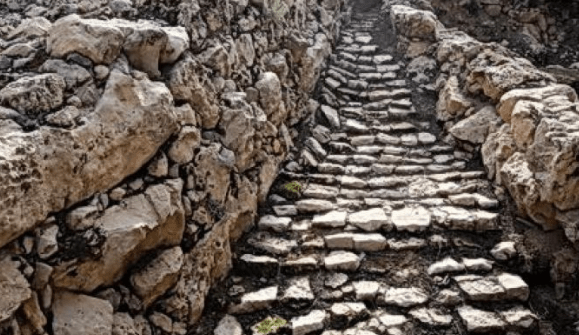
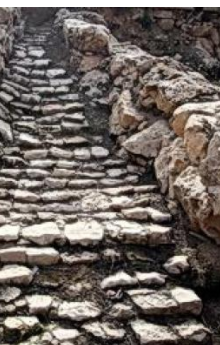
Stairs which Abraham likely used many times within his life
Abraham and Sara, Isaac and Rivka (Rebecca), and Jacob and Leah lived much of their lives in Hebron, and all of them are buried there at the Cave of Machpelah (for more, click here).
Cave of Machpelah where the Patriarchs and Matriarchs are buried.
After the Exodus from Egypt, the Children of Israel were supposed to enter Israel within a short period of time. When they were ready to enter, Moses sent 12 spies to check out the land and learn about the inhabitants they would have to defeat. They visited Hebron, where they witnessed imitating giants (remnants of the Nephilim) and the formidable city walls which protected them.
After 40 days, they returned to the Israelite camp. Ten of the spies convinced the people that the land was unconquerable, while 2 of them (Joshua and Caleb) had faith in G-d and said “The land is very, very good! If G-d desires us, He will bring us to this land and give it to us (Numbers 14:7-8)”. But the people panicked and wept heavily. As a punishment for their lack of faith (expected at their high spiritual level), the children of Israel were destined to spend 40 years in the desert, where that generation would eventually die off, and only their children (anyone 19 or under) could enter the land. According to Jewish sources, this decree did not apply to women or the tribe of Levi (including its men) who 40 years later entered the land (they had not taken part in the “rebellion”). As a reward for speaking in support of entering the land immediately, Joshua later became the one to lead the Jews into the Holy Land, while Caleb and his descendants received ownership of Hebron and its environs as an eternal heritage (Joshua 15:13).
House from the time of King Hezekiah and the Prophet Isaiah (around 2600 years old)
During the days of the Judges and Monarchy, Hebron continued to be an important Jewish city (both religiously and administratively). In fact, during the first 7 years of King David’s reign, this holy city was Israel’s de facto capital, until an important event occurred which would change the course of world history!
Did you know that you can now actually tour Hebron from the comfort of your own home as if you were actually there? Check out my new, Hebron tour video, where we will explore this incredible city’s many historic alley ways and Biblical sites on a guided tour. Check out the free sneak preview tour video from a Biblical worldview perspective: Trailer
By Nosson Shulman – Licensed Tour Guide and Trip Organizer in Israel who specializes in History, Tanach (Bible) and Adventure Tours. For more itinerariesclick here. Check out our new Virtual tours including Jerusalem: free sneak preview videos.
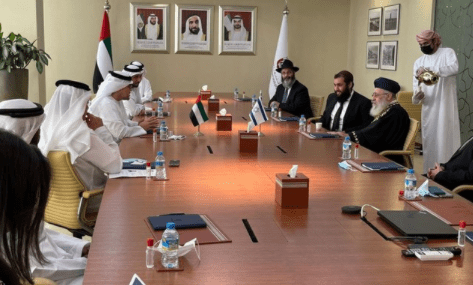
The Rabbi meets with the Royal family of Abu Dhabi
History was made late last week, when Rav Yitzhak Yosef became the first sitting Israel Chief Rabbi ever to visit an Arab state in an official capacity! He arrived Thursday for a three-day, whirlwind tour where he prayed with the Dubai and Abu Dhabi Jewish communities, inaugurated a new Jewish nursery school, met with senior members of the Royal family and government, and broke ground on a Mikveh (Jewish ritual bath).
This is a significant development in a country which historically has heavily regulated displays of any non-Islamic religious activity in public. Until very recently, there was no official Jewish community. A tiny underground community made up of Jewish businessmen did exist, though it kept a low profile for legal and safety reasons, meeting to pray in a non-descript room. Of course, wearing clothing identifying oneself as a Jew, like a kippah, was unthinkable.
Today, the Jewish communities of Dubai and Abu Dhabi, the two most prosperous of the 7 emirates (Kingdoms) which make up the United Arab Emirates (UAE), are openly flourishing; all with the encouragement of the Royal families. Indeed, the UAE is the only Muslim country in the world with a growing Jewish community. There are several functioning synagogues, an Orthodox Jewish day school and a couple of Kosher restaurants, including one recently opened in the Burj Khalifa, the world’s tallest building and main symbol of Dubai’s economic powers. Last week on Chanukah the previously unimaginable happened, when a public lighting ceremony was allowed to take place at the Burj. Rabbi Levi Duchman, Rav of the UAE, lit the candles on a giant, 12-foot menorah according to Jewish custom with hundreds of Muslim and Jewish onlookers attending the celebrations.
This peace deal, announced by President Trump in August, is Israel’s third with an Arab nation, the first two being Egypt in 1979 and Jordan in 1994. However, the first two agreements were peace between governments, not between peoples. In fact, Anti-Semitism still exists in these two countries and the majority of its citizens favor leaving the treaties. When visiting, it is recommended that Jewish and Israeli visitors conceal their identity. However, this new peace deal is the first one that is not limited to only being between their governments, but also a warm relationship between their citizens! Both Israelis and Emiratis are investing big money in one another’s countries, and it is believed that after the pandemic, trade will involve billions of dollars.
Chief Sephardi Rabbi Yitzhak Yosef thanked Sheikh Al Nahayan, Emir (King) of Abu Dhabi and President of the UAE, for his contribution to world peace and tolerance of his Jewish subjects. The Emir responded, “You have no need to thank us, as we are all family, and family members don’t need to thank one another.” The UAE Minister of Religious affairs also added, “We greatly admire the fact that you have come here to visit us, and we have great admiration for religious figures. Your visit here is an historic occasion, and we are delighted that we have merited to host you, and that we can now raise the status of Jewish life here in our country.” The Rabbi concluded with a blessing for the Royal family and their citizens.
This is what true Peace is supposed to look like! Hopefully, the UAE model of tolerance and goodwill towards Israel will serve as an example to Israel’s neighbors that they have a lot more to gain by making peace with the world’s only Jewish State.
Nosson Shulmanis a journalist and Licensed Tour Guide in Israel specializing in Biblical tours. To allow tourists to experience Israel during the Corona era, he created the new hit Israel tour video series which brings Israel to the home of viewers by simulating actual tours. To check out his free sneak preview tour videos, click here.
“He (Jacob) spent the night there…and lay down in that place. He dreamt… A ladder was set earthward and it’s top reached heavenword; and … angels of G-d were ascending and descending on it…G-d was standing over him, and He said “I am Hashem, G-d of Abraham, you forefather and G-d of Isaac. The ground upon which you are lying, to you I will give it and… your descendants… Jacob arose from his sleep and said “Surely G-d is present in this place…and he took the stone… and set it up as a pillar…and he named the place Bethel (Beit El) (Genesis 28:11-19)”.
Jacob dreaming about the ladder with angels ascending and descending the steps. In it, G-d promises the land of Israel to Jacob and his descendants forever. Photo taken from the Public Domain
Today, we will be exploring a real treasure! Although one of the most climatic and consequential events in the Bible took place here, few tourists ever visit. You shall soon see, however, why this site is not to be missed!
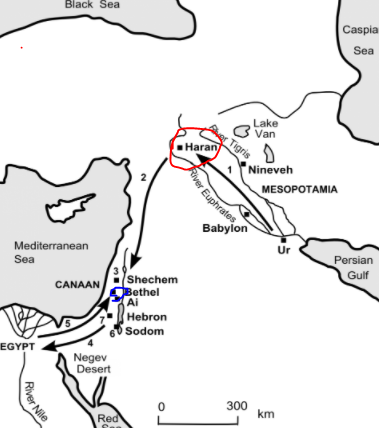
Beit El is initially mentioned when Abraham and his household first entered the land of Israel. G-d had told him to leave his homeland and go to the land “Which I will show you (Genesis 12:1)”. After arriving in Israel from Haran (part of modern day Turkey) he journeyed southwards, eventually arriving in Beit El where he pitched his tent temporarily and set up an altar to Hashem (G-d) and invoked Hashem by name (Genesis 12-8).
Haran (in red circle) where G-d told Abraham to leave his hometown. Beit El (in blue circle) where he built the altar. Photo Credit: Credit: https://www.thebiblejourney.org/
Eventually Abraham traveled further south, ultimately settling in Beer Sheva (often spelled Beersheba). Two generations later, Abraham’s grandson Jacob fled Beersheba (click here to see article) to get away from his murderous brother Esau, returning to Haran to find a wife (Rebecca did not want her son to marry a local Canaanite, so his father Isaac instructed him to return to Haran to get married). On the way, the sun set when Jacob had arrived to Beit El, so he spent the night there out in the open.
Jacob will flee from Beer Sheva (in green circle) taking the road (red line) to Beit El (in Blue Circle)
Why does the Bible make a specific mention of the sun setting (Genesis 28:10)? According to Jewish sources, Jacob was praying there to G-d when he heard Angels having a discussion. Jacob then realized that he was standing in a very holy site connected with heaven. However, with a long journey ahead of him and several hours ahead in the day, he was about to leave when G-d caused the sun to set early, so Jacob would spend the night there and G-d would reveal Himself in a dream (the spot was especially conducive to higher levels of prophesies).
Jacob then took stones from the site, placing them around himself to protect him from wild animals. According to Jewish sources, it was exactly 12 stones, representing the 12 sons he would have who would make up the tribes of Israel. While he slept, the stones combined into one big stone (the one he was using as a pillow) which signified that all 12 of his sons would be righteous and follow in his ways.
According to tradition, this is where Jacob had his dream where G-d promises Israel as an eternal inheritance to the children of Israel.
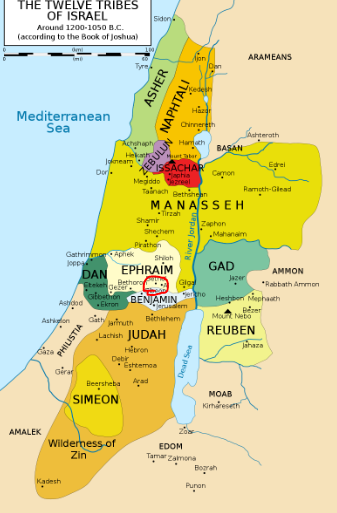
Later, a Canaanite city state emerged at Beit El with its own King. Joshua and his army defeated them upon entering Israel, and the land fell within the territory of Ephraim.
Beit El (in red circle) was in the territory given to the Tribe of Ephraim. Photo Credit: Richardprins – CC BY-SA 3.0
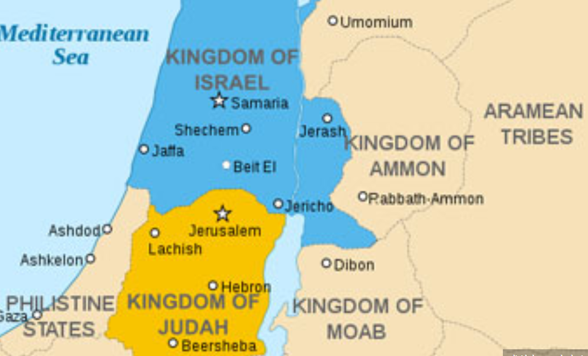
Hundreds of years later, after King Solomon died, the Kingdom split in two and Beit El found itself in the Northern Kingdom of Israel.
After King Solomon, the united Monarchy split into two kingdoms: Judah in the South and Israel in the North. Photo Credit: Oldtidens_Israel_&_Judea.svg: – CC BY-SA 3.0
The Kingdom of Israel was to be ruled by the (initially) righteous Jeroboam with his capital in Samaria, while the southern Kingdom continued to be ruled by Solomon’s son Rehoboam with Jerusalem as its capital.
Unfortunately power quickly got to Jeroboam’s head, and he made some fateful decisions. When the Temple stands, all Jews are obliged to travel to Jerusalem at least three times a year: Passover, Shavuot, and Sukkot. Jeroboam was worried that when his subjects (all of whom were Jewish) would go to Jerusalem, their hearts would turn towards the ruler of Judah, and they would begin to see him as only a secondary king and eventually overthrow him. He therefore decided to set up new places of worships, complete with Golden calves, in Beit El and Dan ( 1 Kings 12:28-29). He even made up his own holidays and declared himself a priest, burning incense to the calves in Beit El. Ultimately, these misguided fears brought the Kingdom of Israel to spiritual ruin. This, according to Jewish sources, is the reason the northern Kingdom was exiled 133 years earlier than the more righteous southern kingdom of Judah. Ultimately, his descendants continued in his wicked ways and were eradicated from the face of the earth (1 Kings 13:33-34) with Jeroboam having no portion in the World to Come.
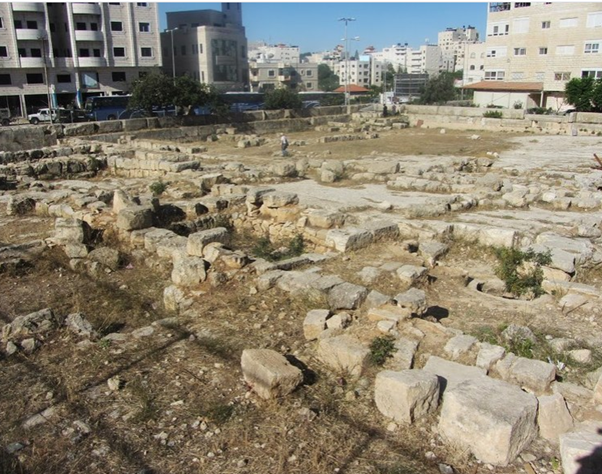
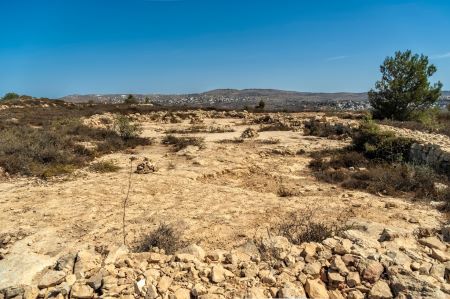
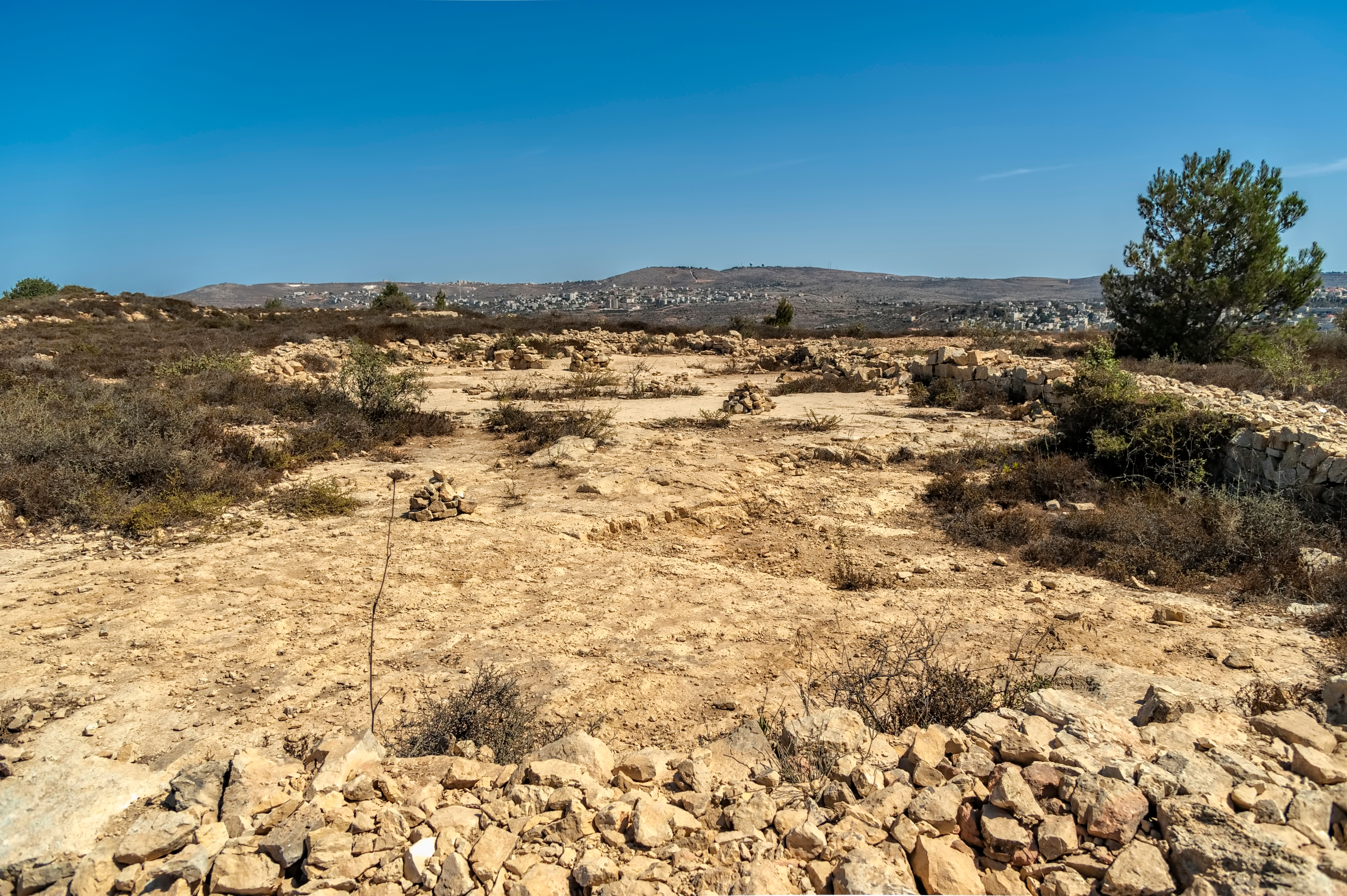
Believed to be the exact location in Beit El where Jeroboam set up his golden calve. Photo Credit butterflycreationfoto / Shutterstock
A few hundred years later, the righteous King Josiah of Judah destroyed this “High place” of Beit-El (2 Kings 23:15). Soon after, Babylonia conquered Israel and destroyed Beit El.
The Persians who conquered the Babylonian empire 70 years later rebuilt Beit El, and when the Greek forces of Alexander the Great conquered the land from them in 332 BCE, the city continued to grow. In the second century BCE when the Hellenists (Greek) forces fought the famous Jewish rebels known as the Maccabees, they fortified the city, though ultimately the Maccabees were successful and expelled the Greeks from Israel, thus re-establishing Jewish sovereignty for the next 80 years in all of Israel (The Jewish holiday of Chanukah is connected to these events).
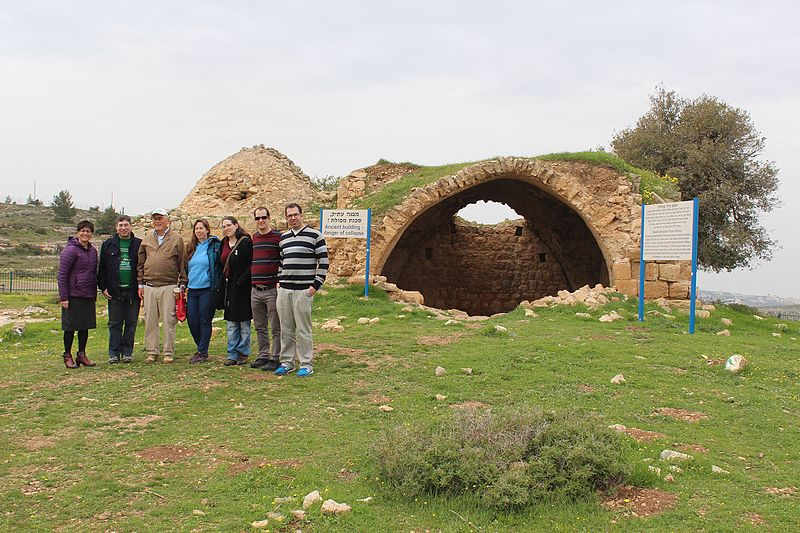
In the 1100s, the Crusaders built a chapel on this site. When the Muslims expelled the Crusaders, they built a mosque here as well.
Entrance to the Crusader Chapel. The (closed) domed structure on the left is the Mosque which was later built by the conquering Muslims. Photo Credit Elef Millim project – CC BY-SA 4.0
Between 1948-67 Jordan controlled this land, and when Israel liberated Judea and Samaria (West Bank) they re-established a Jewish settlement here. Today, the population is about 6200, with many new houses being built.
The Ulpana Neighbourhood of Beit El. Photo Credit: יעקב – CC BY-SA 3.0
Today, Beit El has much to offer to tourists of all ages! On your next trip, let us plan on visiting this treasure together!
By Nosson Shulman – Licensed Tour Guide and Trip Organizer in Israel who specializes in History, Tanach (Bible) and Adventure Tours. For more itinerariesclick here. Check out our new Virtual tours including free sneak preview videos.
Left to right: Prime Minister Netanyahu of Israel, President Trump and King Mohammad the 6th of Morocco
Today President Trump made a historic announcement: Morocco, a major Muslim country in North Africa, will establish full diplomatic relations with Israel. This follows in the footsteps of the United Arabs Emirates, Sudan, and Bahrain, three Muslim countries who themselves have recently established ties with the Jewish state after decades of bitter hostility.
Morocco has a rich Jewish past, which predates the advent of Islam by centuries. Jews historically have played a major role in developing the country. In modern times, the relationship between the Monarchy and their Jewish subjects have been great. Famously, during the Vichy France’s occupation of Morocco during World War 2, the King refused to deport his 250,000 Jewish subjects, protecting them at personal risk. However in 1948 with Israel’s establishment, anti-Jewish furor ran rampant and Jews were attacked randomly on the streets, leading to many casualties. The King, who had lost control of his country and would soon be exiled for several years, was unable to stop the rabble, causing most Jews to leave.
Today, there are believed to be less than 3000 Jews living in the country. The current King, Mohammad the 6th (grandson of Mohammad the 5th) protects his Jewish subjects whole heartedly, issuing strict punishment to those who would harm them. Though few in number, the community lives in relative security and prosperity and have close relations with the royal family, including several members of the community who are among his closest advisors.
The US, who brokered the deal, has a long and storied history with Morocco. In 1777, the Arab kingdom became one of the first countries in the world to recognize America’s sovereignty after the US declared independence from Britain only one year earlier. With the deal, the US will also recognize Morocco’s claim to Western Sahara, a disputed territory which many nations recognize as legitimately belonging to Morocco.
Nosson Shulmanis a journalist and Licensed Tour Guide in Israel specializing in Biblical tours. To allow tourists to experience Israel during the Corona era, he created the new hit Israel tour video series which brings Israel to the home of viewers by simulating actual tours. To check out his free sneak preview tour videos, click here.
The armored vehicle Mohsen Fakhrizadeh was riding in when he and his bodyguards were killed
On Friday afternoon, November 27th, Mohsen Fakhrizadeh, the father of Iran’s nuclear program, hopped into his heavily armored vehicle. Arguably possessing the most valuable brain in the country, he was provided with armed body guards at all times. Newspapers were forbidden from publishing any personal information about his life, and pictures of him were censored online. Always careful to change the route he took to get home, he was always trailed by a vehicle filled with another set of armed body guards assigned to protect him. Why was such precaution taken? Because by all accounts, not only was he in charge of the nuclear program, he actually was the program. If Iran was indeed less than a year away from having the bomb, as some high-ranking intelligent officials have claimed, it was because of him. Therefore,his elimination was a high priority for many countries. After the “surprise” assassination 11 months ago of Iran’s then most well guarded man, General Qasem Soleimani, the arch-terrorist and head of Iran’s Revolutionary Guard, the country was taking no chances this time around.
While driving down a local street outside of Tehran, he didn’t suspect anything was amiss when his vehicle passed a parked Nissan truck. Suddenly, the truck exploded, injuring the scientist and his bodyguards. Then out of nowhere in broad daylight, a team of heavily armed agents appeared, approaching the vehicle and showering the scientist and his body guards with bullets. Iran’s most important asset was now dead. The agents calmly left the scene and seemingly vanished into thin air, leaving no clues or evidence of who they were. While many in Iran’s security apparatus are pointing the finger at the Mossad, due to the sophistication of the operation as well as past attacks by them on Iran’s nuclear infrastructure, no hard evidence exists to confirm this. Other countries like the US, UK, and the Sunni Gulf nations were also interested in his elimination and could have also played a role.
Regardless of whom, Iran’s political and security elite are frightened that they may be next. Mohsen Fakhrizadeh’s location was a closely guarded secret that even Iran’s higher echelon (except for a select few) were not privy to. Yet, the assassins knew exactly where he would be, just like had happened with General Soleimani, and were able to kill him cleanly without sustaining casualties, creating a new level of deterrence.
Mohsen Fakhrizadel’s death is a major blow to Iran’s nuclear program. He kept most of the program’s top secrets close to his heart. Rather than sharing these secrets with his team, he instead will be taking them to his grave. Still, Iran continues to harbor nuclear ambitions. Whoever killed him will likely continue to use all the tools at their disposal to make sure Iran never acquires the weapon.
Nosson Shulmanis a journalist and Licensed Tour Guide in Israel specializing in Biblical tours. To allow tourists to experience Israel during the Corona era, he created the new hit Israel tour video series which brings Israel to the home of viewers by simulating actual tours. To check out his free sneak preview tour videos, click here.
“It happened the next day, when the Philistines came to plunder….they found Saul and his three sons, fallen on Mt Gilboa. They severed his head….and they hung his remains upon the wall of Beth-Shan (Beit Shean). The (Jewish) inhabitants of Jabesh-Gilead heard…what the Philistines had done to Saul and all the daring men arose and went through the night, and took the remains of Saul and…of his sons from the wall of Beit Shean…and buried them (1 Samuel 31: 8-13).”
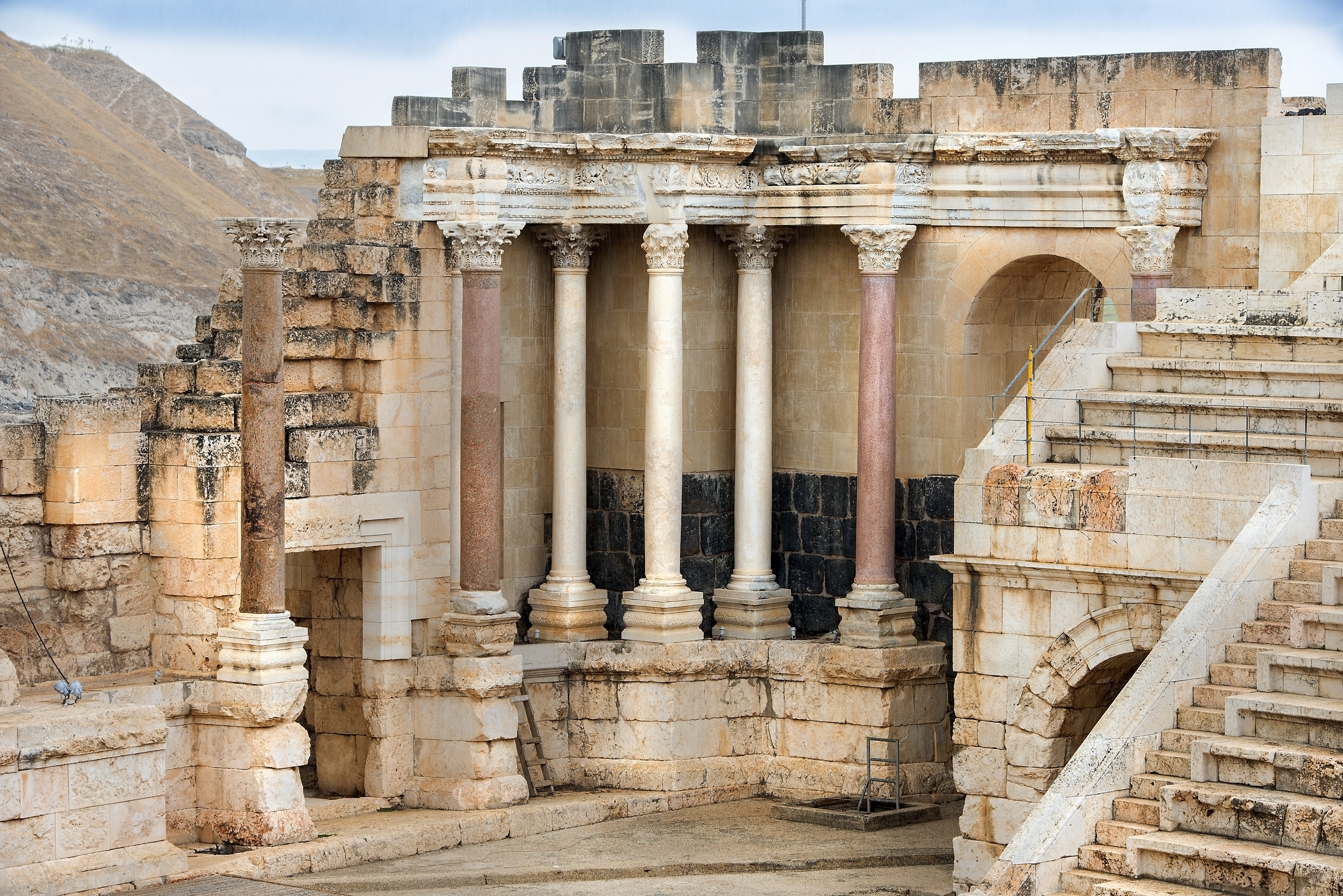
The Roman theater of Beit Shean. In its heyday, it could fit an audience of 7,000. Photo Credit: Shutterstock
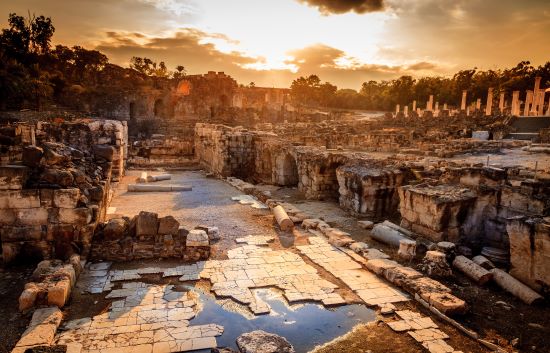
Beit Shean, one of the best-preserved Roman cities in the world, is fairly well visited by tourists who come here to see its impressive ruins. However, visitors often skip the older Biblical Beit Shean, located on top of the hill. That means one thing: they are missing the best part!
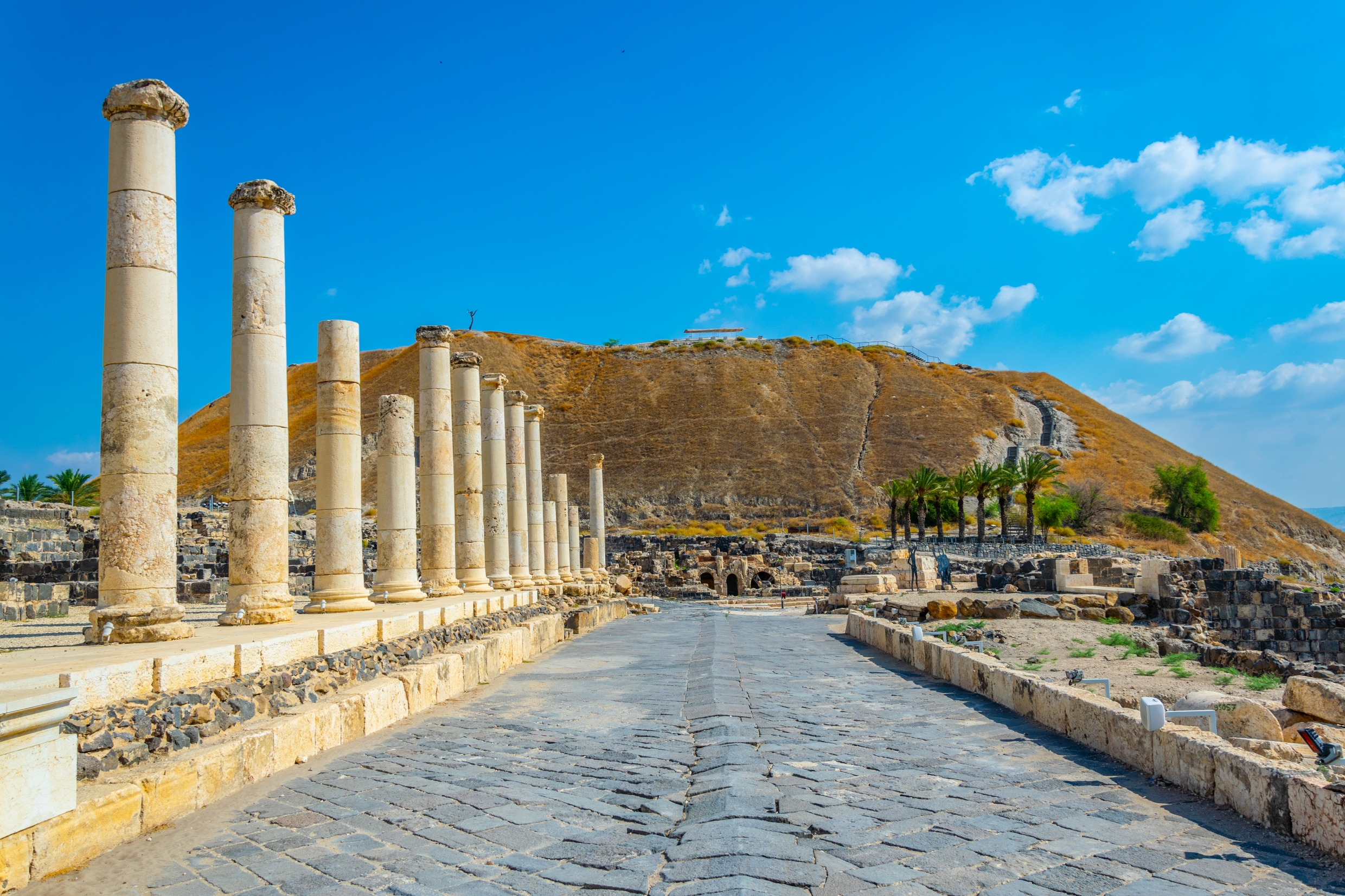
This impressive Roman Avenue leads to the Biblical mound (in the background). Few ascend this Biblical treasure. Photo Credit: Shutterstock
Today we will bypass the relatively new, 1600-year-old Roman ruins and climb up 180 steep steps to visit the older part of the city. Here we see incredible ruins, some of which are more than 3000 years old!
View of Roman Beit Shean as seen from atop the Tel. Photo Credit: Shutterstock
Starting as a local Canaanite city state, the town will be conquered by Pharaoh Thutmose 3rd during his legendary conquest of Israel circa 1550 BCE (approximately the time when the Biblical Hebrews started to become enslaved in Egypt). He will make Beit Shean the capital of Northern Israel and bring an Egyptian Governor to administer this part of the Pharaoh’s Kingdom.
Remains of the Mansion of the Egyptian Governor. Photo Credit: Shutterstock
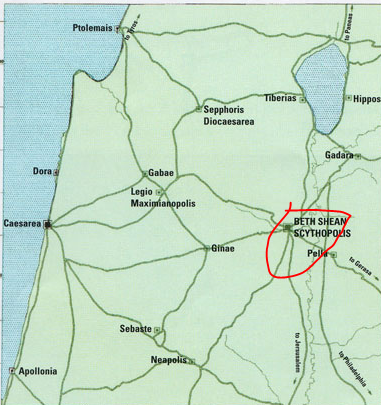
Why, of all places, was this city chosen to be the regional capital? This was because the most important international routes of the ancient world went through here. To get from Egypt to Mesopotamia (the two largest superpowers of the time), the main road crossed through Beit Shean. If one wanted to get from the Mediterranean Sea to the Gilead Mountains in present day Jordan, the easiest route went through Beit Shean. In the ancient world, controlling the routes meant controlling the land. In fact, the city became extremely wealthy from collecting poll taxes from travelers.
Ancient map showing how the main ancient routes went through Beit Shean (circled in Red)
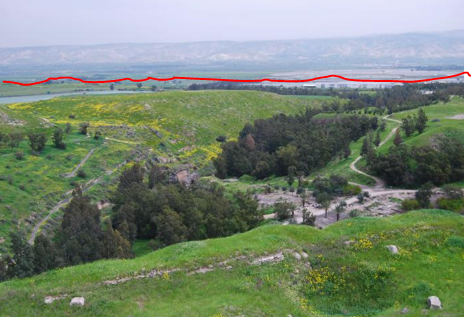
After climbing to the top of the hill, we are immediately treated to a beautiful panoramic view which includes Biblical Mountains of Israel and present-day Jordan (the border between these countries is only about 3 km east from us).
Everything found beyond the red line is today in the country of Jordan. The mountain range seen in the back are the Biblical Gilad mountains (mentioned in Genesis 31 & 37, Numbers 32, Judges 11 and other places)
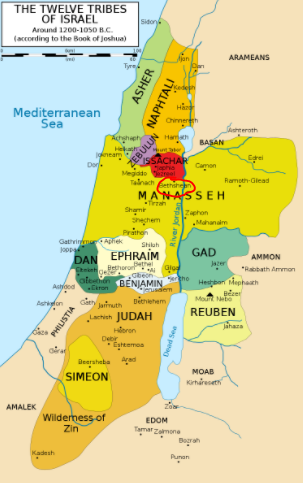
During the Exodus from Egypt (circa 1150 BCE) Pharaoh’s army drowned, causing them to lose Israel overnight. The vacuum allowed the various Canaanite city states to regain their independence temporarily. After 40 years in the desert, the Children of Israel (led by Joshua) entered the promised land, and on G-d’s command they fought the city states. This land was given to the tribe of Manasseh, but they were unable at that time to drive out the inhabitants of this city (Joshua 17:11-12).
The 12 tribes of Israel. Beit Shean (in red circle) was in Manasseh’s territory. Photo Credit: 12 tribus de Israel.svg CC BY-SA 3.0
In King Saul’s time, the Philistines attacked his army at nearby Mount Gilboa, killing Saul and three of his sons including Jonathan (King David’s best friend) and hung his remains on the walls of Beit Shean. In a daring operation, King Saul’s remains were rescued and re-buried according to Jewish custom (1 Samuel 31). When King David became King, immediately upon the death of Saul, he finally conquered Beit Shean, and his son Solomon built up the city as a major administrative center (1 Kings 4:12).
Circa 732 BCE, Assyria will conquer Beit Shean and destroy it.
In the Hellenistic (Greek) times and Roman times, the bulk of the city was rebuilt on the bottom of the hill, becoming an important city in the Roman Empire. The top of the Tel itself lost its importance.
Beit Shean’s Amphitheater where Gladiator fights took place 1600 years ago. Photo Credit Shutterstock
The Roman City was destroyed by a devasting Earthquake in 749 CE, and until modern times, not much was here.
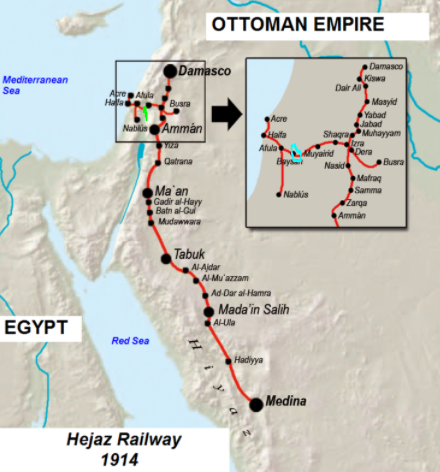
In the early 1900’s, the Ottoman Turkish Empire who controlled most of the Middle East, including Israel, built a railway going from Constantinople (today’s Istanbul) to Mecca in Saudi Arabia (which went through Damascus). From Syria, a new connecting route was built on the line which went to Haifa on the Mediterranean Sea. One of the stops was Beit Shean, and a newer city developed around the train station.
The Hejaz railroads (see the green and turquois markings which show Beit Shean’s location). Photo Credit: en:User:Attilios, User:Degeefe – GNU Free Documentation License,
Upon the establishment of the State of Israel, the route connecting Syria to Israel was discontinued. The train continued to operate within Israel until the 1950’s, until the high costs and low usage didn’t justify continuing the route. As a result, Beit Shean was relatively isolated from the main economic centers of the country, and while the housing was cheap, unemployment was high.
In 2017, the old route from Beit Shean to Haifa was re-established as a high speed route. Now people living in this economically depressed city could easily commute to the major centers, making this city (with low costs of living, great climate all year round and low crime rate) desirable once again. Currently, the city is undergoing a major construction boom.
This has been a mere sampling of what this amazing site has to offer! On your next trip to Israel, let us explore here together! For a sample itinerary which includes Beit Shean and it’s surrounding area, click here.
Nosson Shulmanis a journalist and Licensed Tour Guide in Israel specializing in Biblical tours. To allow tourists to experience Israel during the Corona era, he created the new hit Israel tour video series which brings Israel to the home of viewers by simulating actual tours. To check out his free sneak preview tour videos, click here.To view sample tour itineraries or to inquire about private tour opportunities with a personalized itinerary on your next trip to Israel, click here.
“They journeyed from Beit El… to Ephrath, when Rachel went into labor and had difficulty in her childbirth. And it came to pass…she died…and was buried on the road to Ephrath, which is (another name for) Bethlehem. Jacob set up a monument over her grave; it is the monument of Rachel’s grave until today (Genesis 34: 16-20)”
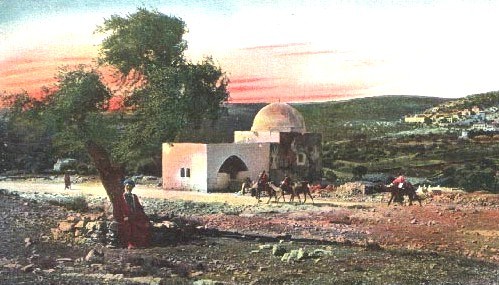
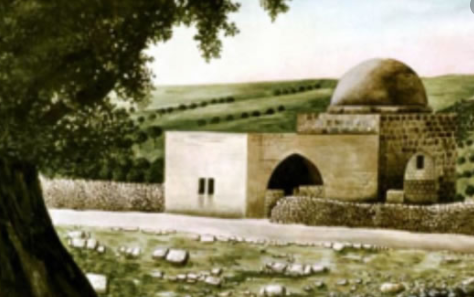
Nostalgic picture of Rachel’s Tomb emblazoned in the Jewish heart
The Tomb of Rachel is an important holy site for Jews. This site is popular with Orthodox Jewish tourists who come to pray, but is seldom on the itineraries of Christian groups or non-religious Jewish groups coming to the Holy land. In my opinion, this site should be on almost everyone’s itineraries. Regardless of one’s background, the prayers said here have extra meaning for everyone!
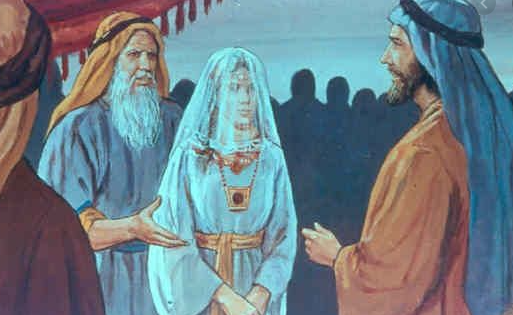
Rachel was Jacob’s favorite wife. In fact, the Bible singles her out by saying how he loved her (Genesis 29:20). Wanting to marry her, he asked her father Laban (a notorious swindler) for Rachel’s hand in marriage. Laban told Jacob that he would have to work for him for seven years, and only then would he grant permission for the marriage. After the seven years, they began planning the wedding, but Jacob had an inkling that Laban would alter the deal in some way. He knew that his future father-in-law wanted him to marry Leah. Due to his suspicions, he gave Rachel 3 secret passwords to confirm that when they were under the chuppah it was indeed her (a chuppah is a canopy, Jewish marriages are still performed this way). His fears were confirmed because during the wedding, Laban made the hall dark and brought out Leah in a veil which covered her face (even today Jewish women get married with a veil, so this alone wouldn’t have aroused suspicion). Rachel really wanted to marry Jacob but faced with her older sister about to be utterly humiliated in front of the whole town, she selflessly gave her sister the passwords. At night, she hid under the bed, speaking with Jacob so that he would hear her voice and think it was her. This was Rachel’s greatness, sacrificing her greatest desire so as not to humiliate someone, at extreme personal cost. We will soon see how this act makes the prayers at this holy site extra special!
Jacob unknowingly married Rachel sister’s Leah. Notice Leah wearing the customary veil under the canopy
When morning came, Jacob saw how he had been deceived and confronted Laban. Laban said brazenly “Such is not done in our place, to give the younger before the elder (Genesis 29:26).” But he would gladly grant him Rachel’s hand in marriage, in one more week, in exchange for another seven years of service (although the Torah forbids a man to marry sisters, this happened before the Torah was given to the Children of Israel at Mt Sinai and therefore this law was not yet binding). After fulfilling his commitments to Laban, Jacob took his 11 kids and wives (Rachel was then pregnant) and returned to Israel. After staying some time in Shechem (today’s Nablus) they went southwards (along today’s highway 60). After they passed Jerusalem and were almost in Bethlehem, Rachel went into labor. Although her son Benjamin was born healthy, she died giving birth and he buried her along the side of the road.
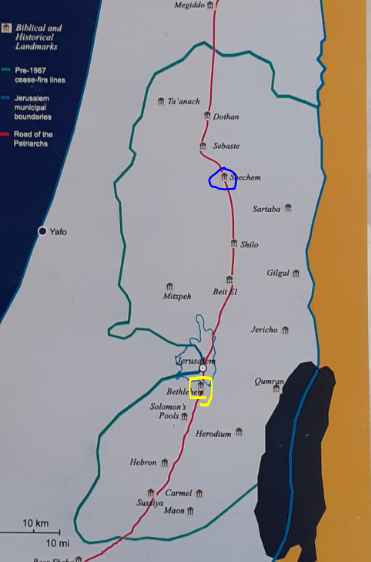
Coming from Shechem (blue circle) they took the Road (Red line) to Bethlehem (Yellow circle).
It might seem odd that Jacob would bury the person he most loved where she happened to die. Why couldn’t she have a proper burial spot like Jacob and Leah would later have in Hebron (click here to see Jacob and Leah’s burial spot). When Jacob was on his death bed (Genesis 48), he brought up the topic to Joseph (Rachel was his mother). According to Jewish sources, he explained that her burial was not random at all, but divinely ordained from above! He prophesized that in the future, his descendants would be exiled by Nebuchadnezzar, King of Babylonia and on route, they would pray here that they would survive exile and eventually return. Rachel’s soul then pleaded with G-d with heavy tears and Hashem accepted them, saying “Restrain your voice from weeping and your eyes from tears: for there is reward in your accomplishment….and they will return (one day) from the enemies land. There is hope for your future…and your children will return to their border (Jeremiah 31: 15-16)”. Because of this, G-d promised that the Jewish people would return to their land (which it what we see happening right now)!
Another question arises: why did the prayers have to be at her tomb as opposed to another righteous person’s grave? According to Jewish sources, G-d was upset with Idol worship and told Jeremiah (the prophet) to pray for His children’s mercy. He went to the grave of Abraham who interjected, but G-d rejected his prayers. The same results happened with Isaac, Jacob and even Moses, who the Bible calls the greatest prophet of all time. But when Jeremiah went to Rachel’s Grave, Rachel said “Master of the Universe, It is well known to you that your servant Jacob loved me and worked 7 years on my behalf…When my father decided to give him my sister instead of me… I found myself in a very difficult situation…I had pity on my sister…and revealed the secret (passwords) so she wouldn’t be put to public shame….I am only human, nonetheless I brought a rival into my house but You are the Eternal Living G-d, why should you be jealous of meaningless idols (i.e. rivals).” Because of what Rachel had done, she was the only one in a position to make that request from G-d, and that is why she needed to be buried at that location by the side of the road.
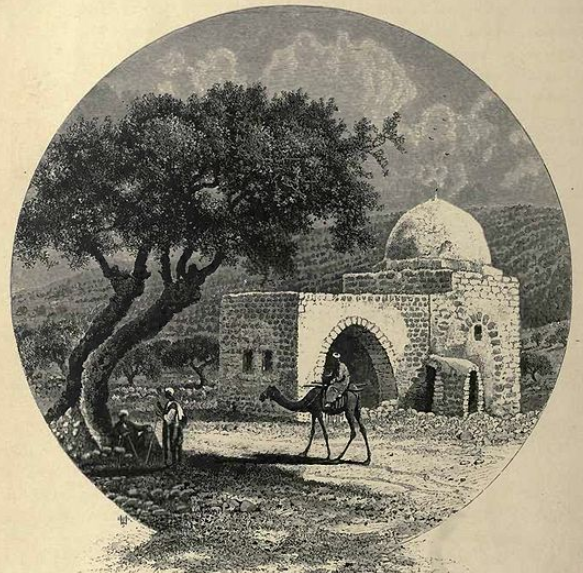
For many years, the tomb looked like this:
The Domed Room is Ancient. The side room with the big arch was later added in 1841 by Sir Moses Montefiore, the first Jewish knight in modern times and one of the wealthiest philanthropists who ever lived
Because Jewish worshippers here (even women and children) were being attacked in the 1980s, 90s and early 2000s by Palestinian terrorists, in 2005 a large concrete wall was built to surround it to protect worships from snipers (today it is very safe to visit and welcomes thousands of people every day). This serves to not only make the site secure, but also gives tourists a fuller understanding of many of the unique challenges Israel has had to contend with.
Today the site flourishes, with a full time Kollel (Talmudic Academy for Torah studies), a synagogue and even a hospitality corner with hot drinks and snacks!
Today, the Tomb of Rachel is a flourishing house of prayer. Photo credit: Kever Rachel Heritage foundation
Upon reading this, it is my hope that your prayers will emanate from this holy site on your next trip to Israel!
To see a sample (day trip) tour itinerary of the area, click here.
Nosson Shulmanis a journalist and Licensed Tour Guide in Israel specializing in Biblical tours. To allow tourists to experience Israel during the Corona era, he created the new hit Israel tour video series which brings Israel to the home of viewers by simulating actual tours. To check out his free sneak preview tour videos, click here.To view sample tour itineraries or to inquire about private tour opportunities with a personalized itinerary on your next trip to Israel, click here.



















 Unique Sites of Israel Blog
