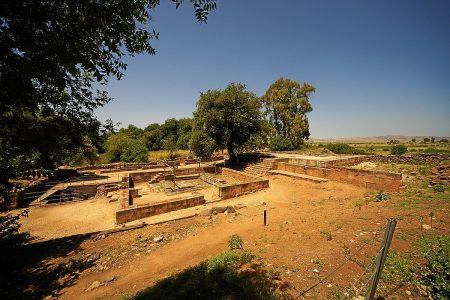
“The king took counsel and made two golden calves, and he said to them, saying, “It is far for you to go up to Jerusalem; here are your gods, O Israel, that have brought you up from the land of Egypt. And he placed one in Beth El and the other he placed in Dan. And this thing became a sin, and the people went before the one even until Dan.” (1 Kings 12-30)”
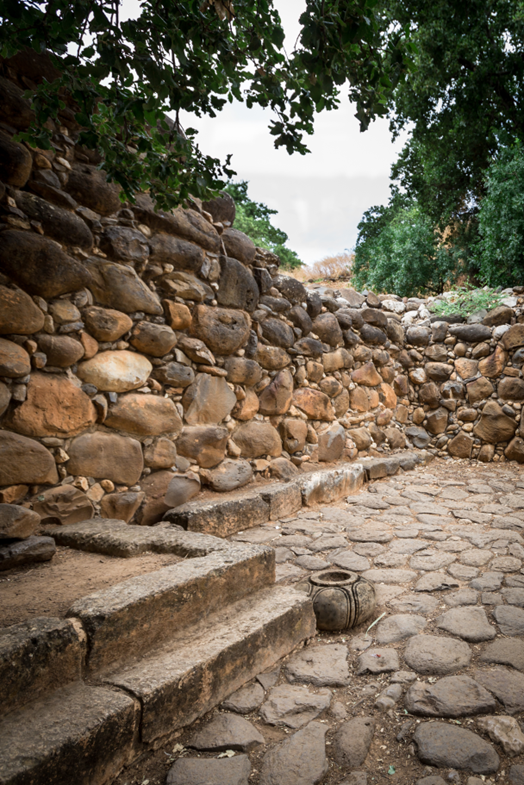
The site where King Jeroboam of Israel erected an altar in Tel Dan. Take note of the stairs leading to the “high place” mentioned in the Bible that was a temple dedicated to a Golden Calf. Photo Credit: Shutterstock
We saw last week how the tribe of Dan conquered the biblical city of Laish and quickly renamed it after their forebearer. They swiftly erected a graven image-focused Temple with a priest from the Levite tribe as its guardian. This quickly turned the city into a major center of idol worship, although by the time of the Judean Monarchy of David and Solomon, idol worship largely ceased to exist here.
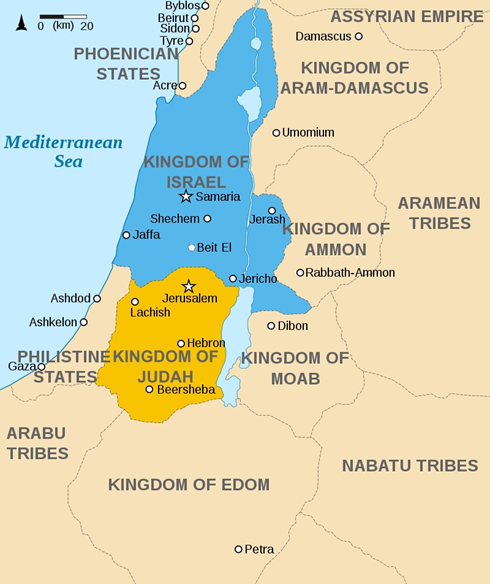
Map of the divided kingdom. After Solomon’s death, his Kingdom split into two: the Northern Kingdom of Israel and the Southern Kingdom of Judah (where Hezekiah reigned). Photo Credit: Oldtidens_Israel_&_Judea.svg: FinnWikiNo – Creative Commons Attribution-Share Alike 3.0 Unported
After King Solomon’s death, the city experienced significant growth. The tax policy of King Rehoboam (Solomon’s son and successor) caused his empire to be divided in two.
Rehoboam continued to hold onto the southern Kingdom of Judah, (including Jerusalem) while the majority of the nation (all except the tribes of Benjamin and Judah) split into the northern kingdom of Israel with Jeroboam as its King. Although Jeroboam was initially very righteous, (Jewish sources point out that G-d would not have chosen him to be King over the ten tribes if he wasn’t) his newfound power quickly got to his head, and he made some catastrophic decisions. When the Temple stands, Jews are required to visit Jerusalem at least three times a year (for Passover, Shavuot, and Sukkot). Jeroboam was concerned that when his subjects—all of whom were Jewish—went to Jerusalem, their hearts would turn to the king of Judah. He thought that they would start to perceive him as a minor king, and ultimately topple him. As a result, he made the decision to establish two new temples, one in Beit El and the other in Dan, both of which included golden calf statues (1 Kings 12:28–29). He even made up his own holidays and declared himself a priest, burning incense to the calves in Beit El. Dan became the most important city in the North (1 Kings 12:30). His misguided fears led to the spiritual destruction of the Kingdom of Israel.
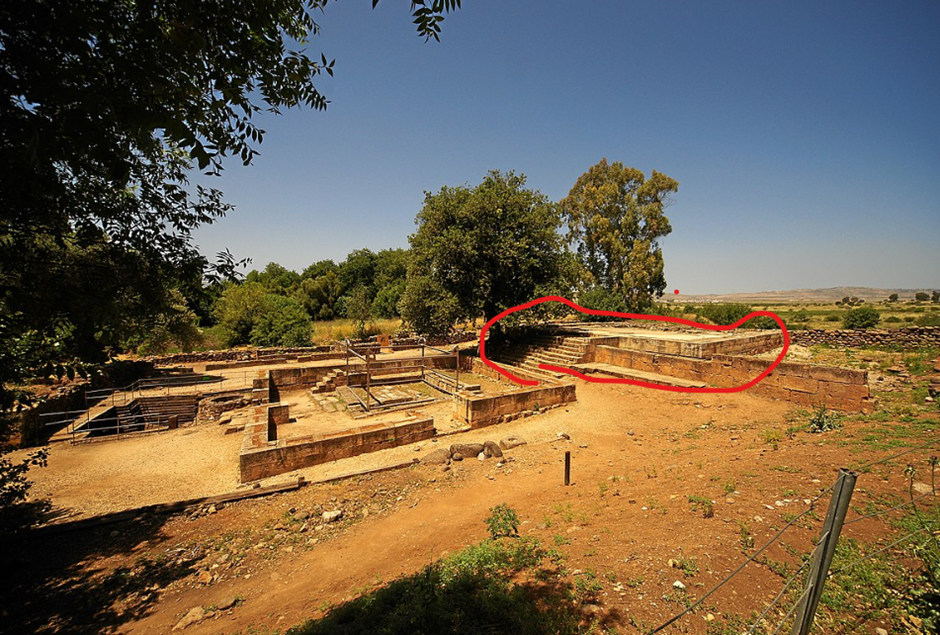
This temple (in red circle) is believed to be the exact location where King Jeroboam housed his golden calf. Photo Credit: Mboesch – Creative Commons Attribution-Share Alike 4.0 International
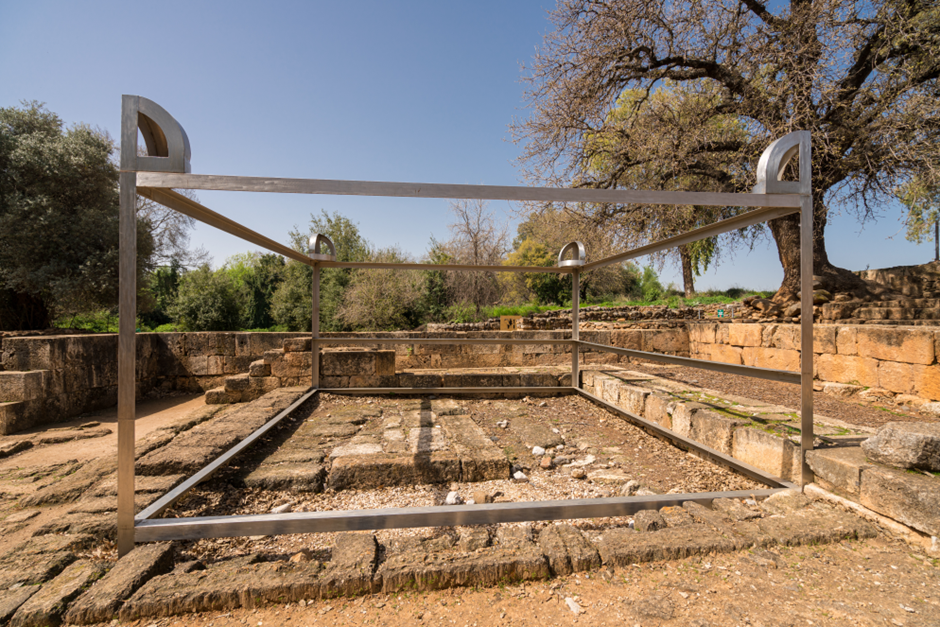
Besides the Temple, he also built an altar (see 1 Kings 12: 32). All of this, according to Jewish sources, is the reason the northern Kingdom was exiled 133 years earlier than the more righteous southern kingdom of Judah. In the end, his descendants continued in his wicked ways and were eradicated from the face of the earth (1 Kings 13:33-34) with Jeroboam having no portion in the World to Come.
The altar built by Jeroboam in the temple complex. Photo Credit: Shutterstock
The city would reach its peak with numerous building projects under the infamous King Ahab, the remnants of which can be seen everywhere here. It is from this time period that arguably the greatest biblical archeological find in history was unearthed at this location!
By Nosson Shulman – Licensed Tour Guide and Trip Organizer in Israel who specializes in History, Tanach (Bible) and Adventure Tours. For more itinerariesclick here. Check out our new Virtual tours including free sneak preview videos
“ And Abram heard that his kinsman had been taken captive, and he armed his trained men, those born in his house, three hundred and eighteen, and he pursued [them] until Dan (Genesis: 14:14).”
“ In those days the tribe of the Danites sought for themselves an inheritance (in which) to dwell… (they) journeyed from… Zorah and Eshtaol, six hundred men girded with weapons….(the inhabitants) they struck them with the edge of the sword. And the city they burnt with fire…And they called the name of the city Dan, after the name of Dan their father, who was born to Israel (Judges 18:1-29)”
The well-preserved city walls and outer gate of Tel Dan, probably built during the reign of the biblical, Israelite King Ahab. Tel Dan is one of Israel’s most beautiful sites, combining the best of nature and history for an incredible experience for visitors! Photo Credit: Shutterstock
Today we are visiting a wonderful biblical site which, in my opinion, is a contender for the title of Israel’s prettiest spot. This site boasts a perfect combination of nature, including cold water wading pools and a stunning walk through the forest alongside a gushing river. It also has well-preserved, one of a kind biblical archeology (connected to several of the Bible’s most climactic stories) and has long played a major role in the survival of the modern state of Israel. While today’s emphasis is on the biblical aspect, let us first explore the nature together!
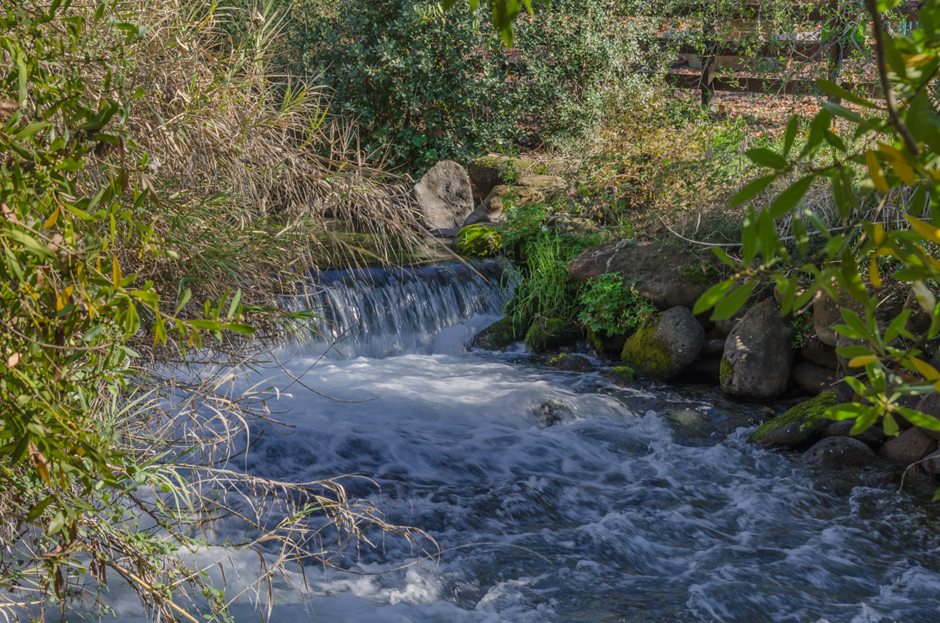
The Dan River supplies almost half of the Sea of Galilee’s water. Because the sea is the State of Israel’s largest fresh body of water (and the largest source of drinking water for most of its existence) this river plays an important role in Israel’s development! Photo Credit: Shutterstock
Since the weather in Tel Dan is often warm, one of the highlights of visiting is the spray of the water mist, and dipping your feet into the cold, refreshing water!
The crystal-clear water is very inviting and great for tourists of all ages (including those with small children). Photo Credit Shutterstock
The several family friendly trails found at the nature reserve offer plenty of shade, because of the beautiful forest made up of Atlantic Pistachio, Oak, Syrian Ash, and Oriental Plane trees.
This Syrian ash tree is known as the Winnie the Pooh tree due to its resemblance to the fairytale home of the legendary bear! Photo Credit: Shutterstock
Now that we have a sampling of some of the natural beauty of Tel Dan, let us now discover the biblical city. In the middle Canaanite period (circa 1800 BCE) an important city developed here. Although little remains from that time period, surprisingly a large, arched gateway was discovered completely intact! Constructed of mud-bricks, the archway is considered by many to be the world’s oldest arch still intact (some say an arch from Ashkelon may be the same age or older).
This archway is from approximately the time of Abraham. When the Patriarch visited (as recorded in the Bible) he likely would have laid his eyes on this actual building. Photo Credit: Shutterstock
The first mention of Dan is connected with a dramatic biblical event that can accurately be called the “First World War”. Five local city state (Canaanite) kings, including the rulers of Sodom (for more on that site, click here) and Gomorrah decided to rebel against their overlords (four powerful Kings of empires, including the ruler of Babylonia). The four kings sent their troops to Israel, subdued the armies of the 5 city state Kings, and took the entire population of Sodom and Gomorrah as prisoners, including Abraham’s nephew Lot. When Abraham was informed, he gathered his men and went in pursuit of the four kings who G-d caused to flee from him. When he reached Dan towards the night, he split up his troops to pursue the kings who were on route back to their homes in modern day Syria and Iraq. At first glance, it seems odd that Abraham would use this strategy of dividing the troops rather than keeping them together as a larger unit. To understand the reason, one needs to understand the topography. Dan is basically at the foot of Mount Hermon (Israel’s highest point). In ancient times, to get to Damascus and the cities of Mesopotamia from Israel, one had to bypass the mountain, as the height made it practically impossible to climb over it. Dan was a fork in the road, with one route going east of the mountain and the other to its west. Abraham didn’t know which route they took, so he divided his troops who pursued and captured them just outside of Damascus. Abraham then freed his nephew and the inhabitants of Sodom and Gomorrah (see Genesis 14).
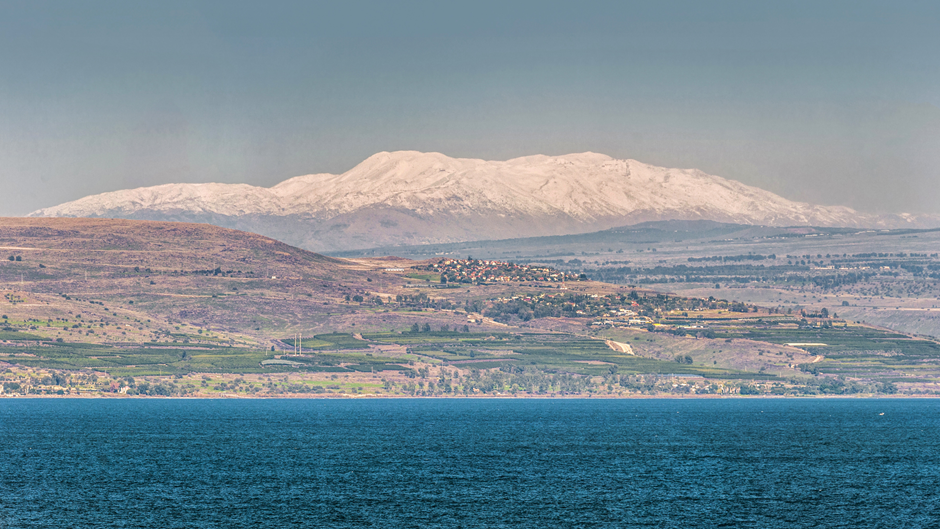
The snowy mountains of Mount Hermon as seen from the Sea of Galilee. The mountain sits on the major ancient highway which started in Egypt and continued all the way to Mesopotamia. Due to its height, it was more feasible to take one of the bypass roads below the mountain than actually climbing it. Photo Credit: Shutterstock.
In the Israelite period (from Judges onwards) Dan is mentioned nine times as being the northern border of Israel in the Bible, using the phrase “From Dan to Beer Sheva” (for more on this site,click here). During the time of the Judges, the town was settled by the Tribe of Dan. Although the heart of Dan’s territory was in the central Israeli coast (today’s Tel Aviv, for example, is here), and because they were unable to take possession of all of it (due to the Canaanites and nearby Philistines) and they needed the living space, five spies were sent to find land they could settle in and happened upon this town, which was called Laish.
Although the tribe of Dan was allocated land along the central coast of Israel (see blue circle), because they didn’t have enough space for their inhabitants, they decided to seek out land they could settle. Photo credit: Photo Credit: “File:12 Tribes of Israel Map.svg” by 12 tribus de Israel.svg: Translated by Kordas 12 staemme israels heb.svg: by user:יוסי 12 staemme israels.png: by user:Janz derivative work Richardprins (talk) is licensed under CC BY-SA 3.0
The spies then returned to their main Danite cities of Eshtaol and Zorah (for more on that site, click here) and gathered 600 fighters who were girded with weapons. They then conquered the city, renaming it Dan. On the way, they had stolen a carved image from Micah and set it up in Dan. As we shall soon see, this would lead to disastrous consequences.
For a sample tour itinerary which can include experiencing biblical Dan,click here
-To Be Continued…
By Nosson Shulman – Licensed Tour Guide and Trip Organizer in Israel who specializes in History, Tanach (Bible) and Adventure Tours. For more itinerariesclick here. Check out our new Virtual tours including free sneak preview videos
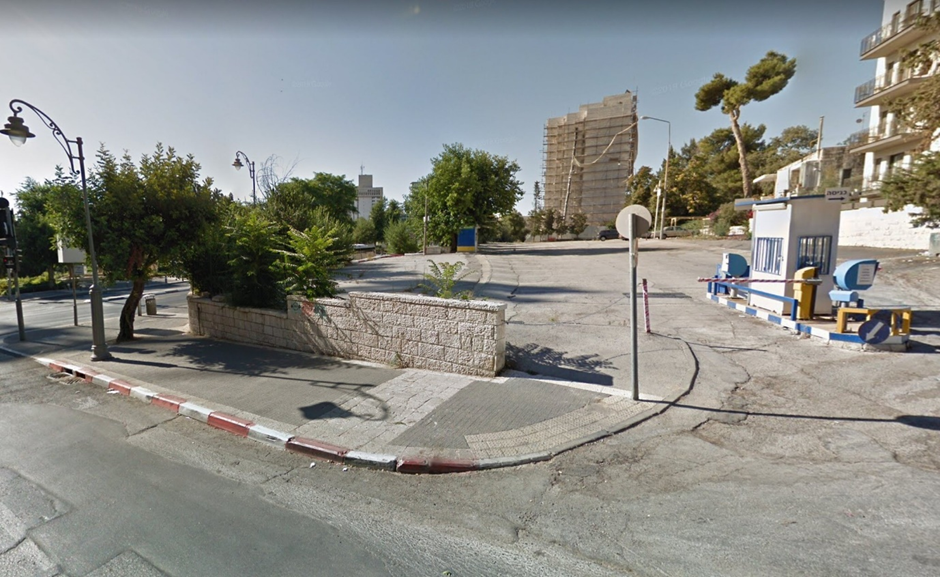
The Parking lot in Jerusalem where the Russians (who claimed to have bought the land in 1885) will retake possession, in exchange for opening a branch of its embassy in Jerusalem. Photo Credit: Google Street View
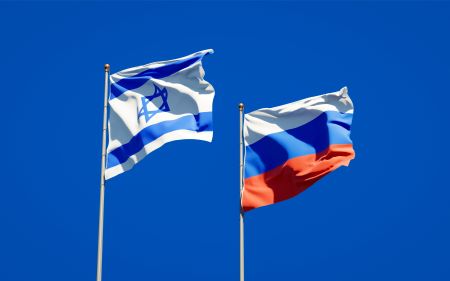
In a major diplomatic victory for Israel, the Russians have shockingly agreed to open a branch of their embassy in Jerusalem, something they previously said they would not do until a final status agreement finalized. This follows a secret deal between the city of Jerusalem and the Russian government, bringing an end to a decades-long dispute over a plot of land. The Russians are to retake possession of the parking lot (located in the city center near the intersection of King George and Maa’lot Streets). They have also agreed to build (expected completion in the next 5-10 years) a full complex with offices providing consular services, and will include diplomatic residences and a conference hall (making its status higher than a consulate).
The land in question was bought by the Imperial Russian Empire in 1885 (an official inventory taken in 1895 of all Imperial Russian owned land in Israel and Syria listed this property as being in their possession). Prior to the First World War, the Tzar’s family owned and administered several properties in Jerusalem. The most well-known was the Russian Compound, that today houses much of Jerusalem’s municipal buildings, a courthouse and the city’s main detention center. Their purpose was to get a foothold in Israel by buying as much land as possible so that when the ruling Ottoman Turkish empire would crumble (which everyone knew was inevitable), they would be able to take it over (other empires such as France, England, Austria-Hungary, and Germany were busy buying up lands for the same reason). Ultimately England was successful, and the Russians lost control of most of their land holdings.
Jerusalem is in the process of extending its light rail system and constructing new lines (that any visitor to Israel’s capital city can see in full force, any time of day). This parking lot was soon to be expropriated for the construction of a new line, but this agreement puts an end to that. It also settles the exact borders of the plot (that had been in dispute) and Jerusalem has agreed to forego any property tax owned by the Russian government.
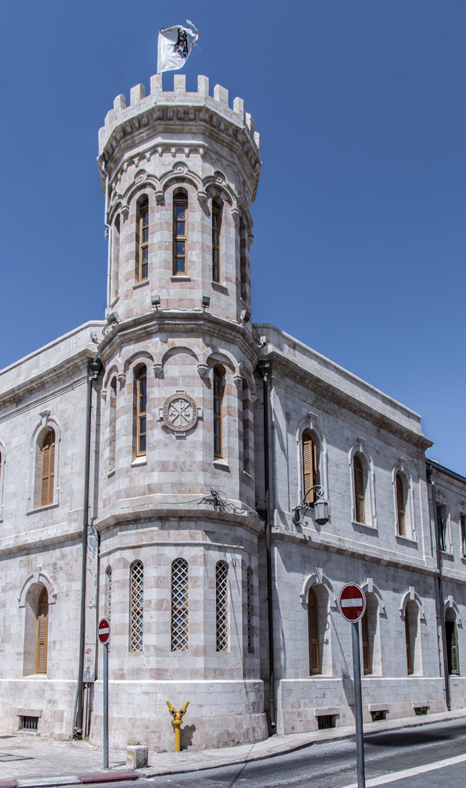
This is not the first deal between Israel and Russia regarding land in Jerusalem. The Sergei Courtyard is found in Jerusalem’s famous Russian Compound where much of Jerusalem’s government buildings are located. It was built in 1889 by Duke Sergei, the uncle and brother-in-law of Tzar Nicholas II, as a hotel for the Russian nobility visiting the Holy Land. It was restored to Russia by Israel in 2008 as part of a deal connected to Iran. Photo Credit: Shutterstock
This deal is being hailed by the foreign ministry and Jerusalem municipality as a major diplomatic achievement. According to Jerusalem’s deputy mayor Fleur Hassan-Nahoum, “We are constantly in talks with many different countries about the recognition of Jerusalem as our capital and opening a presence in our city. We are pleased that this deal brings us a step closer towards that goal with the Russian Federation.””
The agreement was kept secret until it was signed, due to Russia’s ongoing war against Ukraine. Advanced notice might have scuttled the deal. Israel has cautiously supported Ukraine with humanitarian aid (in fact, Israel was the first country to set up a field hospital there) voting with them in the UN and giving early warning systems against missiles. However Israel thus far has not permitted any of its weapons to go to Ukraine, due to the fact that maintaining a good relationship with Russia is deemed essential for Israel’s security (unofficially, Russia controls Syria’s skies and allows Israel a great deal of freedom of movement to act against Iranian aggressors who are trying to entrench themselves in Syria and thereby threaten the Jewish State). Russian also has one of the largest Jewish populations in the world, and they do not want to put the community at risk.
Nosson Shulmanis a journalist andLicensed Tour Guidein Israel specializing in Biblical tours. To allow tourists to experience Israel during the Corona era, he created the new hit Israel tour video serieswhich brings Israel to the home of viewers by simulating actual tours. To check out his free sneak preview tour videos, click here.To view sample tour itineraries or to inquire about private tour opportunities with a personalized itinerary on your next trip to Israel,click here.
The Western Wall in Jerusalem is a remnant of the very holy Second Temple. According to Jewish sources, even with the destruction of the Temple the divine presence never left here, making it the most powerful and effective place in the world to pray! Photo Credit Shutterstock
Recently Israelis celebrated Jerusalem Day, a holiday commemorating the Israeli Defense Force’s miraculous liberation of Jerusalem during the 1967 Six Day War. For the first time in Millenia, Jews were once again in control of the world’s holiest city that G-d gave to His people. In honor of this celebration, here are some interesting facts and statistics about the Holy City that you may not know:
1)Jerusalem is Israel’s largest city in population
The Chord Bridge located at the city entrance of Jerusalem. The bridge is used by Jerusalem’s light rail and includes a glass-sided pedestrian bridge. It is meant to symbolize King David’s harp. Photo Credit: Shutterstock
Jerusalem, Israel’s eternal capital, currently has approximately 970,000 residents, double the population of Tel Aviv (Israel’s second largest city) that now has around 450,000 residents, although the Metro Tel Aviv area is much larger with a population of about 4,421,000.
2) It is estimated that by 2024 or 2025, Jerusalem will become Israel’s first city to have at least one million residents living within its municipality.
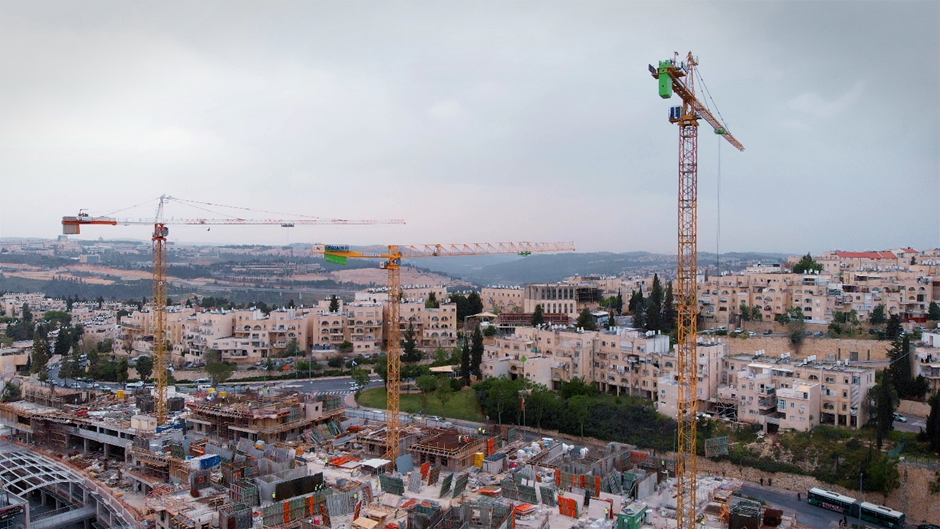
It’s difficult to go anywhere in Jerusalem without seeing a plethora of cranes and new buildings under construction. In 2022, a record 7,300 construction permits were issued! Photo Credit: Shutterstock
Though there are several metro areas of Israel (which consist of multiple municipalities) having more than a million residents including Tel Aviv (4,421,000), Jerusalem (1.4 million) and Haifa (1,179,000), no single municipality on its own has reached that number yet. If by the next Jerusalem Day celebration, Israel’s capital hasn’t reached that milestone, it is predicted that by 2025 celebration, they will almost certainly attain that number.
3) Although Jerusalem is a Jewish majority city, it also has a large Muslim and Christian population
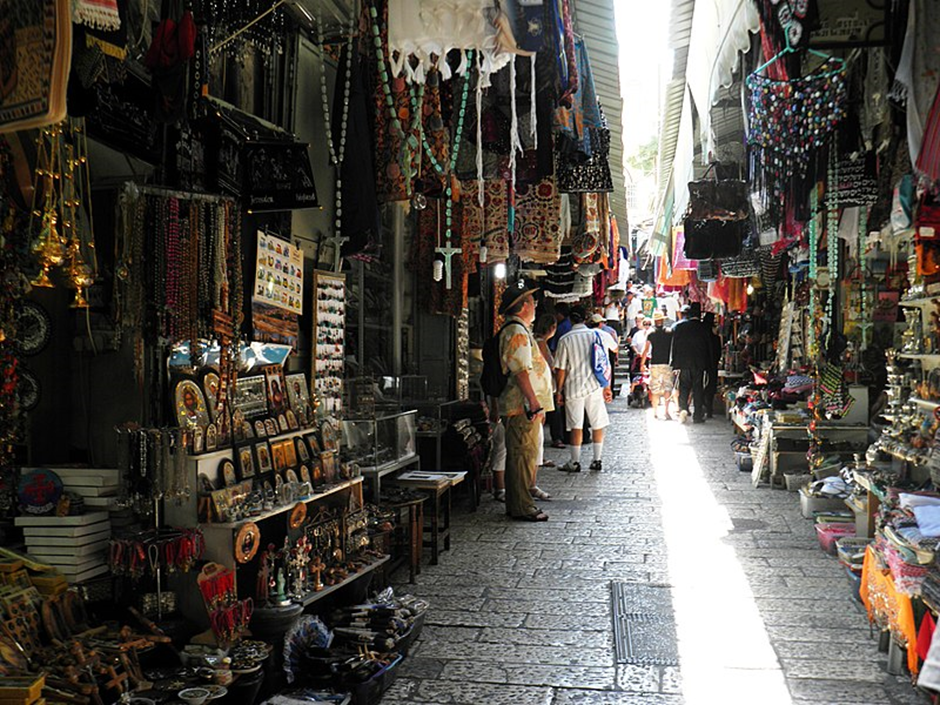
The Old City Arab Shuk (Marketplace) is popular with tourists from abroad. Photo Credit: Ariel Palmon – CC BY-SA 3.0
In 2021, Jerusalem had 590,000 Jewish residents and 374,900 Arab Residents (362,000 were Muslim, 12,900 were Christian). There were 3,500 non-Arab Christian residents and 10,500 who did not divulge their religious background.
4) The majority of Jerusalem’s Jewish population are religious
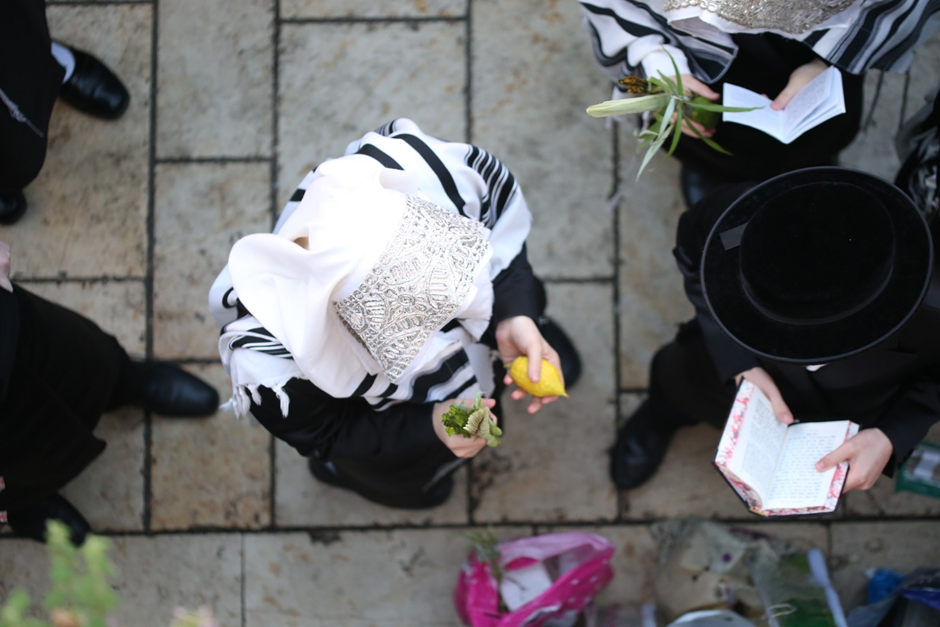
Torah Observant residents of the Old City celebrating the 7-day (or 8 days outside of Israel) holiday of Sukkot. Photo Credit: Shutterstock
When looking at Jerusalem’s Jewish population (aged 20 or older), 35% identified as Charedi (Ultra Orthodox) while another 20% identified themselves as being religiously observant. A further 25% of residents identify as traditional. Only 19% identified themselves as being “secular”.
5) Jerusalem’s population is very young compared to other major cities in developed (first world) countries and has a high birthrate.
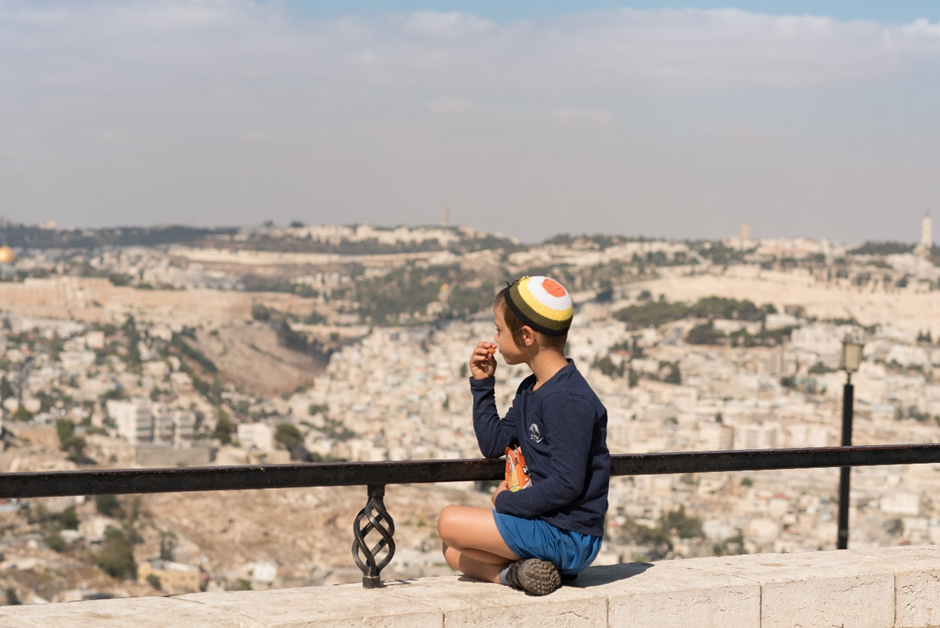
Young boy overlooking the Old City from the Haas Promenade in Jerusalem (for more on that site, click here). Photo Credit: Shutterstock
In 2020, 39% of Jerusalem’s population were 17 years of age and under (as a comparison, in Tel Aviv that number was only 21%, which is high when compared to major U.S. cities such as San Francisco (11%) and Seattle (15%).
The average birthrate among Jewish women is 4.4 and 3.10 for Arab women.
6) Jerusalem has more than 2000 active archeological sites (with that number growing exponentially each year)
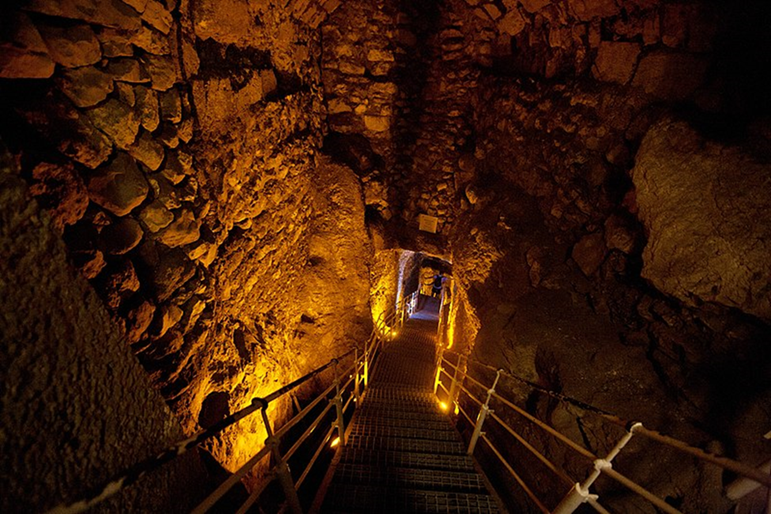
This Subterranean tunnel at the City of David was built approximately 3800 years ago to allow access (in a time of war) to the source of the Gihon Spring (then Jerusalem’s main source of drinking water) which sat outside of the city wall. There are more than 2000 archeological sites in Israel’s capital. Photo Credit: israeltourism – CC BY-SA 2.0
Anyone who has ever been to the Holy City knows that it is nearly impossible to be anywhere without being exposed to ruins illustrating Jerusalem’s rich past. The ancient ruins are so abundant that there is a law stating that before a new building can be built, an archeological dig must be conducted on location (it is exceedingly rare not to find anything).
7) Although the word “Jerusalem” is mentioned explicitly about 660 times in Tanach (Hebrew Bible) it is not mentioned even once in the Quran
Muslims were in control of Jerusalem from 638 CE to 1099, and again from 1187 until 1917. Although Muslims today consider Jerusalem to be their third holiest city, it is not mentioned at all in the Quran Photo Credit: Obendorf – Creative Commons Attribution-Share Alike 3.0 Unported
Jerusalem is considered holy by Jews, Christians, and Muslims. Although Tanach mentions the city hundreds of times, it is not mentioned in the Quran explicitly even once, although according to Islamic scholars, it is referred to implicitly in the 17th chapter when discussing a night journey that Muhammad was said to have taken from the “Closest Mosque (located in Mecca)” to the farthest Mosque (Al Axel in Arabic), which Muslims believe to be on Jerusalem’s Temple Mount. However when looking at historical records, at the time of Muhammad there were no Mosques located in Jerusalem. In 638 CE (six years after the death of Muhammad) Jerusalem was conquered by one of his successors, Caliph Omar, at which point the first Mosque in Jerusalem was built.
Today, there are over 50 mosques in Jerusalem.
8) Jerusalem is home to hundreds of prestige yeshivas (Academies of advanced Torah Studies) including the world’s largest one.
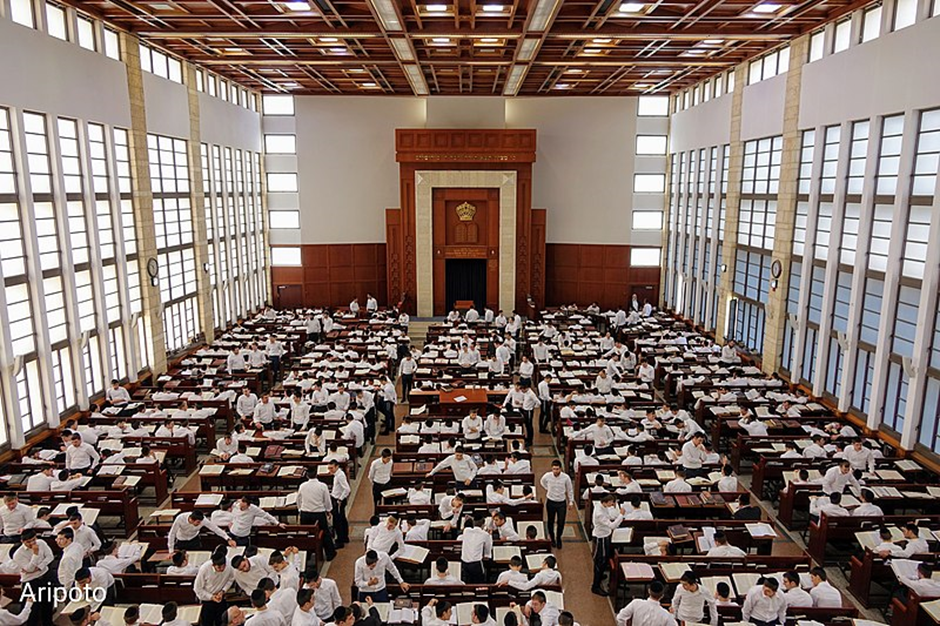
The Mir Yeshiva has over 9600 students, who selflessly devote themselves to full time Torah studies. Photo Credit: שמיה רבה – Creative Commons Attribution-Share Alike 4.0 International
In 2018 there were over 133,000 students learning Torah full time in Israel, with a large percentage in the Holy City. Almost 10,000 of the students were learning in the Mir Yeshiva in Jerusalem’s Beis Yisrael neighborhood.
The Torah learning in these institutions is fundamental to Israel’s survival and been recognized as such by the Jewish people ever since Joshua brought the Children of Israel into the Holy Land and conquered Jericho by miraculous means (according to Jewish sources, the night before the battle, Joshua commanded his soldiers to spend the night learning Torah instead of resting). Indeed, G-d tells Joshua just before entering Israel that the “Book of the Torah shall not depart from your mouth, rather you should contemplate it day and night in order that you observe to do accordingly to all that is written in it; for then you will make your way successful (Joshua 1:8)”. According to Jewish sources when drafting an army, the leaders of the Jewish people such as Moses (all the way down to the Judean Kings such as David and Hezekiah) recruited a certain number of soldiers into a unit whose job was to learn and pray full time for the success of their comrades in the combat units (in a Jewish army, both roles are essential).
In modern times, the combination of a strong IDF with very dedicated soldiers, together with robust Torah learning has been instrumental in Israel’s victories (defying logic) on the battlefield. As Israel’s first Prime Minister David Ben Gurion said “to be a realist in Israel, you have to believe in miracles.”
9) Jerusalem first became Israel’s capital in the 7th year of King David’s reign more than 3000 years ago.
I often take my tourists to visit the ruins of King David’s palace which is accessible for all to see (to see a tour itinerary which includes this wonderful site, click here). Photo Credit: Shutterstock
For the first 7 years of his 40-year reign, King David ruled from Hebron (for more on that, click here). When David conquered Jerusalem from the Jebusites, it became Israel’s eternal capital. Even after the Jewish people were exiled, Jerusalem never ceased to be in Jewish minds and hearts. Indeed three times a day, Jews pray for the rebuilding of the Holy City and its Temple with the faith that they will return. Once again (against all historic odds) Jerusalem is the capital city of the Jewish nation in both the spiritual and physical sense!
10) Jerusalem has been conquered 40 times, destroyed 18 times, and been witness to more than 100 battles for its control
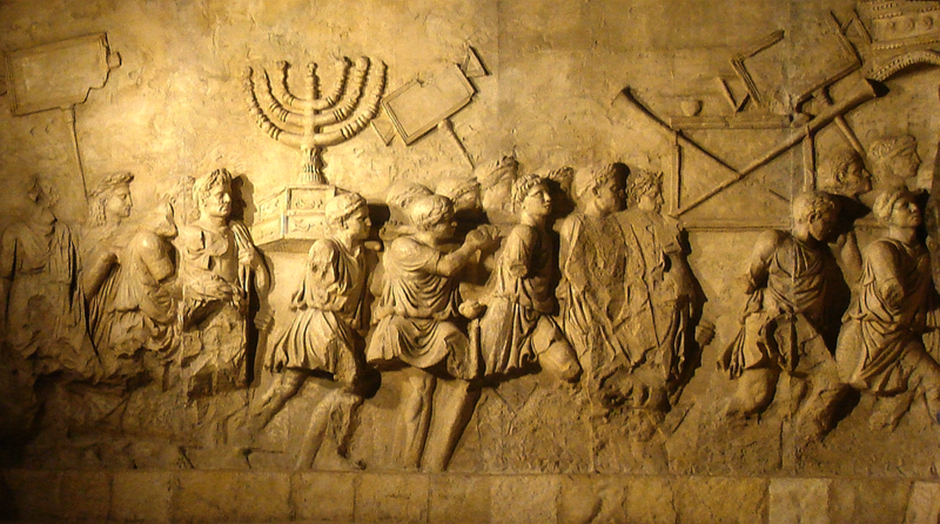
Titus’s arch in Rome commemorates the destruction (and looting) of Jerusalem and the Second Temple in 70 CE. This was not the first time Jerusalem was destroyed and unfortunately, it wouldn’t the last.
From the beginning of time, the conquest of Jerusalem has been a prize that most empires dreamed about, and which many accomplished. This list includes the Egyptians, Babylonians, Romans, Greeks, Persians, Crusaders, Muslims, Ottomans, the British and even the Mongolians (in 1260 CE). This is one of the reasons why Jerusalem has so many diverse archeological sites (see #6 above).
By Nosson Shulman – Licensed Tour Guide and Trip Organizer in Israel who specializes in History, Tanach (Bible) and Adventure Tours. For more itinerariesclick here. Check out our new Virtual tours including free sneak preview videos
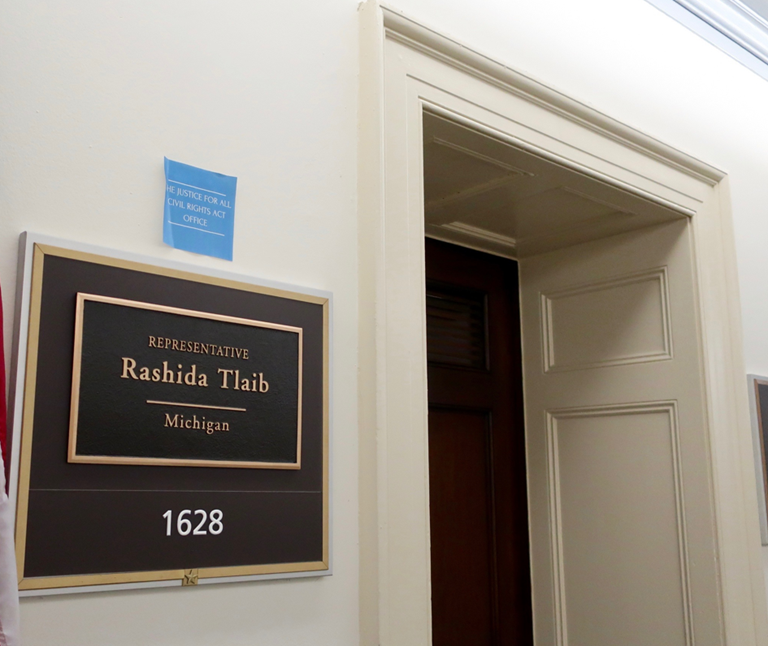
Although only in congress since 2018, Rashida Tlaib (D-MI) has an established history of making anti-Semitic comments without facing any significant repercussion. Photo Credit: Shutterstock
Pro-Israel journalists, activists, politicians, and even the IDF have long been complaining about the major social media companies unfairly censoring their views. This is usually without explanation as to what rules were being violated and done in a selective manner (compared to anti-Israel activists). This has oftentimes led to their accounts being suspended. As an example, an IDF war hero (and close friend of mine) had his account suspended for referring to Hezbollah as a terrorist organization. When reaching out to ask what rules had been violated, he received no response. Other times, certain posts are blocked for arbitrary reasons, as in 2021 when Hamas sent hundreds of rockets into Israel, Twitter prevented the IDF’s official page from posting about sirens sounding in Beersheba. Many pro-Israel social media influencers have shown (offering compelling evidence) that their accounts tended to be shadow banned when their posts discussed Israel (unlike their posts unconnected to Israel, which did not receive the same treatment). In some cases, the bias has been so evident that outcries ensued and in many cases the affected accounts were restored (with the companies regularly blaming it on technical issues or on a rogue “fact checking” employee). These companies have been much slower to interfere with posts which clearly violated their terms of use when used against Israel (including some openly calling for the destruction of the Jewish State) and often allowing terrorist groups (like Hamas and Hezbollah) to maintain accounts and even recruit new members. Due to intense lobbying by Israel, several of the companies have begun to “crackdown” on some of their posts and suspend accounts, although sometimes only temporarily. Companies such as Facebook and Twitter employ “fact checkers” to search for “misleading” posts and label them as such, although it is clear that the bar of what is “misinformation” seems to be higher for the defenders of Israel than its critics. It is within this environment that a recent “fact check” against a prominent congresswoman on Twitter has become so newsworthy!
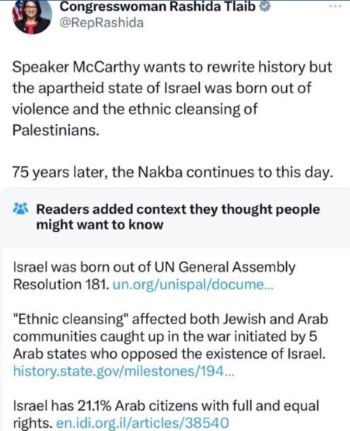
Commenting on a Twitter post made by Speaker of the House Kevin McCarthy (R-CA) celebrating the special relationship between the US and Israel, Congresswoman Rashida Tlaib (D-Mi) falsely called Israel an “Apartheid” state writing “Speaker McCarthy wants to rewrite history but the apartheid state of Israel was born out of violence and the ethnic cleansing of Palestinians, 75 years later, the Nakba (literally meaning “catastrophe”, a word commonly used by some Arabs to describe Israel’s creation) continues to this day”. Immediately, her false claims were fact checked by twitter, who corrected some of the points she made. Twitter pointed out that Israel was not an Apartheid state (a racist system previously used in South Africa, dictating that non-white South Africans were required to live in separate areas, could not join the (all-white) government, vote, or be educated in the same schools as white people. Within this system, black citizens were deprived of political and civil rights). On the contrary, the Israeli Arab population make up 21% of Israeli citizens, and have full equal rights enshrined in the law (and strictly enforced) including the right to vote, serve in the government, run for office (there are several Arab parties in the current Knesset, although many Arabs also belong to Jewish-majority parties including both on the left and right wing) and go to state-funded public schools. There is an Arabic public school system although Arabs have the legal right to send their kids to government-funded Jewish schools and many do so.
With regards to her false claims that “Israel was born out of…the ethnic cleansing of Palestinians”, Twitter pointed out that the war “affected both Jewish and Arab communities caught up in the war initiated by 5 Arab states who opposed the existence of Israel”. To bolster this fact, Twitter provided a link to the US State Departments official history of the Arab Israeli War. They also pointed out that the Arab population has continued to grow since the beginning of the state, with high birthrates, declining infant mortality and longer life expectancy (growth statistics usually not associated with anything related to genocide). Twitter also mentioned that Israel wasn’t born out of violence but by UN General Assembly Resolution 181 (a link to the UN’s official page was provided).
Officially, Twitter now has a new policy which states that there will be “no further exceptions” to fact checks for those who post “materially false statements on the platform”, regardless of which side they support. In fact, this was the seventh time that Tlaib had accused Israel of apartheid (although the first 6 times, under the old rules, she was NOT fact checked).
Rashida Tlaib has a history of making vile, antisemitic statements with minimum consequences. In 2019, she wrote “There’s always kind of a calming feeling I tell folks when I think of the Holocaust, and the tragedy of the Holocaust” which caused the Palestinians to “lose their land…their lives, their livelihood, their human dignity, (and) their existence in many ways”. She openly supports the BDS movement that calls for the boycott of the Jewish state. When four Senators in 2019 sponsored anti-BDS legislation, she accused pro-Israel advocates in congress of dual loyalty, a common canard used by antisemites throughout recent history to accuse Jewish citizens of being more loyal to Israel, or to the alleged priorities of Jews worldwide, than to the interests of their own nations. This belief has caused much harm to Jews around the world over the last few centuries. On December 2020, in a since deleted tweet, she called for a Palestinian State from the (Jordan) River to the (Mediterranean) Sea, a common nationalist Palestinian slogan associated with calls for Israel’s elimination. There are many other examples of bigoted comments she has made publicly. Although many of her anti-Israel statements have been condemned by people on both the left and right (including some of her Democratic colleagues who called her words antisemitic) she has not been officially censured by her party. In spite of all this, she was still endorsed in the Democratic primaries for reelection by former Speaker of the House Nancy Pelosi (D-CA).
Nosson Shulmanis a journalist andLicensed Tour Guidein Israel specializing in Biblical tours. To allow tourists to experience Israel during the Corona era, he created the new hit Israel tour video serieswhich brings Israel to the home of viewers by simulating actual tours. To check out his free sneak preview tour videos, click here.To view sample tour itineraries or to inquire about private tour opportunities with a personalized itinerary on your next trip to Israel,click here.
Israeli foreign minister Eli Cohen and Turkmen foreign minister Raşit Meredow inaugurate the new Israeli embassy in Ashgabat, the capital of Turkmenistan. Photo Credit: GPO of Israel
In another diplomatic victory, Israel has once again successfully opened another embassy in a Muslim country, this time in Turkmenistan. While milestones like this have become much more common due to warming relationships between the Jewish State and several other Islamic countries, on a strategic level, this may be among the most important. That is because the Israeli embassy is located a mere 10 miles (17 kms) from the Iranian border!
Turkmenistan, a central Asian country located in the former Soviet Union, is an energy rich country of 6 million people. In addition to possessing an abundance of known oil reserves, it is believed to have the 4th largest natural gas reserves in the world. Although the landlocked country has officially had a relationship with the Jewish State since 1993, it was largely kept under the radar. For the past decade Israel has had an ambassador in Ashgabat, although until this embassy was opened he mainly worked from hotels and a temporary office. In the last year cooperation between the two countries has increased significantly, particularly in the areas of cyber defense and health. Trade between the two nations is currently at 8 million dollars annually, however with this move that number is likely to increase. Clearly illustrating how Turkmenistan understands the benefit to having a good relationship with Israel, the country’s head of state, President Serdar Berdimuhamedow, personally attended the embassy’s inauguration.
Recently, Israel has made establishing and strengthening relations with central Asian, Muslim countries like Azerbaijan (who will soon open an embassy in Tel Aviv. For more on that, click here) and Turkmenistan a top priority. The two countries share a significant border with Iran, and should Israel need to strike Iran’s nuclear facilities without US support, both can potentially be used as a base for Israeli planes, making such action more feasible. Indeed, there have been reports that Azerbaijan allows Israel to use bases on its soil to launch reconnaissance flights over Iran, and to send intelligence operatives into the Islamic theocratic state to disrupt its nuclear program.
Officially Turkmenistan is politically neutral and does not enter into any political or military blocs (much like Switzerland). Recently, however, it has had economic disputes with Iran over large hydrocarbon deposits and other financial issues, including Tehran’s non-payment of 1.8 billion dollars’ worth of gas it received from its landlocked neighbor, and Iran’s holding up a pipeline that would allow Turkmenistan to export gas from the Caspian Sea to Europe. If Israel has to go against Iran on its own, this relationship can prove to be vital.
Nosson Shulmanis a journalist andLicensed Tour Guidein Israel specializing in Biblical tours. To allow tourists to experience Israel during the Corona era, he created the new hit Israel tour video serieswhich brings Israel to the home of viewers by simulating actual tours. To check out his free sneak preview tour videos, click here.To view sample tour itineraries or to inquire about private tour opportunities with a personalized itinerary on your next trip to Israel,click here.
“ And it came to pass, when Adonizedek, king of Jerusalem, heard that Joshua had taken Ai, and had completely destroyed it; as he had done to Jericho and her king … and Ai; and … the inhabitants of Gibeon had made peace with Israel…Adonizedek, king of Jerusalem, sent to Hoham, king of Hebron, and to Piram, king of Jarmuth, and Japhia, king of Lachish, and to Debir, king of Eglon, saying, Come up to me and help me, and we will smite Gibeon, for it has made peace with Joshua and with the children of Israel. (Joshua 10: 1-4)”
These are the remains of the massive gate that served as the outer entrance into Jarmuth. It was in use for centuries, beginning about 4500 years ago.
When living in Israel, one gets so accustomed to seeing Bible sites at every turn, that you can almost start taking it for granted! Some are well known, others less so. One of the most impressive sites well below the radar is only a 15-minute walk from my home. I am referring to Jarmuth (Tel Yarmut), mentioned 7 times in the Bible. Its remains are among the world’s oldest, and the panoramic views on a clear day afford a view of much of Israel that includes Tel Aviv, Ashdod, and the Mediterranean Sea on one side, and the Judean Mountains (in the environ of Jerusalem) on the other side. Let us explore this wonderous, ancient city together!
The views from Tel Yarmut are spectacular on all four sides, including these rolling hills just east of us which you can see all the way to the Judean Mountains on the horizon.
When I bring my tourists here, we almost always have the site to ourselves. The city was first founded in the early Bronze age (circa 3050 BCE – 2400 BCE) by the early Canaanites, which is when the first urban cities with walls began to appear in Israel. Although most cities from that time (while organized) were rarely large, this city was an exception. It was about 40 acres (in comparison Jerusalem at the time of King David, over a thousand years later, was only about 15 acres). The palace alone was a whopping 1.5 acres, unheard of from that time!
Some of the remains of the massive Canaanite palace, built around 4500 years ago. The structure was constructed with perfect angles and was no less than 2 stories. Photo Credit: Davidbena – CC BY-SA 4.0
The city walls were massive (the Greeks called the massive rocks that made up the structure “Cyclops Stones” because they were so large that only someone with the strength of Cyclops would be able to build something like this). Due to the height difference between the palace and the surrounding topography, which was much lower, a series of elaborate platforms were built leading from the ground level to the city gate. The width of road leading there was 38.5 meters thick (as wide as a multi-lane highway today). The gate is still remarkably well preserved.
Remains of the massive, 4500-year-old city wall. Notice (in the foreground) part of the elaborate ramp that took visitors to the ancient city from ground level to the fortified city above. Today, tourists can walk along this ramp!
Around 2400 BCE, most of the urbanized Canaanite cities were abandoned (to this day, the reason is not so clear why, although there are several theories). The economy collapsed, and people returned to a more rural, nomadic lifestyle. Jarmuth was no exception.
An ancient vessel from Jarmuth’s heyday. Around 2400 BCE, the economy collapsed region wide (including this city) and moved into a long dark age. Photo Credit: Bukvoed – CC BY 4.0
For the next 1000 years, the city lay more or less in ruins (with perhaps some light settlement). In the later Canaanite period (not too long before Joshua brought the Children of Israel back to Israel), the city was re-established. Although the city seems to have flourished (there were pottery shards found from faraway places, suggesting that they were involved in trade) the city was much smaller and confined to the Acropolis. The lower city area including the palace was not resettled, which is one of the reasons why its remains are still in great shape since no one built on top of it. It is the city from this time period that is first mentioned in the Bible.
The location of the upper city (Acropolis) as seen from the lower city. In the late Canaanite period (when the city was resettled after 1000 years of laying in ruins) the city was only rebuilt on the hill and the lower city remained abandoned. It was this city that fought against Joshua’s army.
The city (like most major Canaanite cities) had its own King. After Joshua successfully conquered Jericho and Ai, the powerful city of Gibeonmade an alliance with the Children of Israel. Five Canaanite kings attacked Gibeon. sending a message that making peace with the Children of Israel was not in their best interest. When they attacked, Joshua felt bound by his oath and came to their rescue. As the armies of the five kings saw him coming, G-d put panic into their hearts and they were smitten, with the survivors fleeing by way of the “Ascent of Beth-horon”. As they began descending from Beth-Horon, G-d sent a hailstorm that finished off most of the remaining troops (Joshua 10). According to Jewish sources, these actual hailstones were left over from the plague of hail in Egypt. When Moses asked G-d to stop the plague (see Exodus 9:33) the remaining hail was saved. With the death of most of the Canaanite troops, the remainder fled westward through the Ayalon valley and the sun was quickly setting (according to Jewish sources, it was Friday evening and therefore almost Shabbat). In order to take care of the job before sundown, Joshua prayed to G-d for the sun to stand still (which it did) and it didn’t set until the enemies had been destroyed and the war was over. The King of Jarmuth (along with the four other kings) was found hiding in a cave. Joshua ordered that they be brought to him, and then personally slew them (see Joshua 10).
The remains of the ancient city state of Gibeon (in red circle) as seen from the Tomb of Samuel. It was this city that made an alliance with the Jewish people and was subsequently (and unsuccessfully) attacked by five Kings including the King of Jarmuth. Photo Credit: Natritmeyer – Creative Commons Attribution-Share Alike 4.0 International
The conquered city of Jarmuth was given to the tribe of Judah (see Joshua 15:35). In 422 BCE (some historians say 586 BCE) Jerusalem was destroyed, its people exiled and the cities of Judah, including Jarmuth, became desolate. About 50 years later, during the days of Ezra and Nehemiah, the Jewish people were permitted by the Persians (who now controlled Israel) to return to their homeland. One of the towns resettled was Jarmuth (see Nehemiah 11:29). The city continued to be in existence until the Byzantine period (circa 4th Century CE) when it was abandoned. The town was never rebuilt, but the intriguing Biblical ruins can be visited and enjoyed on your next visit to Israel!
To see a sample Jerusalem walking tour itinerary which can include Yarmut,click here
Sponsored by Rockets Into Roses: Discover the powerful art of an Israeli Hero living on the Gaza border, who transforms rocket fragments into stunning, one-of-a-kind masterpieces. His Art, his Jewelry, and items of Biblical Value owned by US presidents and many world leaders, not only symbolizes resilience but directly supports charities aiding Israelis in the Gaza Envelope. Enter code vip10 for a 10% discount, valid for a limited time only.
To sponsor our next article or newsletter and have your business seen by thousands of our American pro-Israel subscribers and beyond, please contact us at info@guidedtoursofisrael.com
By Nosson Shulman – Licensed Tour Guide and Trip Organizer in Israel who specializes in History, Tanach (Bible) and Adventure Tours. For more itinerariesclick here. Check out our new Virtual tours including free sneak preview videos
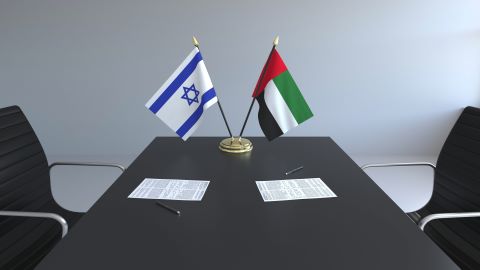
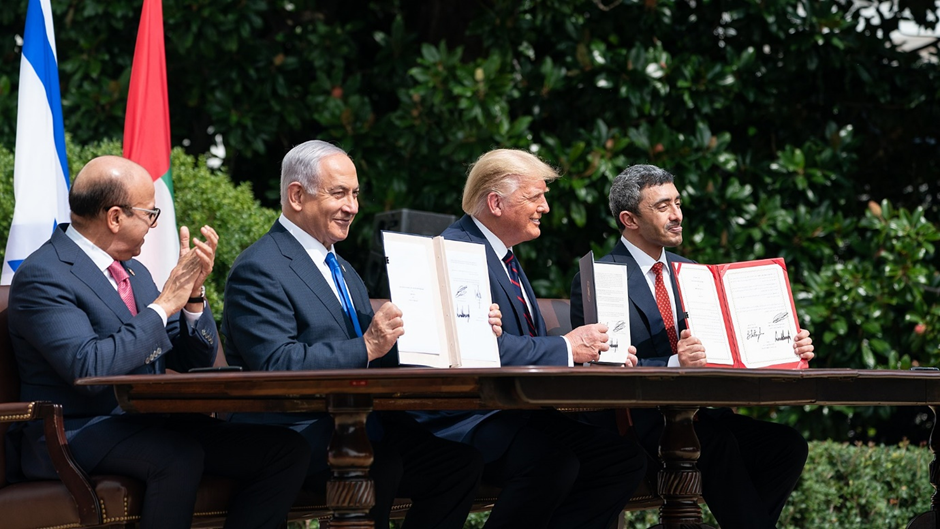
In 2020 the Trump Administration brokered a surprise peace deal between Israel and the United Arab Emirates. Since then, relations between the two countries have been flourishing on both a governmental and personal level between their citizens.
Prior to the start of Passover 2023 as Israelis were preparing to celebrate, extreme Muslim worshippers on the Temple Mount rioted and illegally barricaded themselves in the Al Aqsa Mosque (where Muslims today claim is their third holiest site) with weapons and explosives. Israeli police were also violently attacked and had no option but to enter the Temple Mount and arrest the terrorists to restore calm. As expected, the “condemnations” of Israel came from the usual sources including Muslim countries, the UN and some of Israel’s “allies”, hardly newsworthy. However, in a rare move, the United Arab Emirates also condemned the Muslim extremists. After giving their usual rebuke of Israeli police, the UAE foreign ministry added “worshipers should not barricade themselves inside the mosque and places of worship with weapons and explosives.” A comment like this from an Arab country, even ones having good relations with Israel, is almost unheard of and a sign of the growing strength of the ties between the Middle Eastern countries.
This began in August 2020, when then President Donald Trump announced that Israel and the United Arab Emirates (UAE) were to sign a peace treaty, a deal he was instrumental in negotiating. In quick succession, the Trump administration would then subsequently broker deals between the Jewish State and Bahrain, Sudan, and Morocco (collectively known as the Abraham Accords). For the first 72 years, only Egypt and Jordan had made peace with Israel, with those deals leading to nothing more than a cold peace between their governments, practically limited to (important) security cooperation. The rank-and-file population of Israel’s two neighbors have largely rejected the treaty, and being identifiably Jewish is still dangerous in those countries. This particular treaty, however, has turned out to be a game changer.
Less than 3 years into the treaty, in addition to excellent government relations, there is general goodwill towards Israelis on the streets of Dubai and Abu Dhabi. Hundreds of thousands of Israelis have visited the Gulf country as Israelis may travel freely to the country, with no particular attempts made to hide their identities. For Torah observant Jews, wearing a clearly visible yarmulka, black hat, or exposed Tzitzit on the streets is the new norm (certainly a rarity in most of “civilized” Western Europe today). There are also Kosher restaurants opening, including a new one inside of the Burj Khalifa (currently the world’s tallest building). Synagogues too are being built with the encouragement of the Royal family, who maintain excellent relations with the fast-growing Jewish community. Recently, some antisemitic content has been removed from school textbooks and curriculum, although that is still a work in progress (and much remains to be done). As reported here, the countries recently signed a lucrative free trade agreement (the Jewish State’s first with an Arab country) which has already resulted in billions of dollars of trade. Both countries have opened embassies in their respective countries ((for more on that, click here).
Although much remains to be done in the attitude of the Arab world towards Israel, even in the UAE, the fact that criticizing the Palestinians (albeit with kid gloves and still reserving most of its harsher criticism for Israel ) is less taboo, demonstrates the strength and influence of the Abraham Accords as compared to previous “peace” treaties.
Nosson Shulmanis a journalist andLicensed Tour Guidein Israel specializing in Biblical tours. To allow tourists to experience Israel during the Corona era, he created the new hit Israel tour video serieswhich brings Israel to the home of viewers by simulating actual tours. To check out his free sneak preview tour videos, click here.To view sample tour itineraries or to inquire about private tour opportunities with a personalized itinerary on your next trip to Israel,click here.












 Unique Sites of Israel Blog